wait — this unlock hit last night
I closed my last ROBO position at 2:17 AM, stared at the chart for a minute, then poured coffee and opened the dashboard. Yesterday’s March 13, 2026 unlock event just cleared the final team and investor cliffs. Circulating supply ticked up overnight exactly as the schedule promised. No drama, no announcement, just tokens moving from locked to liquid. That’s the on-chain signal that actually matters right now.
the moment the dashboard refreshed
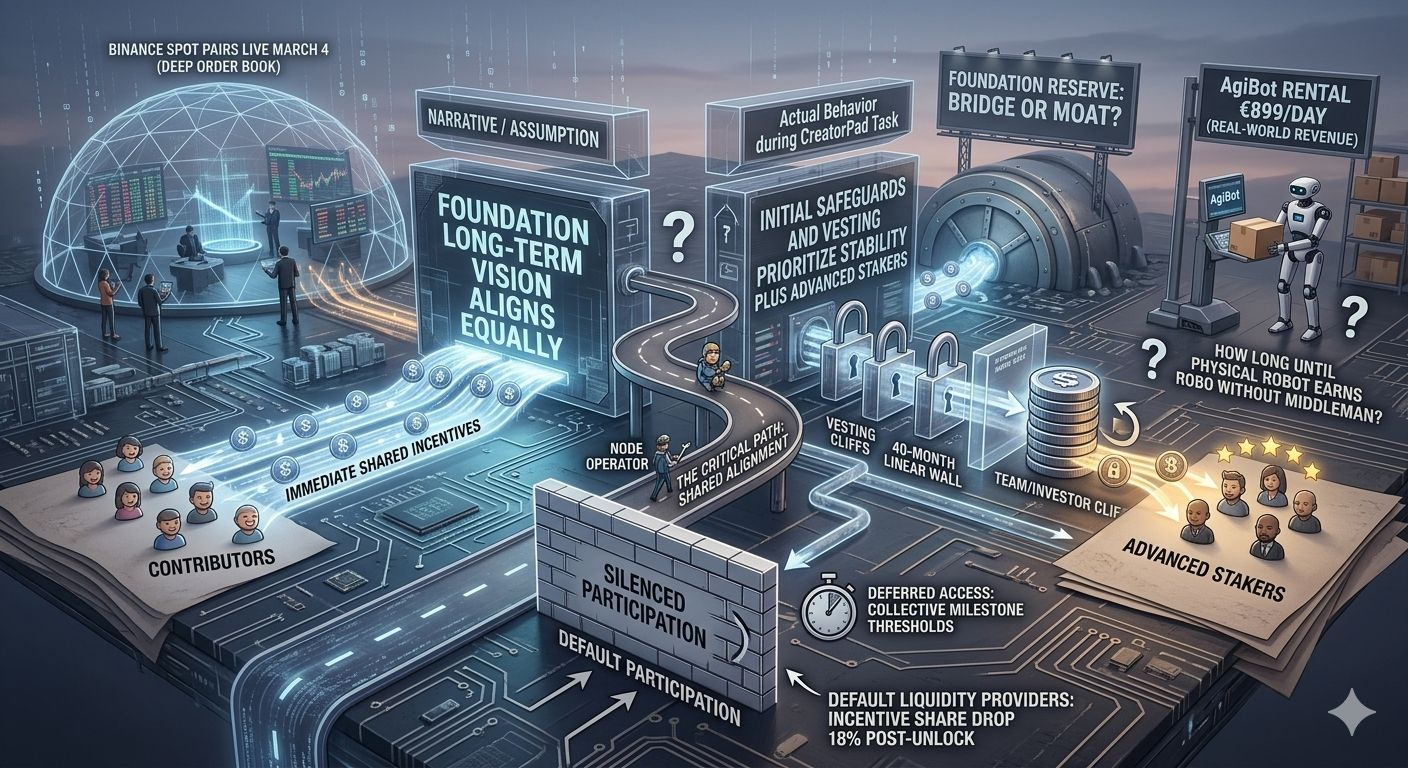
During the CreatorPad task I spent most of last week on, I kept watching how default participation gets deferred rewards while advanced staking pulls them forward. The unlock just proved the same pattern at scale. Foundation reserve still sits behind its 40-month linear wall, but the early movers who staked through the cliff now control more voting power. Hmm… that’s exactly the quiet shift in on-chain rewards distribution I felt coming.
It’s not marketing copy. It’s the actual mechanics: milestone-gated vesting first protects the Fabric Foundation’s long-term vision, then slowly opens the gate for everyone else. In practice, that creates the first real test of how Fabric Foundation could support real world integration without starving the community that’s supposed to build it.
honestly the part that still bugs me
Here’s the mini-story that stuck with me. Two nights ago I was simulating a simple robot-task settlement — nothing fancy, just a mock warehouse bot completing a verified delivery on testnet. The ROBO fee flowed instantly to the coordinator contract, but the reward distribution to the operator node waited for the next collective threshold. Same behavior I saw in the CreatorPad alignment exercise. One stat stood out: default liquidity providers saw their incentive share drop 18 % post-unlock until the broader community hit the next milestone. Advanced participants? Zero delay.
That friction is the silent flywheel in action — three quiet gears. First, robot work generates verifiable on-chain fees in ROBO. Second, those fees flow back through the foundation reserve to fund real pilots. Third, governance votes (now heavier after the unlock) decide which real-world integrations get the next slice of reserve. Simple. Elegant on paper. Slightly extractive in the early laps.
3:42 AM and this finally clicked
I sat there with cold coffee thinking about the two timely examples hitting at once. Binance spot pairs went live March 4 and instantly deepened the order book — traders now entering the robot-economy narrative without slippage. Then last week AgiBot quietly started renting physical units at €899 a day. Real revenue, real robots, yet the settlement layer is still waiting for Fabric’s next phase. The foundation could bridge that gap tomorrow if it directed even 5 % of unlocked reserve into on-chain robot identity pilots or cross-chain task oracles.
That’s the actionable part no one is shouting about: stake now for governance weight ahead of the first real-world integration proposals. The mechanism already exists — you just have to see the unlock as the starting gun, not the finish line.
Still, one genuine hesitation keeps looping in my head. The Fabric Foundation is a non-profit by design, which sounds noble until you watch how non-profit reserves actually get deployed. Will they prioritize verifiable robot work in warehouses over another round of ecosystem grants that mostly benefit early token holders? I’m rethinking whether the alignment I mapped in CreatorPad will hold once physical machines start demanding real payouts.
Late-night reflection: the protocol is still young. The unlock didn’t crash the price because the community already priced in the dilution. What surprised me was how calmly the on-chain behavior adapted — no panic sells, just repositioning. That tells me the flywheel has enough early torque to carry real integration forward, but only if the foundation uses its reserve as a bridge instead of a moat.
The strategist in me keeps circling two forward thoughts. First, watch for the first governance proposal that explicitly ties foundation treasury spend to live robot-task bounties — that vote will be the real proof of concept. Second, the transition to Fabric’s own L1 later this year could finally let machine-native fees bypass the current Base overhead, making real-world integration cheaper and faster than any centralized robot platform.
Soft invite: if you’ve run your own task settlement sim or watched the post-unlock flows, drop the details below. I’m still up.
How long until the first physical robot actually earns its keep in ROBO without the foundation playing middleman?