
Lately I’ve been thinking about something interesting when looking at projects connected to robotics and AI. Most conversations in the market focus on one thing: intelligence. Everyone asks the same questions. Which robots are smarter? Which systems are faster? Which AI models are improving the quickest?
But the more I read about Fabric and the idea behind the robot economy, the more I feel the real challenge might be something different.
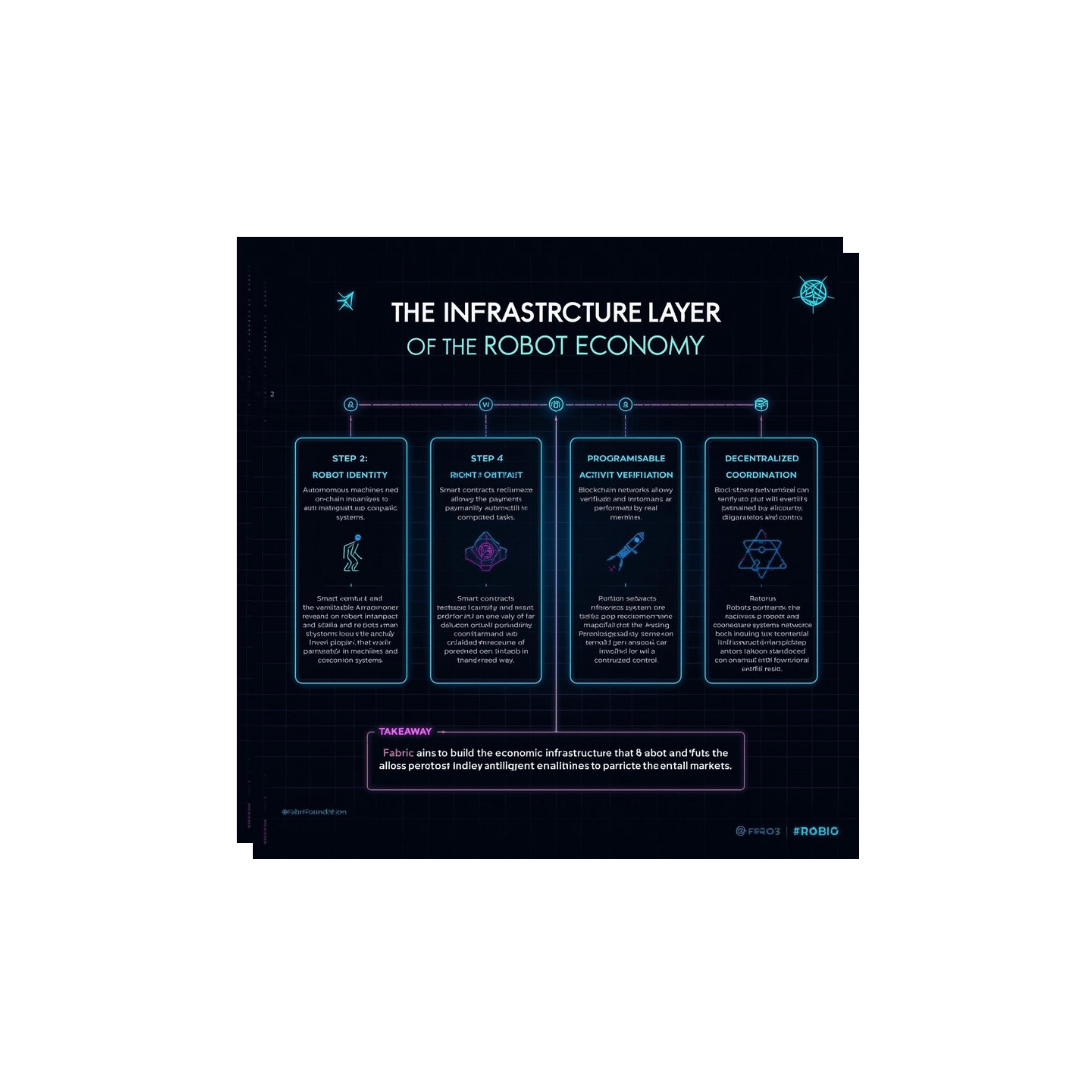
It might be infrastructure.
Because even if robots become extremely capable, that alone does not automatically make them part of the global economy. A robot can perform work, deliver goods, assist humans, or manage tasks, but without proper identity, payment systems, and coordination networks, it still remains locked inside closed environments.
That is where Fabric’s vision starts to make more sense to me.
Fabric is positioning itself as an open network designed to support the economic layer of robotics. Instead of focusing only on building smarter machines, the project is exploring how intelligent systems can interact with economic structures in a transparent and programmable way. In other words, the idea is not just about robots working — it is about robots participating.
And participation requires infrastructure.
Machines will need ways to prove identity, verify activity, receive payments, and coordinate with other systems. Traditional financial rails were built for humans, not autonomous agents. Robots cannot open bank accounts or operate through traditional identification frameworks the same way people do.
This is where blockchain-based infrastructure becomes interesting.
By using on-chain identity, programmable payments, and decentralized coordination systems, robots could theoretically operate within a more open economic framework. Tasks could be verified, payments could be automated, and participation could become more transparent.
From my perspective, that is what makes the Fabric concept worth paying attention to.
The network is still early, and a lot of execution remains ahead. Real-world robotics integration, developer participation, and ecosystem growth will ultimately determine whether this idea moves beyond theory. But the direction itself highlights something important: the future robot economy will not depend only on intelligence.
It will depend on the systems that allow intelligent machines to participate in real economic activity.
And that is the layer Fabric appears to be trying to build.