
I've spent enough time watching privacy-focused blockchain projects die in the gap between elegant design and actual user adoption to know that the technical story is rarely where the real risk hides. The real risk usually sits in the onboarding layer — the moment when a real user, not a crypto native, not a node operator, not a whitepaper reader, tries to use the product for the first time and hits a wall they were never warned about. That wall, in almost every blockchain project I have studied, is the token requirement. You want to use the network? First buy the token. First set up a wallet. First understand gas. Most people stop there. Midnight's DUST delegation model is a direct architectural response to that exact problem, and I think it is the most underanalyzed feature in the entire project right now.
To understand why delegation matters, you need the baseline first. Midnight runs a dual-token system. NIGHT is the capital asset — public, tradeable, held by investors and node operators. DUST is the network resource — shielded, non-transferable, and generated automatically by holding NIGHT over time. Every transaction on Midnight consumes DUST. Under normal circumstances, if you want to use a Midnight application, you need DUST, which means you need to hold NIGHT first. That is already a better model than most chains, because your NIGHT principal is never consumed. You generate DUST passively, the way a savings account generates interest, and DUST covers your costs. But the delegation layer goes one step further. Midnight's architecture allows application developers to delegate their own accumulated DUST directly to their end users. A developer builds a privacy application on Midnight, accumulates DUST from their own NIGHT holdings, and then covers the transaction costs of every user who interacts with their app. The user never needs to buy NIGHT. The user never needs to hold DUST. The user just uses the application.
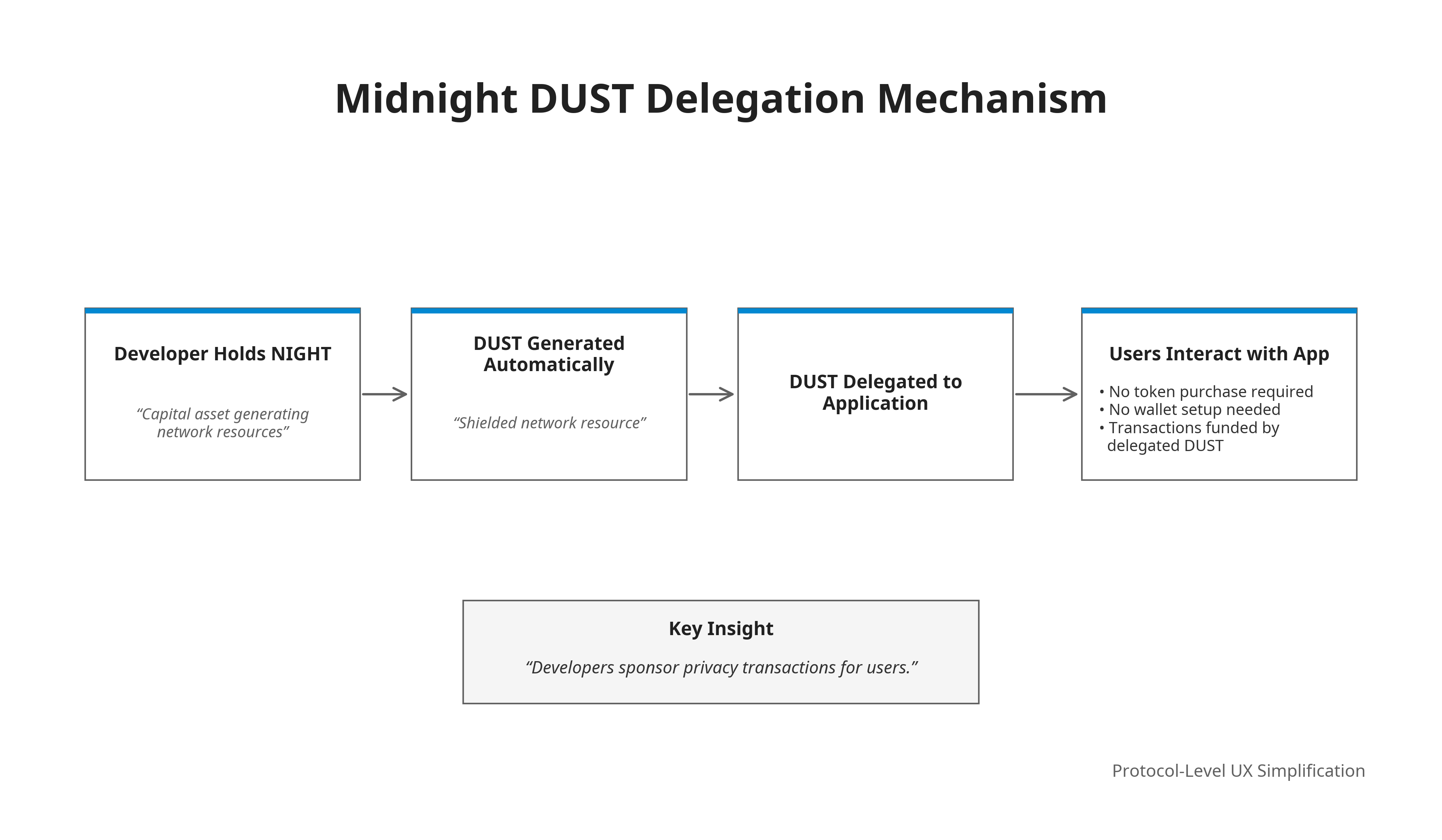
I want to be direct about why this matters for the investment case, not just the product case. Every serious Web3 developer I have seen try to build consumer-facing applications on a public blockchain has eventually hit the same conversation with their product team: we cannot ask normal users to buy a token before they try the app. It kills conversion. It introduces regulatory friction. It turns a product demo into a crypto onboarding tutorial nobody asked for. DUST delegation solves that problem at the protocol level, not with a workaround. A developer holding sufficient NIGHT can effectively sponsor their users' activity on Midnight the same way a SaaS company covers server costs instead of billing users per API call. The economic model shifts from user-pays to developer-absorbs, which is exactly how successful consumer software has always worked. That design choice opens Midnight's privacy infrastructure to developers who would otherwise never touch a blockchain product, because the user experience barrier disappears entirely.
Here is the part I would not skip over. DUST delegation only works as a growth mechanism if developers actually accumulate meaningful NIGHT positions to generate delegation capacity. A developer who holds minimal NIGHT generates minimal DUST and can sponsor minimal user activity. At current prices, NIGHT sits at $0.05005 on Binance with a 24-hour volume of $101.06 million and a session range between $0.04717 and $0.05523. The market cap sits near $830 million at this level. That tells me NIGHT is liquid and accessible right now, but it also means building a serious DUST generation position costs real capital for an early-stage development team working on a tight budget.
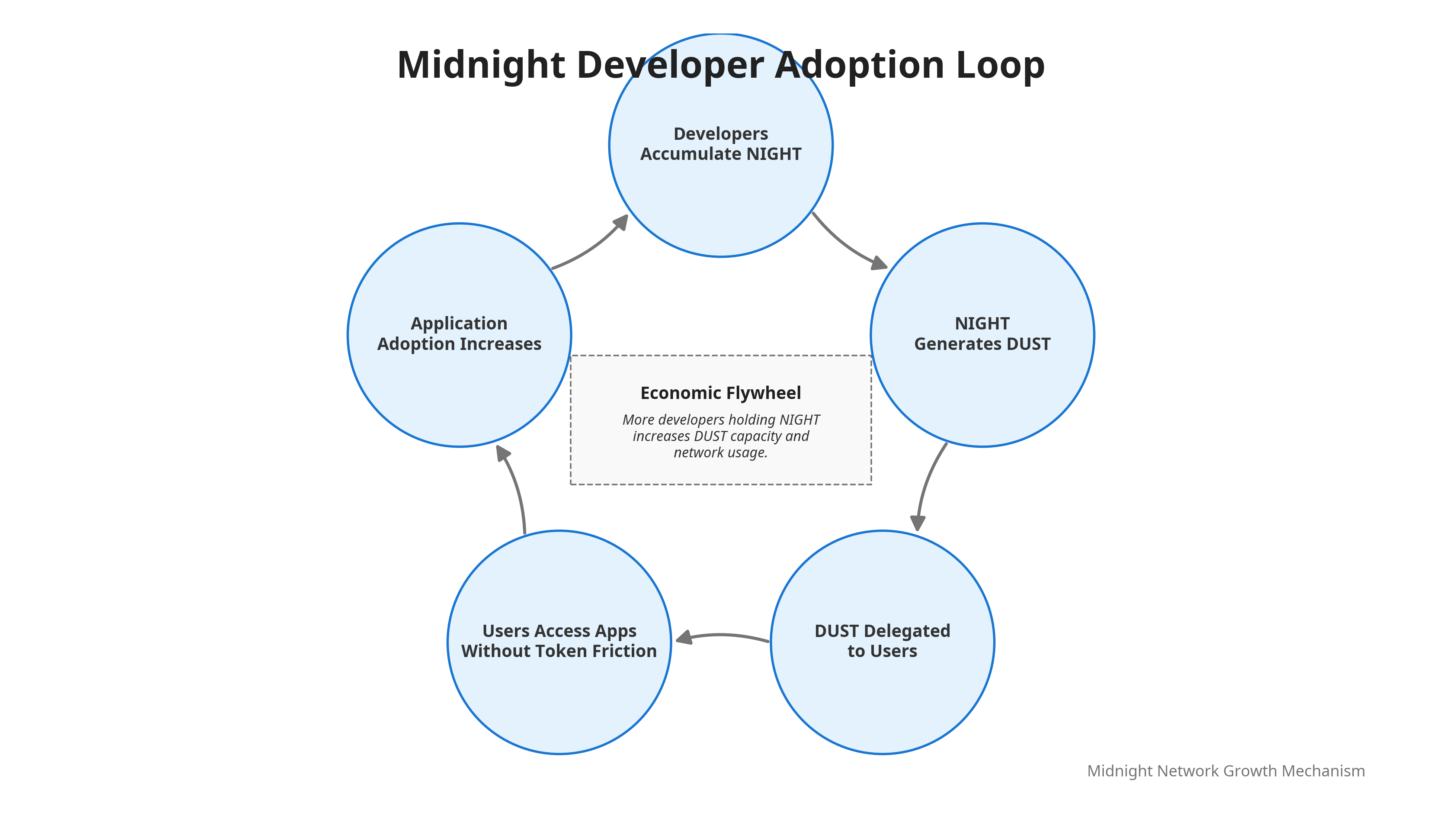
There is also a subtler risk inside the delegation model that I think deserves honest attention. If delegation becomes the dominant usage pattern, the health of the network becomes heavily dependent on whether developers keep their NIGHT positions intact through market volatility. A developer who bought NIGHT at higher prices and watches the token drop 40 percent faces a real decision about whether to keep holding for DUST generation or cut losses and exit. If enough developers make the second choice during a sustained drawdown, delegation capacity across the network shrinks, user experience degrades, and the adoption story goes into reverse exactly when the market is already stressed. That is not a hypothetical. That is a known failure pattern in token-incentivized developer ecosystems, and Midnight's delegation model is not immune to it.
Mainnet is confirmed for the final week of March 2026. That is the first real test of whether DUST delegation works in production, not just on paper. What I want to see after launch is whether developer teams are accumulating NIGHT specifically to build delegation capacity, whether applications are appearing that genuinely hide the token layer from end users, and whether DUST consumption starts climbing from real sponsored transactions rather than test activity. If that pattern emerges, delegation stops being a design feature and starts being a growth engine. If mainnet launches and DUST sits idle while NIGHT trades actively on Binance, then the token has market interest but the network has no traction, and those are two very different things wearing the same price tag.
Do not watch the NIGHT chart alone. Watch whether developers are holding to generate DUST or just trading for exposure. That distinction is the whole story.
@MidnightNetwork #night $NIGHT
