
I watched a lending protocol collapse in 2022 because the collateral requirements looked solid on paper but failed in practice. The design assumed liquidators would show up fast enough to protect the system, but when volatility spiked, the liquidation mechanics could not keep up with price movement, and the whole thing imploded. That taught me to look hard at any economic model that relies on participants behaving rationally under stress, especially when the penalties are supposed to prevent bad behavior but might not be calibrated right. ROBO's operator bond model has that same tension built into it, and I am not sure Fabric Foundation has solved it yet.
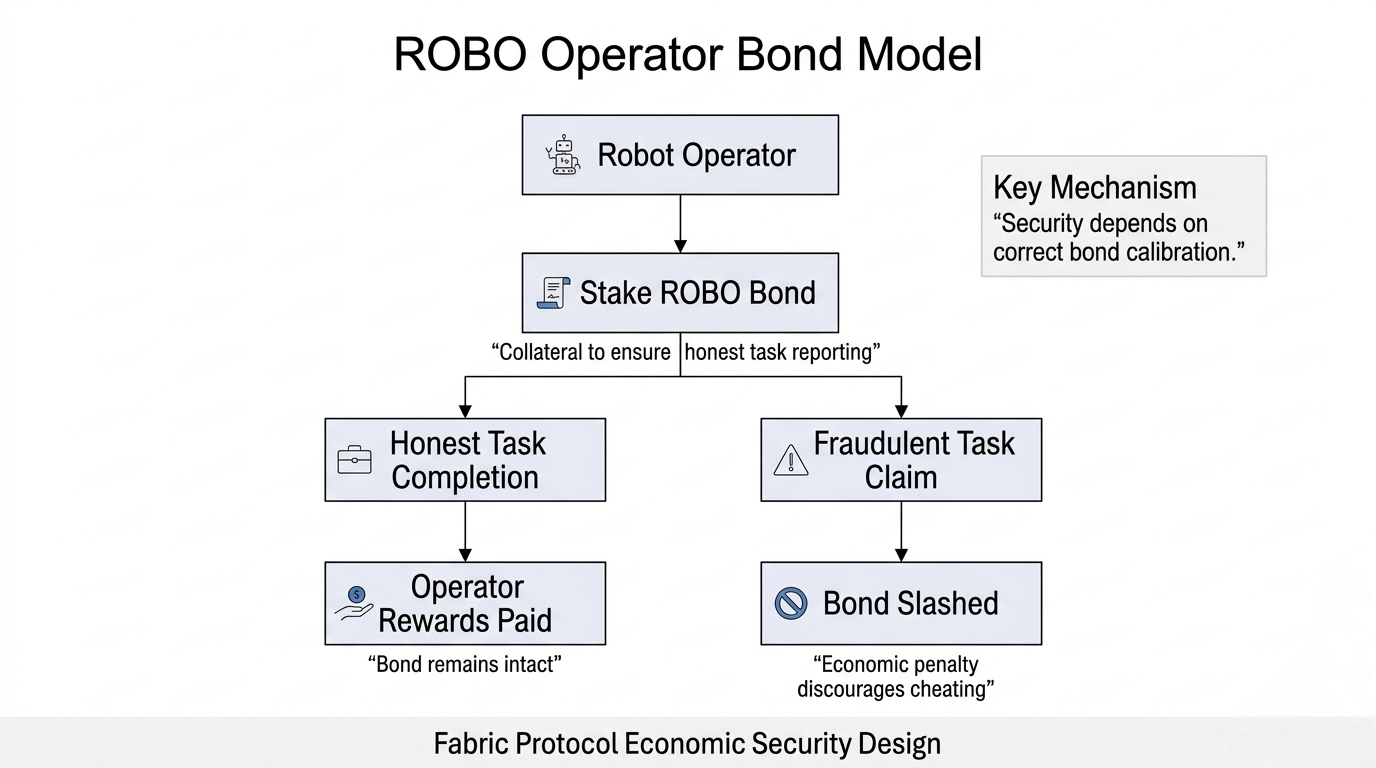
As of March 13, ROBO is trading at 0.04057 USDT, down 3.29 percent in the last 24 hours, with 346.24 million tokens traded for roughly 14.22 million USDT in volume. The token hit an all time high of 0.06071 on March 2 and has since pulled back about 33 percent. That price action is fine, but what keeps pulling me back to ROBO is the structural question underneath the token mechanics. Fabric Protocol says robot operators must stake ROBO as a bond that gets slashed if they submit fraudulent task completion claims. That creates an economic disincentive for dishonesty, but only if the bond amount is calibrated correctly. Too low, and operators can afford to cheat. Too high, and legitimate operators get priced out of participation. The whitepaper admits this design is still being finalized, and that is the part that makes me uneasy.
Here is the problem. Fabric's verification model is challenge based, not universal. The whitepaper says physical service completion cannot generally be cryptographically proven in full, so the system relies on validators, challenge mechanisms, and slashing rules to make fraud economically unattractive. Proven fraud can lead to major stake slashing, availability failures can trigger penalties, and poor quality can suspend reward eligibility. That sounds reasonable until you think about what happens at scale. If a robot operator is running 100 robots and submitting 1,000 task completion claims per day, and the bond per robot is 10,000 ROBO, that operator has 1 million ROBO at risk. At current price of 0.04057, that is roughly $40,570 locked up. If the operator can make $50,000 in revenue by completing tasks honestly, the bond works as intended. But if the operator can make $100,000 by submitting fraudulent claims and only risks losing $40,570 if caught, the math breaks. The bond is not high enough to prevent fraud. It just becomes the cost of doing business.
The flip side is also a problem. If Fabric Foundation sets bonds too high to prevent that kind of fraud, say 100,000 ROBO per robot, then small operators get priced out entirely. At 0.04057 per token, 100,000 ROBO is $4,057 per robot. If you are deploying 10 robots, that is over $40,000 locked up before you even start operating. Most small participants cannot afford that, which means the network becomes dominated by large, well capitalized operators who can absorb the bond requirements. That creates centralization risk, which undermines the whole point of building an open coordination network. I have seen this exact dynamic play out in validator networks where the barrier to entry gets so high that only institutions participate, and the network starts looking less decentralized and more like a cartel.
Fabric's own materials acknowledge this tension. The whitepaper says governance structures may evolve over time and that early stage decision making may involve a limited set of stakeholders. It also says several design parameters are still open, including what metrics should count as non-gameable success and whether the initial validator set starts permissioned or permissionless. That tells me the team is thinking about these problems, but it also tells me they have not solved them yet. The bond model is not finalized, the slashing rules are not finalized, and the governance process for adjusting those parameters is not finalized. That is a lot of unfinalized structural design for a token that is already trading and already asking participants to take economic risk.
The other thing I keep thinking about is what happens when bond requirements change. Let's say Fabric Foundation launches with a 10,000 ROBO bond per robot, and six months later they realize that is too low because fraud is starting to show up. They increase the bond to 50,000 ROBO through governance. Existing operators now have to lock up five times more capital or stop operating. That creates forced selling pressure if operators cannot afford the new requirement, or it creates attrition if operators decide the network is not worth the increased capital lockup. Either way, retention suffers, and retention is the thing Fabric Protocol needs most if it wants to become real infrastructure rather than just an experiment.
What would change my mind is evidence that Fabric Foundation has run economic simulations on bond calibration under different fraud scenarios, different operator scales, and different token price levels. If they publish research showing that bond amounts remain economically viable across a wide range of conditions, that would give me more confidence. If they show a clear governance process for adjusting bond requirements without disrupting existing participants, that would help. If they demonstrate that slashing penalties are severe enough to deter fraud but not so severe that they create existential risk for honest operators who make mistakes, that would matter. Right now, I do not have that evidence, and without it, the operator bond model feels like a structural risk that could break the network before it proves itself.
The market is pricing ROBO like an early narrative asset, which means price can run ahead of proof. CoinGecko shows roughly 2.23 billion tokens circulating against a 10 billion max supply, with a market cap near 90 million and an FDV around 405 million. That setup can attract attention fast, but it also means the network needs to show it works before vesting unlocks start pressuring supply in late 2026 and 2027. If the operator bond model breaks because the calibration is wrong, the whole retention thesis collapses, and ROBO reprices lower until it finds participants who are willing to take that structural risk. Track whether Fabric Foundation publishes bond requirements, slashing rules, and governance mechanisms for adjusting those parameters. That is where the real signal lives, not in today's three percent pullback or yesterday's volume number.
#ROBO $ROBO @Fabric Foundation
