

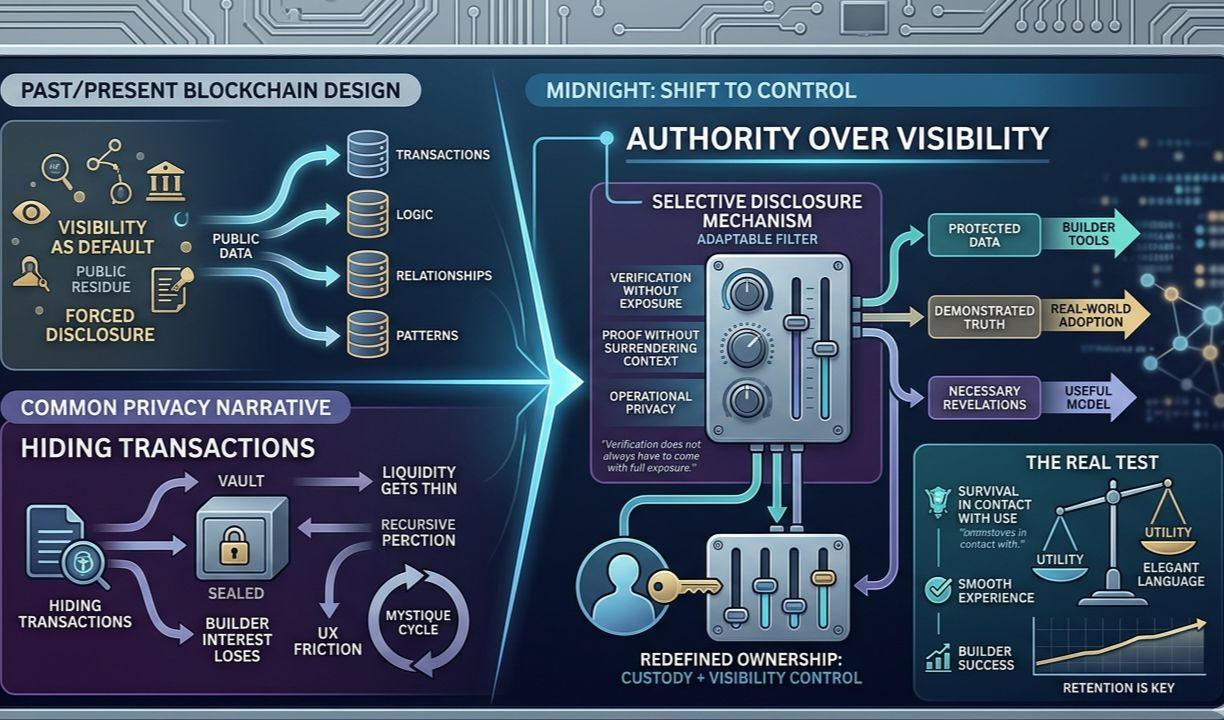
I have heard the privacy pitch too many times to be easily moved by it now. In crypto, privacy is often dressed up like a final answer, as if hiding transactions alone is enough to make a system meaningful. Most of the time, it is just another cycle narrative. A layer of mystique gets added, people call it a new standard, attention rushes in, and then the same old problems return. Liquidity gets thin, builders lose interest, user experience turns into friction, and the entire story starts feeling lighter every time it gets retold. That is why Midnight catches my attention in a different way. Not because it says privacy matters, but because it seems to understand that privacy is not really the deepest issue. Control is.
That is the part I keep circling back to. Midnight does not feel most interesting when it talks about hiding things. Plenty of projects can market concealment. That is the easy version. What feels more serious here is the idea that information should not always move in the same way, to the same people, under the same assumptions. In most blockchain systems, visibility is treated like a virtue by default. Everything becomes public residue. Transactions, logic, relationships, activity trails, behavioral patterns, all of it gets pushed into permanent exposure and then framed as trust. But that has never fully made sense outside the narrow worldview of crypto natives who mistake total transparency for clean design. Once real users, real businesses, and real applications enter the picture, that model starts to feel less like trust and more like forced disclosure.
That is where Midnight begins to matter more to me. The project seems to be built around a better question. Not whether something can be verified, but whether verification always has to come bundled with full exposure. That is a more mature problem to solve. It accepts that people may want proof without surrendering every layer of context. It accepts that trust does not have to come from making every interaction visible to everyone forever. Sometimes trust comes from being able to demonstrate what matters and protect what does not. That distinction sounds simple when stated directly, but the industry still struggles with it in practice.
Crypto talks constantly about ownership, but most of the time it means custody and nothing more. Hold your keys, hold your assets, own your wallet. That is necessary, but it is also the most basic version of the idea. Midnight seems to reach toward something heavier. It points toward ownership as authority over visibility itself. That is a much more important concept in digital systems, because the person who controls information flow often controls the relationship around the asset, not just the asset alone. And relationships are where real power sits. Who gets to see what. Who gets to prove what. Who gets to reveal what only when it becomes necessary. That is not just privacy language. That is systems design with a more realistic understanding of how people and institutions actually behave.
What makes this more compelling than the average privacy narrative is that Midnight does not seem obsessed with turning blockchain into a sealed vault. It appears more interested in selective disclosure, which is not a glamorous phrase, but it may be the one that matters most. Selective disclosure suggests structure. It suggests that privacy is not a theatrical refusal to share anything at all, but a disciplined ability to decide what should be visible, what should remain protected, and what can be proven without exposing the full record underneath. That is a more useful model than the usual absolutism. It makes privacy functional instead of ideological. It makes it operational instead of decorative.
Still, none of that means much on its own. Instinct is cheap. Good framing is cheap too. I have seen enough well-packaged projects to know that elegant language can survive far longer than real utility. The actual test for Midnight is not whether the architecture sounds thoughtful. The test is whether it survives contact with use. That is where the truth always shows up. Builders will eventually discover whether the tooling feels natural or suffocating. Users will feel whether the experience is smooth or exhausting. Teams will find out whether the system helps them build real applications or traps them inside abstractions that only looked beautiful in diagrams. Every project feels coherent before the friction begins. The friction is where the truth lives.
That is why I stay interested, but cautious. Midnight appears aimed at a real weakness in blockchain design, not a manufactured one. Open systems often assume that maximum openness is the cleanest path to trust, yet in many environments it becomes oversharing disguised as principle. It creates unnecessary leakage. It exposes business logic, user behavior, and sensitive relationships that never needed to become public in the first place. In those situations, transparency stops feeling noble and starts feeling crude. Midnight seems to understand that discomfort. It seems to be building around the idea that people want verifiability without turning every action into public property. That is not fantasy. That is a very real pain point.
The problem is that markets are rarely kind to nuance. Midnight sits in a strange position. It may be too private for those who want everything loud, visible, and instantly legible. It may be too structured for those who still romanticize total opacity as the only honest version of privacy. It may also be too subtle for traders who need a one-line story they can repeat without thinking. That middle ground is difficult. Sometimes it becomes the most durable place to build from. Sometimes it gets ignored because the market would rather chase simpler narratives, even when they are worse. I have watched that happen enough times that I no longer assume the better idea wins first.
There is also the harder truth that almost nobody likes to admit. Being right about the problem does not guarantee adoption. It never has. A project can identify the exact gap in the market and still lose because the ecosystem stays thin, the developer experience is clumsy, the token narrative gets ahead of the product, or the surrounding market simply prefers louder and dumber stories. Midnight may be reaching toward something important, but reaching is the easy part. The real grind is building a system that people keep returning to after the curiosity fades. The second week matters more than the launch week. Retention matters more than intrigue. Repeated use matters more than polished language.
That is probably why I read Midnight with divided instincts. Half of me sees a project trying to approach privacy from a more serious angle, one rooted in authority, disclosure, and informational boundaries rather than empty mystique. The other half has been in this market long enough to expect flattening forces everywhere. Narrative recycling. Thin attention spans. Token-first thinking. Infrastructure that sounds better than it feels. It would not surprise me if Midnight gets swallowed by the same machinery that strips complexity out of everything and sells back the simplified version to a louder crowd. That outcome is always possible.
Even so, I think there is something genuinely valuable in the shift Midnight is making from concealment to control. That change in framing is not small. It suggests a future where blockchain systems are judged less by how loudly they expose everything and more by how intelligently they manage the movement of information. That feels closer to what real adoption will demand. The next meaningful stage of this industry probably does not belong to systems that reveal everything, and it probably does not belong to systems that hide everything either. It belongs to systems that understand when information should move, when it should stop, what should be proven, and who gets to decide.
That is the possibility Midnight is pointing toward. Maybe it gets there. Maybe it does not. Maybe it is another project trying to survive an exhausted market with sharper language than the rest. But at the very least, it seems to be asking a better question than most. Right now, that alone is enough to make me keep looking.
@MidnightNetwork #night $NIGHT
