
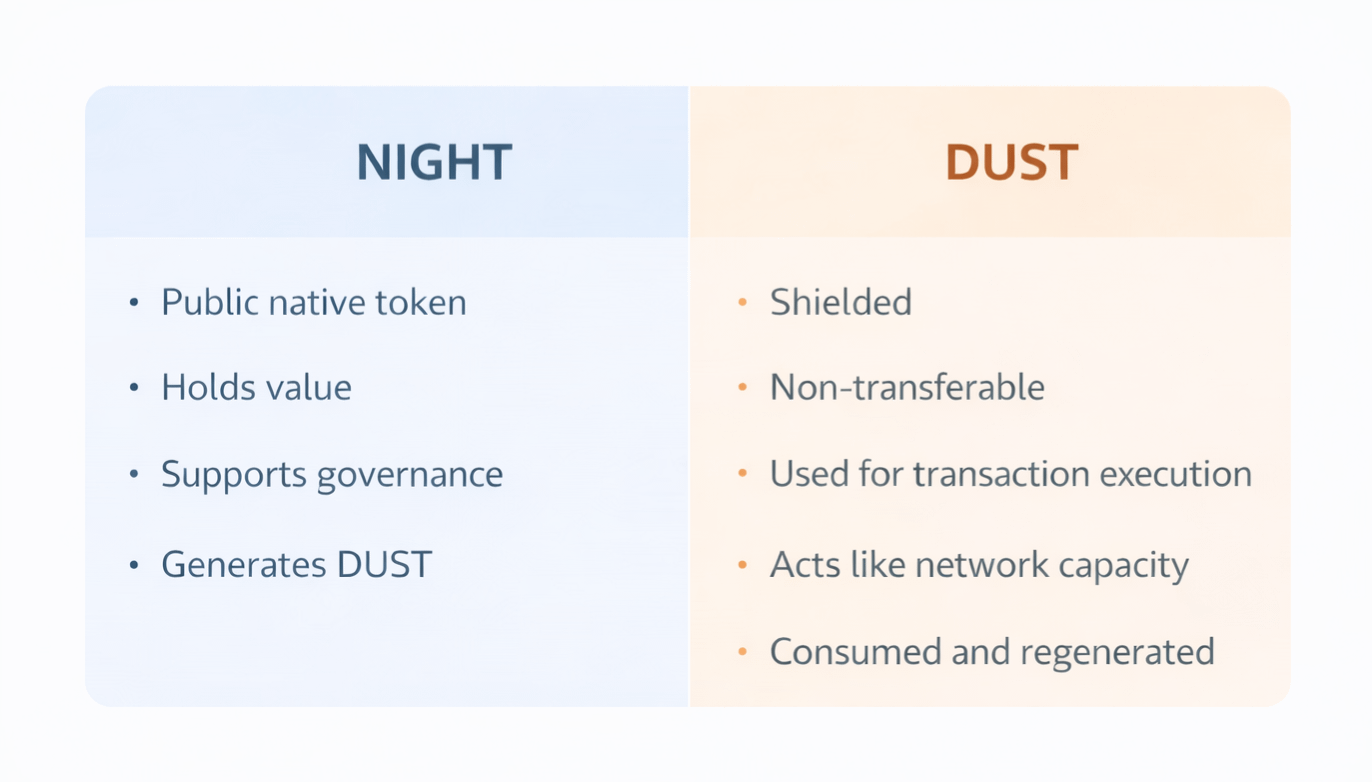
A lot of token models sound more interesting than they really are. I kept thinking about that while reading Midnight, because at first glance NIGHT looks like another native token story. Then you get to DUST, and the whole model changes shape. Midnight does not ask one asset to do everything. NIGHT is the public native and governance token, while DUST is the shielded resource used to pay for transactions and execute smart contracts.
That split is the part most people miss, and honestly, it is the part that makes the model worth talking about.
The simplest way to read it is this. NIGHT is the asset you hold. DUST is the resource you use. Holding NIGHT automatically generates DUST over time, and DUST acts more like rechargeable network capacity than a normal gas token.
Midnight even describes it with a battery-style logic, where DUST is consumed for activity and then regenerates based on NIGHT holdings.
I think that framing helps because it gets you away from the usual habit of treating every token as if it only exists to be bought, sold, and spent in the same way.
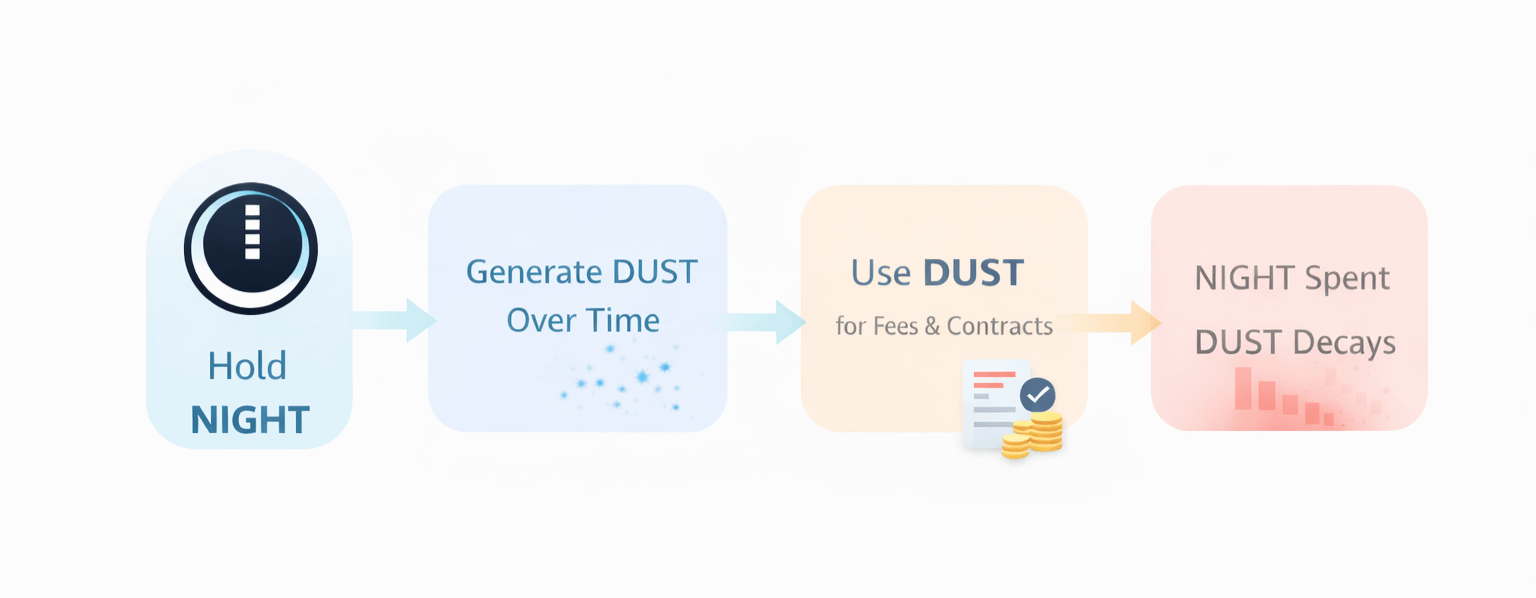
The mechanics become much more fascinating when you analyze them a bit more. DUST is protected and non-transferrable, which means that it should not be circulated through the users just like a privacy coin. It is a network resource only for gas. Its available capacity is derived from an associated NIGHT UTXO, it grows over time to a maximum, and once the backing NIGHT is spent, that DUST starts decaying to zero. Midnight’s January 2026 architecture post also gave an initial parameter set, 5 DUST per NIGHT, around one week generation time, and a 3 hour grace period for transaction timing.
To me, that makes the model feel much more concrete. It is not just a whitepaper idea anymore.
I also think this design says something about what Midnight is trying to optimize. On most chains, the same token holds value and pays for every action, which means speculation and usage are tangled together. Midnight is trying to separate those jobs. The official docs are pretty direct about that. NIGHT is the capital and governance layer, DUST is the operational layer. That matters because it gives developers a way to think about network usage in a more budgetable way, and it also helps Midnight keep privacy focused on computation and activity rather than turning the main token itself into anonymous transferable value.
There is also enough rollout data now to show that this model is not just theoretical. Midnight lists a total supply of 24 billion NIGHT and a 450 day thawing period for distribution unlocks. Its public distribution data says more than 3.5 billion NIGHT were claimed in Glacier Drop by over 170,000 wallet addresses, while Scavenger Mine accounted for 1 billion NIGHT claimed by more than 8 million unique wallet addresses. As of February 2026, Midnight says it is in the Kukolu phase and has announced mainnet for late March 2026. I’d include these details in the article because they ground the token discussion in actual rollout progress.
That said, I would not pretend the model is effortless to understand. The weakness here is complexity. A normal reader can grasp a basic gas token in seconds. Midnight asks people to understand a public token, a shielded non-transferable resource, recharge behavior, decay behavior, and a cross-chain generation process tied to Cardano based NIGHT activity. I think this is a really good idea. Before I can say if I like this cleaner design or not, I need to see if it is intuitive when you actually use it.That is the honest test ahead.
My takeaway is pretty simple. NIGHT is not the whole story, and that is exactly the point. Midnight’s token model makes more sense when you stop asking how one token captures everything and start asking how the network separates value from usage. Once I looked at it that way, the DUST model stopped feeling like an extra layer of jargon and started looking like the real core of Midnight’s design.