
At the beginning, I was looking at Fabric Protocol the way people usually look at robot projects. I was paying attention to the machine first and everything else second. After a while, that stopped making sense to me. The robot is only the visible part. The more important part is the system around it and how the work actually moves from request to execution to final delivery.
That is also why Fabric feels different from the usual robotics narrative.
The project does not describe itself as just a robot builder. In its whitepaper, Fabric presents the network as decentralized infrastructure for coordinating robotics and AI workloads across devices and services.
It also makes clear that Robo is meant to function as a utility token for network fees and operational bonds, not as some vague symbol attached to a futuristic story. Once you read that, the project starts to look less like a machine showcase and more like a workflow system.
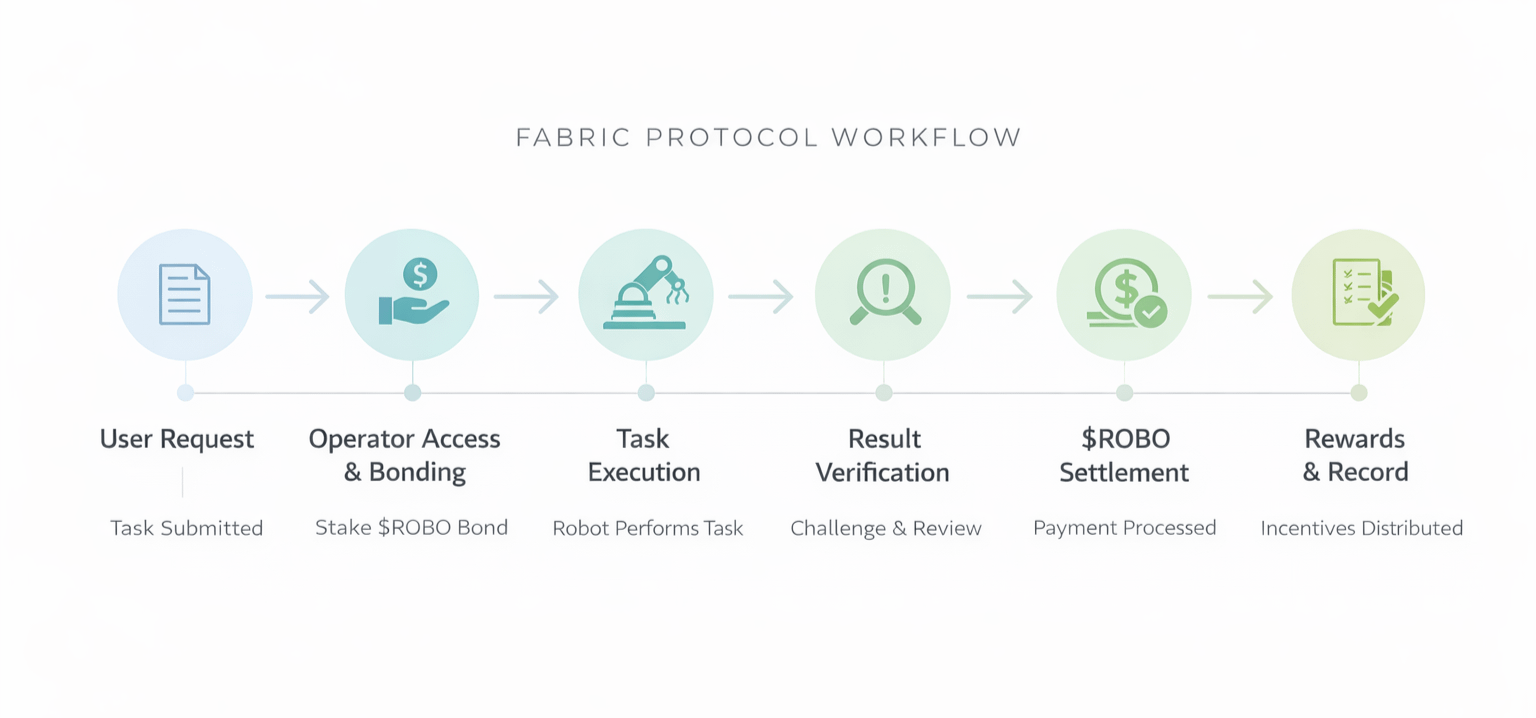
The workflow begins before any task is completed. Fabric says robot operators have to post refundable performance bonds in Robo in order to register hardware and provide services. Those bonds are there for a reason. They act as economic security deposits, and the requirement scales with declared capacity.
So the protocol is not only asking whether a robot exists. It is asking whether the operator has enough stake in the system to be accountable for the work. That is a much more grounded way to think about robotics infrastructure than just watching a demo and assuming the rest will sort itself out.
Then comes pricing and settlement, which is where the workflow lens becomes even more useful.
Fabric explains that services such as data exchange, compute tasks, and API calls use Robo for network-native fees. At the same time, tasks can still be quoted in stable-value terms for predictability, with offchain or stable-value payments converted into $ROBO to complete settlement onchain.
I think this part matters because it connects the user side of the network to the protocol side. The request may start in familiar pricing terms, but the network still settles the work through its own infrastructure.
The result stage is probably the most important part.
In the physical world, not every task can be perfectly proven the way a purely digital action can. Fabric is fairly open about that. Its whitepaper says network integrity does not require universal verification of all tasks because that would be too expensive. Instead, it uses a challenge-based system where validators monitor quality and availability, investigate disputes, and earn compensation for successful fraud detection. If fraud is proven, part of the earmarked task stake can be slashed.
The paper also describes penalties tied to uptime and quality thresholds. That makes the project more interesting to me, because it is not pretending robot work becomes trustworthy by default. It is trying to make dishonest behavior costly.
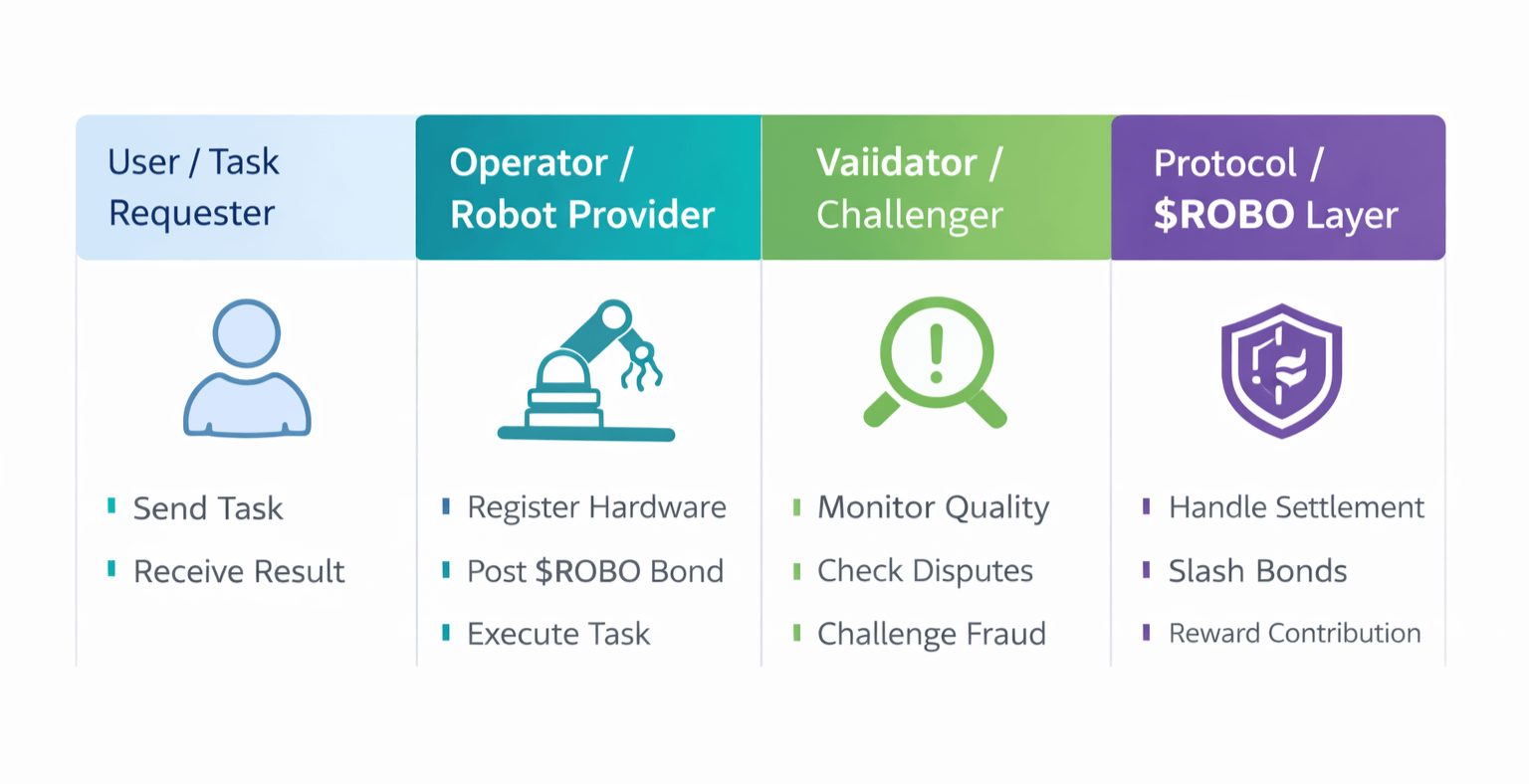
This also changes how I look at $ROBO. The token makes more sense when it is placed inside the workflow. It is used for access, bonding, settlement, delegation, governance, coordination around robot genesis, and rewards tied to verified contribution. Fabric’s own materials even describe rewards as linked to active participation such as task completion, data contributions, compute, and validation work.
So the token is not really the first thing to explain. It only becomes clear once the workflow is clear.
Of course, there is still a lot this model has to prove in practice. A strong design on paper is not the same thing as large-scale adoption, reliable task flow, or healthy incentives in the real world.
Fabric also says the network will initially be deployed on Base and may later migrate into its own Layer 1 as adoption grows, which shows that some of the system is still part of a phased rollout rather than a finished endpoint today.
That is really the main takeaway for me. Fabric Protocol becomes easier to understand when I stop asking only what the robot can do and start asking how the whole process is supposed to work. Request comes in. Access is bonded. Work is executed. Results are challenged if needed. Settlement happens. Rewards go to verified contribution. Once I looked at it that way, the project felt a lot more coherent.