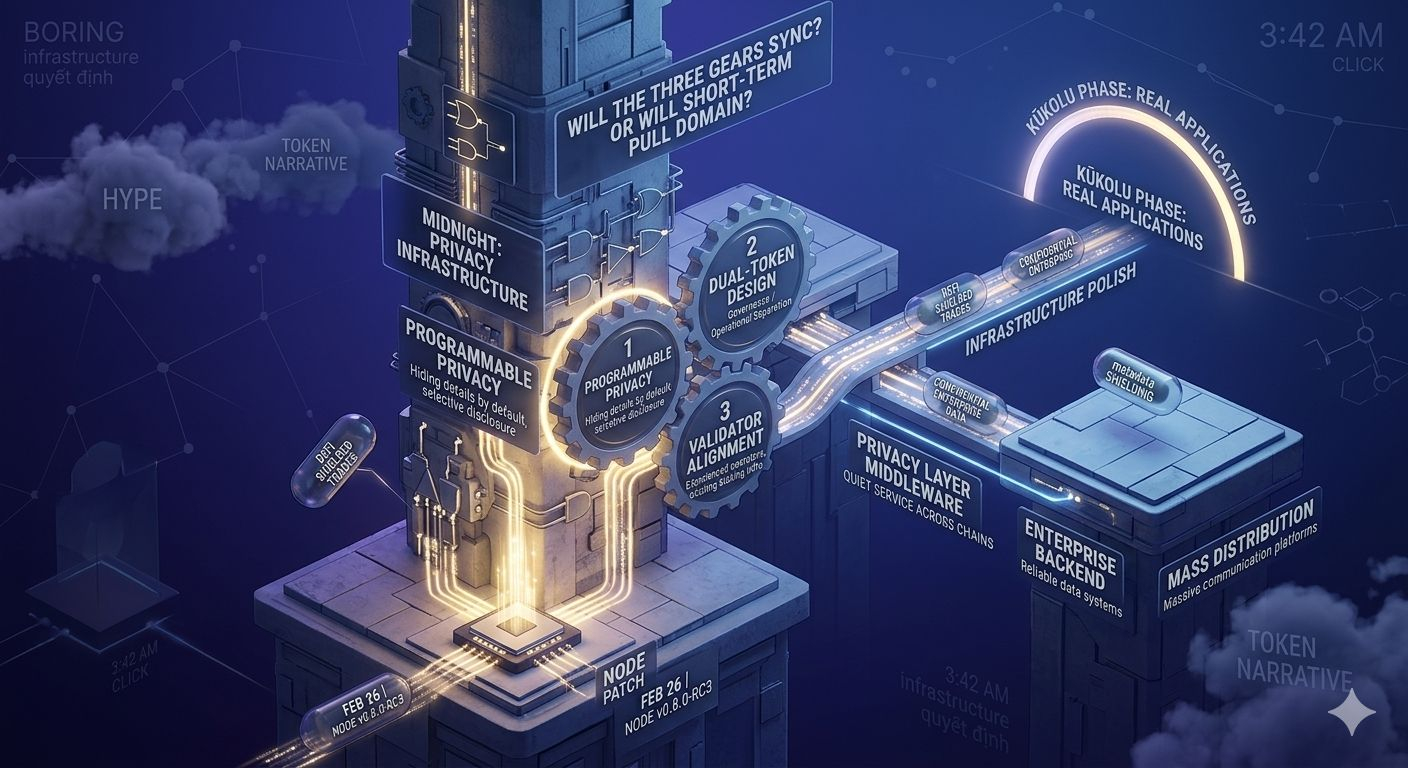
wait — the node patch quietly shipped feb 26
Two nights ago I was scrolling through validator discussions while my coffee went cold… and a small detail caught my eye.
On Feb 26, 2026, the Midnight team quietly released Node v0.8.0-RC3 — a release candidate focused on performance tuning and security improvements as the network moves closer to launch.
Not a flashy announcement.
Not some giant token narrative.
Just infrastructure work.
But if you’re actually watching The Vision and Mission of Midnight Network: Building a Privacy-Preserving Layer for Web3, those quiet infrastructure updates usually matter more than the headlines.
Privacy networks rarely fail because of ideas.
They fail because the validator layer can’t hold up once real transactions start flowing.
And this update — small as it looks — suggests the team is tightening the bolts before usage actually begins.
Which… honestly made me pause for a second.
Because teams only start polishing validator software when they expect it to be tested in the wild soon.
the moment the repo refreshed at 01:17
Here’s the specific event that triggered the thought.
Event: Midnight Node Release Candidate
Version: v0.8.0-RC3
Date: Feb 26, 2026
The update focused mainly on two things validators had quietly mentioned before:
• execution slowdowns during heavier block simulations
• edge-case security improvements in node validation
Nothing dramatic.
But that’s usually how meaningful upgrades look from the outside — boring, technical, almost invisible.
Still… when you step back and connect it to the bigger picture of Midnight Network’s privacy infrastructure, it becomes more interesting.
Because this patch arrives right before the network transitions toward its Kūkolu phase, the stage designed to prepare the ecosystem for real applications.
And that timing rarely happens by accident.
When developers begin optimizing the validator layer, it usually means one thing:
they expect the chain to start handling real workloads soon.
a small memory that made this click
This update reminded me of something from years ago.
Back in 2021 I experimented with running a validator for a small proof-of-stake network that eventually disappeared.
The funny thing is… it didn’t fail because of token price.
It failed because the node software couldn’t stay synchronized under load.
Users thought the project “lost momentum.”
But operators knew the truth.
Infrastructure is what quietly decides whether a chain survives.
That memory popped back into my head while reading Midnight’s patch notes… because the team seems to be doing the opposite pattern.
Instead of rushing toward hype cycles, they’re strengthening the technical foundation first.
Which actually fits perfectly with the privacy-first architecture Midnight is trying to build.
three quiet gears in the midnight machine
If you zoom out a bit, Midnight isn’t trying to replicate traditional privacy coins.
The model is slightly different.
Rather than full anonymity all the time, the system aims for programmable privacy — something closer to controlled visibility.
I’ve started thinking about it as three quiet gears working together.
First gear: programmable privacy
Zero-knowledge proofs hide transaction details by default, but selective disclosure allows users to reveal information when necessary.
That balance could matter if institutions ever start experimenting with private on-chain transactions.
Pure anonymity tends to scare regulators.
But selective privacy… that’s a different conversation.
Second gear: the dual-token design
Midnight separates governance capital from transaction usage.
The governance token handles network alignment, while the operational token pays transaction costs.
That separation might sound small, but it removes one of the strange friction points in many crypto systems where the same asset has to serve too many roles.
Third gear: validator alignment
The network is designed to leverage existing staking infrastructure from experienced operators rather than relying entirely on brand-new participants.
That might sound like a technical detail, but experienced validators dramatically reduce the risk of early network instability.
And suddenly that v0.8.0-RC3 node update starts making a lot more sense.
You don’t refine validator software unless those validators are about to become very important.
honestly the part that still bothers me
Still… I keep coming back to one question.
Privacy narratives in crypto have always struggled to find the right balance.
Projects like Monero proved that strong privacy works technically.
But adoption slowed once compliance concerns entered the conversation.
Midnight is trying to solve that tension.
Privacy by default — but with optional disclosure when needed.
That sounds elegant in theory.
But the execution will be delicate.
Too private, and regulators push back.
Too transparent, and privacy users lose interest.
Somewhere in the middle is the equilibrium… though it might take a few iterations before the ecosystem finds it.
3:42 am and something else clicked
Another signal appeared while I was thinking about this.
Midnight’s ecosystem alignment isn’t only technical — it’s also structural.
Infrastructure partnerships are forming quietly in the background.
On one side you have enterprise-grade cloud infrastructure supporting development environments.
On the other side you have massive communication platforms capable of distributing applications to hundreds of millions of users.
At first that combination seemed random.
But after sitting with it for a while… it actually looks like a classic infrastructure stack.
Reliable backend systems.
Mass-scale user distribution.
And potentially a privacy layer sitting between them.
If Midnight becomes that layer, it stops looking like a niche blockchain.
It starts looking more like middleware for privacy in Web3.
Which is a very different category of project.
the part traders might be overlooking
Most traders I talk to still frame Midnight as simply “a privacy extension in the Cardano ecosystem.”
But that framing might be too narrow.
The bigger experiment here is whether privacy can become a modular service across multiple chains.
Instead of replacing ecosystems, Midnight could quietly support them.
Imagine a few scenarios:
DeFi protocols routing sensitive trades through private execution layers.
Enterprise applications handling confidential data without exposing it publicly on-chain.
Cross-chain bridges shielding transaction metadata while still verifying settlement.
If those types of applications start appearing, Midnight won’t compete directly with other chains.
It will sit underneath them.
Quietly doing the work most users never see.
something I’m watching now
A few signals will probably tell the story over the next months.
Validator participation once the network reaches full operation.
The first wave of applications experimenting with programmable privacy.
And whether other ecosystems begin integrating Midnight as an infrastructure layer.
Right now everything still feels early… almost experimental.
But sometimes the most important shifts start exactly like this.
A quiet patch update.
A small performance fix.
A validator improvement most people scroll past.
And then, months later, you realize that was the moment the foundation started locking into place.
Anyway… that’s where my head ended up tonight after staring at node updates longer than I probably should.
Maybe I’m overthinking it.
But when infrastructure starts moving quietly like this… it usually means something bigger is assembling underneath.
So I’m curious — when you watch Midnight’s development lately, what signal actually makes you pause and think twice?