
@Fabric Foundation #robo $ROBO
We have all seen projects launch with grandiose promises, only to fade when the underlying technology fails to deliver real-world value. When evaluating a digital asset, the line between a fleeting trend and a sustainable ecosystem is drawn by the architecture of its smart contract and the economic reality of its whitepaper.
The Reality of Modern Token Economics
As a market analyst who spends countless hours dissecting blockchain protocols, I approach new whitepapers with a strict demand for transparency. The cryptocurrency space is notoriously saturated with artificially inflated metrics and vague roadmaps. However, reviewing the Robo coin white paper presents an opportunity to examine a project that attempts to anchor its value in operational utility rather than purely speculative trading. Let us break down the core mechanics of the $ROBO ecosystem, focusing strictly on token distribution, actual network utility, and the mechanisms of earning rewards.
Analyzing the 29.7% Ecosystem and Community Allocation
One of the first metrics to evaluate in a smart contract audit is the token distribution schedule. The Robo coin white paper allocates precisely 29.7% of its total supply to Ecosystem and Community planning. From an analytical perspective, this is a calculated and deliberate figure. It is substantial enough to incentivize network growth, yet restricted enough to prevent immediate supply dilution.
In my experience tracking tokenomics, a community allocation hovering just under the 30% mark generally signals a long-term deployment strategy. This 29.7% is not intended to be dumped on the open market as an arbitrary airdrop. Instead, the smart contract is programmed to release these funds gradually to finance developer grants, community moderation, and infrastructure expansion. It essentially acts as a decentralized treasury governed by the protocol's growth metrics, ensuring that tokens enter circulation only when corresponding value is actively added to the ecosystem. 
The Core Utility: Network Fees, API Calls, and Data Queries
A token without a dedicated function is little more than a digital collectible. The Robo smart contract designates the token as the strict operational currency of its proprietary network. This is where the true review of the asset's viability comes into play. If an individual or enterprise wishes to interact with this ecosystem, acquiring the token is a technical necessity.
Consider this real-time example: A data scientist or a decentralized application developer needs to pull complex, verified datasets from the network. They cannot execute this action using fiat currency or a generic cryptocurrency. They must use Robo coin to pay for the API calls and the subsequent data queries. Every time a query is executed, the smart contract automatically processes a micro-transaction in $ROBO as a network fee.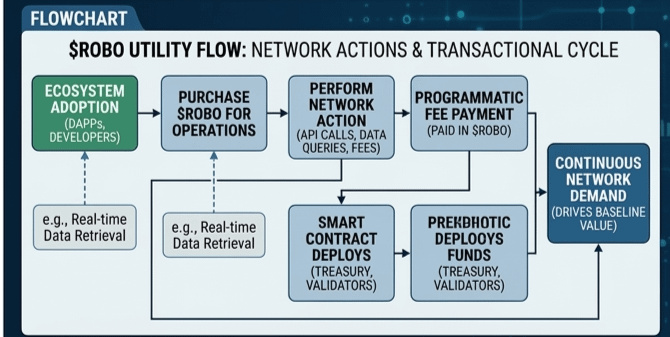
This mechanism creates a baseline operational demand. Regardless of whether the broader cryptocurrency market is experiencing a bullish or bearish phase, developers building on the platform must continually purchase and spend Robo coin to maintain their applications. This fundamental utility transforms the token from a speculative trading instrument into a software license and a medium of computational exchange.
Earning Rewards: Passive Holding Versus Verified Work
Perhaps the most transparent and critical section of the whitepaper deals with how participants earn rewards within the network. Traditional decentralized finance often relies heavily on passive holding, where users lock their tokens in a vault and earn a yield simply for restricting the circulating supply. While this can artificially support price action in the short term, it does not inherently build long-term network value.
The Robo coin fabric foudesion protocol takes a fundamentally different approach by clearly distinguishing between passive holding and verified work. The smart contract is coded to heavily favor the latter. While there may be minor foundational incentives for providing baseline liquidity, the substantial block rewards and fee distributions are cryptographically reserved for nodes and users who perform verifiable work.
Verified work means actively contributing computational power, validating data sets, or providing reliable uptime for network API endpoints. For instance, a user who operates a node that actively processes the data queries requested by developers will earn $ROBO directly from the network fees generated by those queries. This creates a closed-loop economy. The reward mechanism requires mathematical proof of contribution before dispensing tokens, which significantly mitigates the inflationary pressure caused by passive staking models. It is a meritocratic system enforced directly by the code.
Trading Review and Market Dynamics
From a trading perspective, analyzing Robo coin requires looking past typical retail chart patterns and focusing heavily on network usage metrics. Because the token is directly tied to API calls and network fees, its velocity how often it is utilized and changes hands within the network is a far more accurate indicator of its health than its daily speculative trading volume on centralized exchanges.
In my observation of similar utility-driven assets, the price action tends to be less volatile but more securely floored by its baseline utility value. Traders and investors should monitor the volume of verified work being executed and the frequency of data queries on the network. An increase in ecosystem adoption directly translates to programmatic buying pressure, as developers must acquire tokens to fuel their daily operations. Conversely, if network activity stalls, the speculative premium will inevitably evaporate, leaving the asset to rely solely on its baseline utility. Transparency is paramount here: this is an asset suited for individuals willing to track on-chain data and developer adoption, rather than relying on market sentiment.
Final Thoughts
The Robo coin whitepaper and its accompanying smart contract present a logical, mathematically sound framework for a utility-driven digital economy. By allocating a precise 29.7% to ecosystem growth, tying the token directly to API and data query fees, and strictly prioritizing verified computational work over passive holding, the architecture supports sustainable growth over short-term market hype. It is a system that demands active participation and real-world usage to thrive.
Disclaimer: This article is for informational, educational, and analytical purposes only and does not constitute financial, investment, or trading advice. Cryptocurrency markets are highly volatile, and interacting with smart contracts involves significant technical and financial risk. Always conduct your own independent research, review the open-source smart contract code, and consult with a certified financial professional before making any investment decisions.