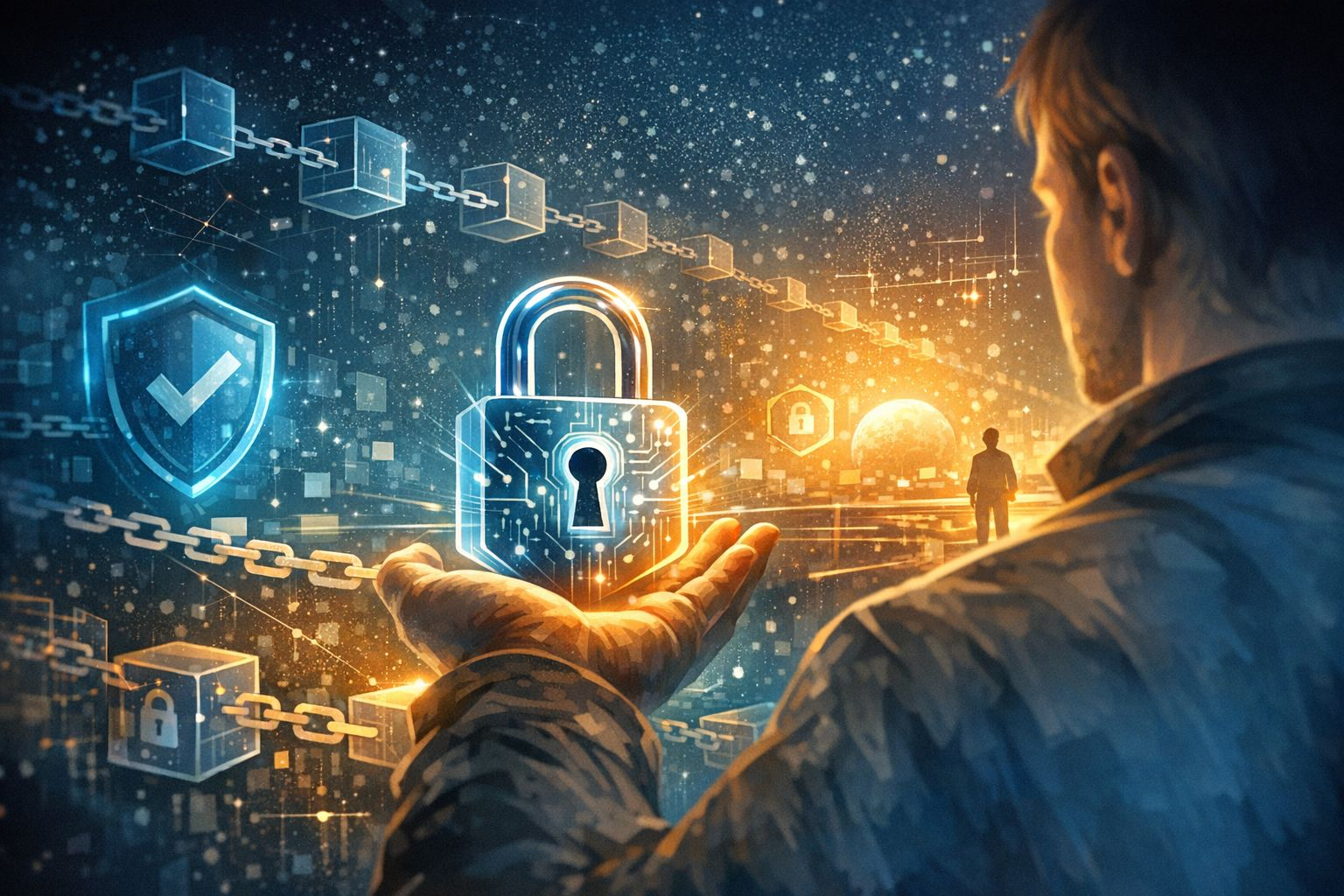
For a long time, the internet has asked people to trade privacy for convenience. Every time someone signs up for a platform, sends money online, or verifies their identity, pieces of personal information are usually shared and stored somewhere. Over time those pieces turn into massive databases controlled by companies, governments, and institutions. While this system helped the internet grow quickly, it also created a world where personal data often feels fragile. Breaches happen, identities are exposed, and people rarely have full control over how their information moves across the digital world. In this environment, the idea behind zero-knowledge proof technology feels almost like a quiet revolution. It asks a simple but powerful question: what if people could prove something is true without revealing the data behind it?
This idea sits at the heart of a new generation of blockchain technology built around zero-knowledge cryptography. At first, the concept sounds almost paradoxical. Proving something usually means showing the evidence. But zero-knowledge proofs change that logic. Instead of revealing the data itself, a person or a system can generate a mathematical proof that confirms the statement is true. The verifier checks the proof, becomes convinced that the claim is valid, and yet learns nothing about the hidden information that produced that proof. It is like confirming someone knows the answer to a puzzle without ever seeing the answer written down. The truth becomes visible, but the secret remains protected.
To understand why this matters so much, it helps to look at the early design of blockchain networks. When blockchain first appeared, its biggest innovation was transparency. A distributed network of computers could maintain a shared ledger of transactions, and anyone in the world could verify that the records were correct. This openness created trust between strangers. Instead of relying on banks or central authorities, the system relied on mathematics and consensus. But transparency also meant that every transaction lived permanently on a public record. Even if users were identified only by wallet addresses, patterns could reveal surprising details about financial behavior, spending habits, and connections between people.
Over time, many users and developers realized that complete transparency was not always healthy. Financial activity is deeply personal, and businesses often need confidentiality to operate safely. The world needed a way to keep the trustless verification that blockchains provide while protecting the privacy that people expect in real life. Zero-knowledge technology emerged as one of the most elegant solutions to that problem.
When a blockchain integrates zero-knowledge proofs, it changes how the system verifies transactions. Instead of exposing every detail, the network receives a compact proof confirming that the transaction follows all the rules. The proof shows that the sender has enough balance, that the transaction is legitimate, and that no coins are created out of thin air. But the sensitive details remain hidden from the public ledger. The network knows the transaction is valid, yet it never sees the private information behind it. It is a subtle shift in design, but it changes the experience of using blockchain in profound ways.
Interestingly, the roots of zero-knowledge proofs go back decades before blockchain technology existed. Cryptographers in the 1980s explored the idea while studying secure communication systems. At the time it was mostly theoretical work. The mathematics was fascinating, but applying it to real systems seemed difficult and expensive. Generating proofs required heavy computation, and the technology remained largely inside academic circles for years. As computing power improved and cryptographic research advanced, developers slowly began to experiment with turning those theories into practical tools.
The first real breakthroughs appeared in privacy-focused digital currencies. These systems showed that transactions could be verified without revealing the sender, receiver, or amount involved. For many people in the blockchain community, this was the moment when zero-knowledge technology stopped being an abstract concept and became a living part of the ecosystem. It proved that privacy and security did not need to be enemies. The two could exist together if the underlying mathematics was strong enough.
But as the technology matured, developers realized its potential went far beyond private payments. One of the biggest challenges facing blockchain networks has always been scalability. When millions of users want to interact with a network, processing every transaction individually can slow things down. Zero-knowledge systems offer a clever workaround. Instead of verifying each action separately, thousands of transactions can be grouped together and processed off-chain. Once processed, a single proof is created that represents the entire batch. The blockchain only needs to verify that one proof to confirm that every transaction inside it was valid.
This ability to compress large amounts of activity into a small proof transforms how blockchains operate. It allows networks to grow without becoming slow or expensive. Verification becomes simple, even if the underlying computation is complex. In a sense, the blockchain evolves from a system that records every detail into a system that verifies the truth of results. The heavy lifting happens somewhere else, but the proof guarantees that nothing dishonest occurred.
Another area where zero-knowledge technology could reshape the digital world is identity. Today, proving who you are online often means sharing far more information than necessary. When signing up for services, people frequently provide names, addresses, identification numbers, and other sensitive details. Those details are then stored in centralized systems that may eventually be hacked or misused. With zero-knowledge systems, identity verification could work differently. Instead of sharing raw data, a user could generate a proof confirming a specific fact. For example, someone could prove they are above a certain age, hold a specific credential, or meet regulatory requirements without revealing their full identity.
This approach places control back in the hands of individuals. Personal information no longer needs to travel across multiple platforms just to confirm simple facts. The user keeps the data, and the network only receives a proof about it. Over time, this could reshape the relationship between people and digital services. Trust would rely less on storing sensitive information and more on verifying mathematical proofs.
The possibilities extend even further when zero-knowledge systems interact with other emerging technologies. Artificial intelligence, for example, often produces results that are difficult to verify. When an AI system processes complex data or generates predictions, users must often trust that the computation was performed correctly. Zero-knowledge proofs could allow those computations to be verified mathematically. A system could produce a proof showing that it followed a specific model or dataset without revealing the underlying data itself. This could create more transparent and trustworthy AI systems while protecting sensitive information.
Despite all this promise, the technology is still evolving. Generating proofs can require significant computational resources, and researchers continue working to make the process faster and more efficient. New proof systems are constantly being developed, each designed to reduce costs and improve scalability. What once required specialized infrastructure is gradually becoming easier for developers to implement and for users to interact with.
The long-term vision behind zero-knowledge blockchain systems is surprisingly simple. It imagines a digital world where verification does not require exposure. People can interact, transact, and collaborate while keeping ownership of their information. Financial systems remain transparent enough to maintain trust, yet private enough to protect individuals. Identity becomes something users control rather than something stored in distant databases.
When people first encounter zero-knowledge proofs, the concept can feel almost magical. The idea of proving something without revealing the underlying information challenges our instincts about how knowledge works. Yet the mathematics behind it is solid, and its applications continue to grow. What began as a theoretical exploration by cryptographers has slowly become one of the most important building blocks for the future of blockchain technology.
In many ways, this technology reflects a deeper shift in how society thinks about trust in the digital age. Instead of asking people to reveal everything in order to prove honesty, systems built on zero-knowledge principles allow honesty to be demonstrated without unnecessary exposure. The proof becomes enough. And in a world where data has become one of the most valuable and vulnerable resources, that simple idea may reshape how digital trust is built for generations to come.