For a long time, machines lived simple lives in the human world. They were built to help us finish difficult work faster. In factories they assembled cars and electronics with perfect precision. In warehouses they lifted heavy boxes that would have exhausted any human worker. On farms they helped plant and harvest crops. Yet no matter how advanced these machines became, they always remained tools. They followed instructions, completed tasks, and stopped when their job was finished. They did not communicate with other machines outside their own systems, and they certainly did not take part in any kind of economic life. Everything they did was controlled by the people who owned them.
But technology rarely stands still. Over the last decade something interesting has started to happen. Artificial intelligence has slowly given machines the ability to understand more about the world around them. Robots can now recognize objects, navigate complex environments, and learn patterns from data. Some can deliver packages, inspect bridges, monitor farms, or help doctors inside hospitals. These machines are no longer limited to factory floors. They are beginning to move into everyday life, quietly becoming part of the systems that keep modern society running.
As robots become more capable, a deeper question begins to appear. If millions of intelligent machines are going to operate around the world, how will they coordinate with humans and with each other? How will people trust that machines are doing exactly what they claim to do? And how can robots built by different companies communicate or cooperate instead of being trapped inside separate corporate systems?
These questions form the foundation of the idea behind Fabric Protocol.
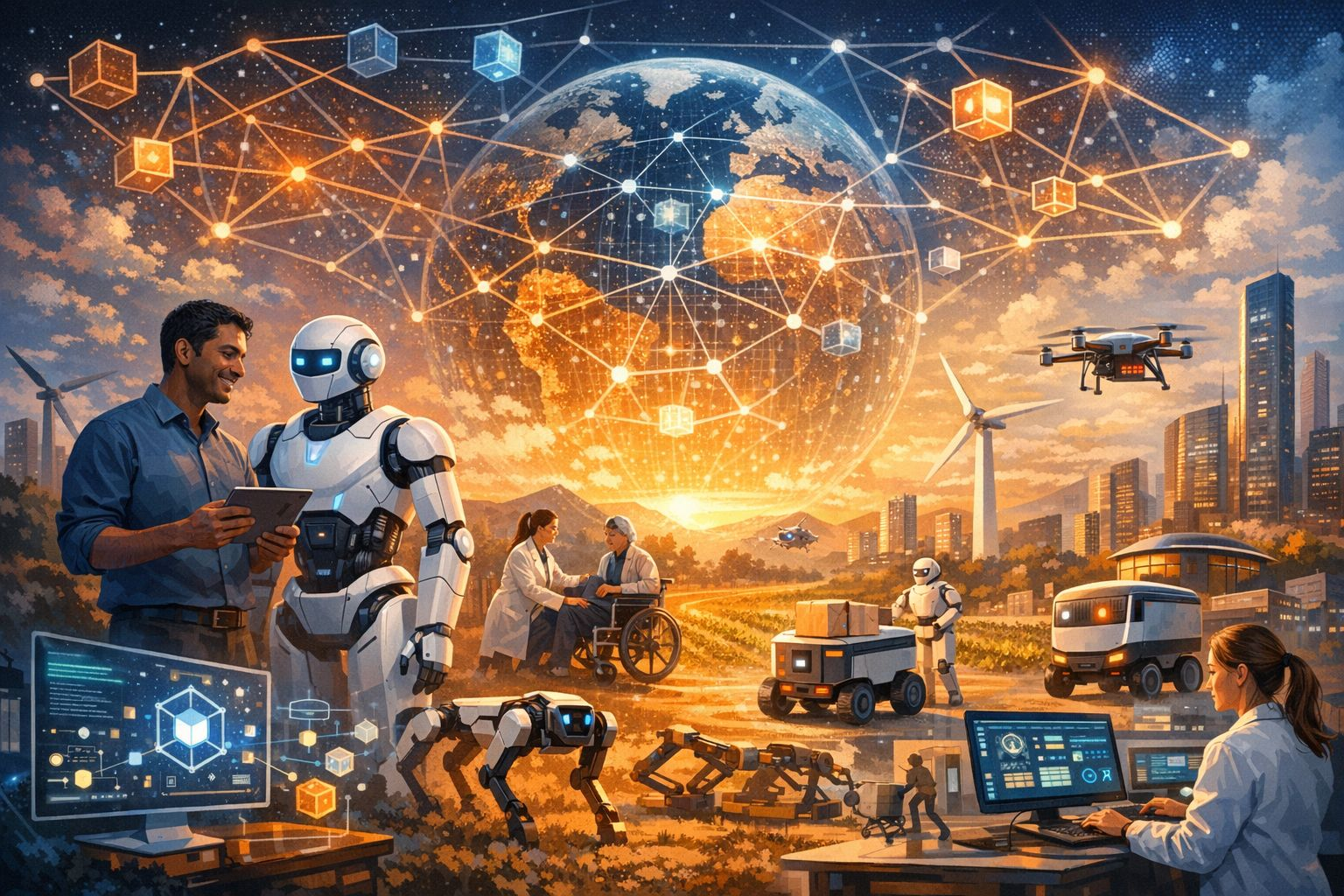
Fabric Protocol is not simply another robotics project or a single product. It is an attempt to create a shared digital environment where robots, developers, and humans can collaborate openly. Instead of imagining a future where each robotics company builds its own closed ecosystem, Fabric imagines a global network where machines from different places can interact, share information, and perform tasks together in a transparent way. It is almost like building an internet designed specifically for robots.
Today, most robotic systems exist inside isolated environments. A robot built by one company often cannot easily communicate with systems created by another. Data is stored privately, decisions are controlled centrally, and the internal processes of these machines remain hidden from everyone outside the organization that owns them. While this model works for individual companies, it slows down innovation and makes large-scale cooperation between machines extremely difficult.
Fabric Protocol tries to approach the problem from a different direction. Instead of concentrating control in one place, it creates a decentralized network where trust is built through transparent technology. By using blockchain infrastructure, the protocol allows robots to have digital identities, record their actions, and coordinate tasks through shared systems that anyone can observe and verify.
In this environment, a robot is not just a device performing instructions. It becomes a participant in a larger network.
One of the most interesting ideas within Fabric Protocol is the concept of verifiable computing. In simple terms, this means that machines should be able to prove that they actually performed the tasks they claim to have completed. In traditional systems, if a robot reports that it inspected a building or delivered an item, people must trust the system that produced that report. There is often no transparent way for others to confirm whether the process truly happened as described.
Fabric introduces mechanisms where important actions and computational processes can be verified within the network. When a robot performs a task, the result can be recorded on a public ledger, creating a permanent and transparent record of what happened. This helps build trust, especially when robots are performing work that has economic value.
This leads to another important idea behind the network: the possibility of a machine economy.
As robots become more capable, they will increasingly perform real tasks that create value in the world. They might deliver goods, collect environmental data, inspect infrastructure, or assist in complex industrial operations. But if machines are doing work, there must also be a way for them to receive tasks and be rewarded for completing them. Traditional financial systems were designed for humans and companies, not for autonomous machines.
Fabric Protocol introduces the ROBO token to help solve this challenge. Within the ecosystem, ROBO acts as the economic layer that supports interactions between participants. It allows tasks to be assigned, rewards to be distributed, and transactions to happen automatically within the network. When a robot completes verified work, it can receive compensation through the system, creating an automated and transparent process that does not rely on centralized intermediaries.
This may sound like a futuristic concept, but it is really an extension of ideas that already exist in digital economies. Just as people use decentralized systems to exchange value online, Fabric imagines a world where machines can also interact within similar frameworks.
Behind the development of this vision is the Fabric Foundation, a non-profit organization dedicated to maintaining the openness and integrity of the ecosystem. The foundation focuses on research, development, and long-term governance of the network. Its role is to ensure that the infrastructure remains transparent and accessible to developers, researchers, and communities around the world.
This approach reflects an important philosophy. The future of robotics will likely affect everyone, not just the companies building machines. If robotic infrastructure becomes too centralized, the benefits may remain concentrated in a small number of organizations. By contrast, an open network allows people from different countries and industries to contribute ideas, build applications, and shape how intelligent machines interact with society.
The long-term vision behind Fabric Protocol reaches even further. The creators of the project imagine a future where robots form a connected global ecosystem sometimes described as the “internet of robots.” In such a world, machines would not operate as isolated devices. They would communicate, share capabilities, and coordinate tasks across networks that span cities and industries.
A drone monitoring farmland could share environmental data with climate research systems. A delivery robot might accept tasks from multiple logistics platforms rather than belonging to a single company. Service robots in hospitals could learn from shared datasets that improve their ability to assist doctors and nurses.
In this type of environment, robots would not replace humans but collaborate with them in new ways. Humans would continue to design systems, create ideas, and guide technological development. Machines would handle physical tasks, data collection, and operations that require constant attention or precision. The network would coordinate these interactions, ensuring transparency and fairness.
Of course, the road toward this vision will take time. Robotics technology still faces many technical challenges. Machines must operate safely in unpredictable environments, maintain reliable energy systems, and interact with people in ways that feel comfortable and natural. Building a decentralized infrastructure capable of supporting millions of machines will also require careful engineering and global cooperation.
Yet the direction of progress is clear. Artificial intelligence continues to improve, robotics hardware is becoming more capable, and decentralized technologies are opening new possibilities for coordination. Fabric Protocol sits at the intersection of these developments, attempting to build the foundation for a future that has not fully arrived yet.
Perhaps the most interesting thing about this project is not the technology itself but the shift in perspective it represents. For generations, machines have existed as silent tools that obey human instructions. Fabric imagines a world where machines become active participants in networks of cooperation, where their actions are transparent, their work is verifiable, and their contributions can be integrated into systems that benefit everyone.
@Fabric Foundation #ROBO $ROBO