
I’ve noticed that discussions around blockchain often stay inside the digital world. Tokens move between wallets, smart contracts execute code, and decentralized networks maintain ledgers of transactions. But the moment those systems start interacting with the physical world, the conversation becomes more complicated. Sensors, machines, and connected devices operate under very different constraints than purely digital systems. That’s part of what made me curious about how Robo Coin attempts to integrate with IoT devices.
The Internet of Things has been expanding quietly for years. Factories rely on sensor networks to monitor equipment. Logistics companies track shipments using connected devices. Cities deploy smart infrastructure to measure traffic patterns, environmental conditions, and energy usage. Each of these systems generates streams of data about physical processes.
The challenge is not collecting the data. The challenge is deciding how that data is trusted and shared.
Most IoT networks today rely on centralized infrastructure. Devices send information to a central platform where it is stored, analyzed, and interpreted. That architecture is efficient because it allows one organization to control the system. But it also means that the records produced by those devices depend heavily on the operator maintaining the platform.
As connected devices become more widely distributed, that model begins to show its limitations.
Imagine sensors deployed across supply chains owned by different companies, or robotic systems operating in environments where multiple vendors contribute machines and devices. In those cases, the data generated by IoT systems may influence decisions across organizations. When that happens, the question of verification becomes more important.
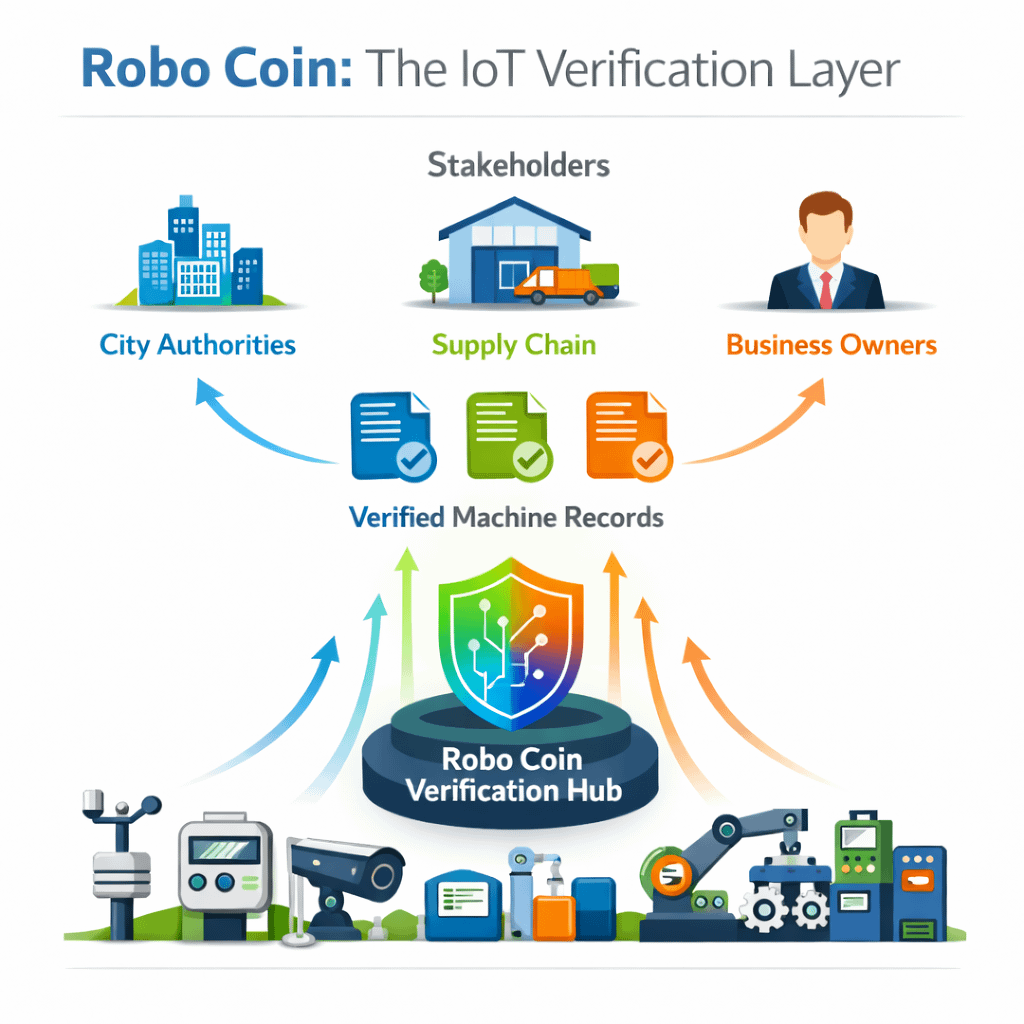
This is where Robo Coin’s approach starts to look interesting to me.
Instead of focusing only on financial transactions, the project appears to position itself around the verification of machine activity. IoT devices and robotic systems can generate data about tasks performed, environmental conditions, and operational outcomes. Through a decentralized infrastructure, those records can potentially be validated in ways that multiple participants recognize.
From my perspective, this idea reframes the role of blockchain in IoT environments.
Rather than acting as a control system for devices, the network functions more like a verification layer. Machines continue operating within their local environments, responding to sensors and executing tasks. The blockchain infrastructure records the outcomes of those activities in a way that can be independently confirmed.
Still, integrating IoT systems with decentralized networks is not straightforward.
Connected devices often operate under strict hardware constraints. Many sensors have limited processing power and energy resources. Expecting those devices to interact directly with blockchain infrastructure could create performance challenges.
This is why many architectures separate device operation from verification layers. IoT systems generate data locally, and specialized gateways or middleware systems transmit relevant records to decentralized networks. That approach allows the devices themselves to remain lightweight while still participating in broader verification frameworks.
Even with that structure, several practical questions remain.
Data integrity becomes critical. Sensors can malfunction, produce inaccurate readings, or be manipulated. Verification mechanisms must account for these possibilities without overwhelming the system with complexity. Incentive structures also need to align with the real economics of operating IoT devices.
I also think about scalability. IoT networks can generate massive volumes of data. Recording every sensor reading on a blockchain would quickly become impractical. Systems must decide which events are important enough to verify and record.
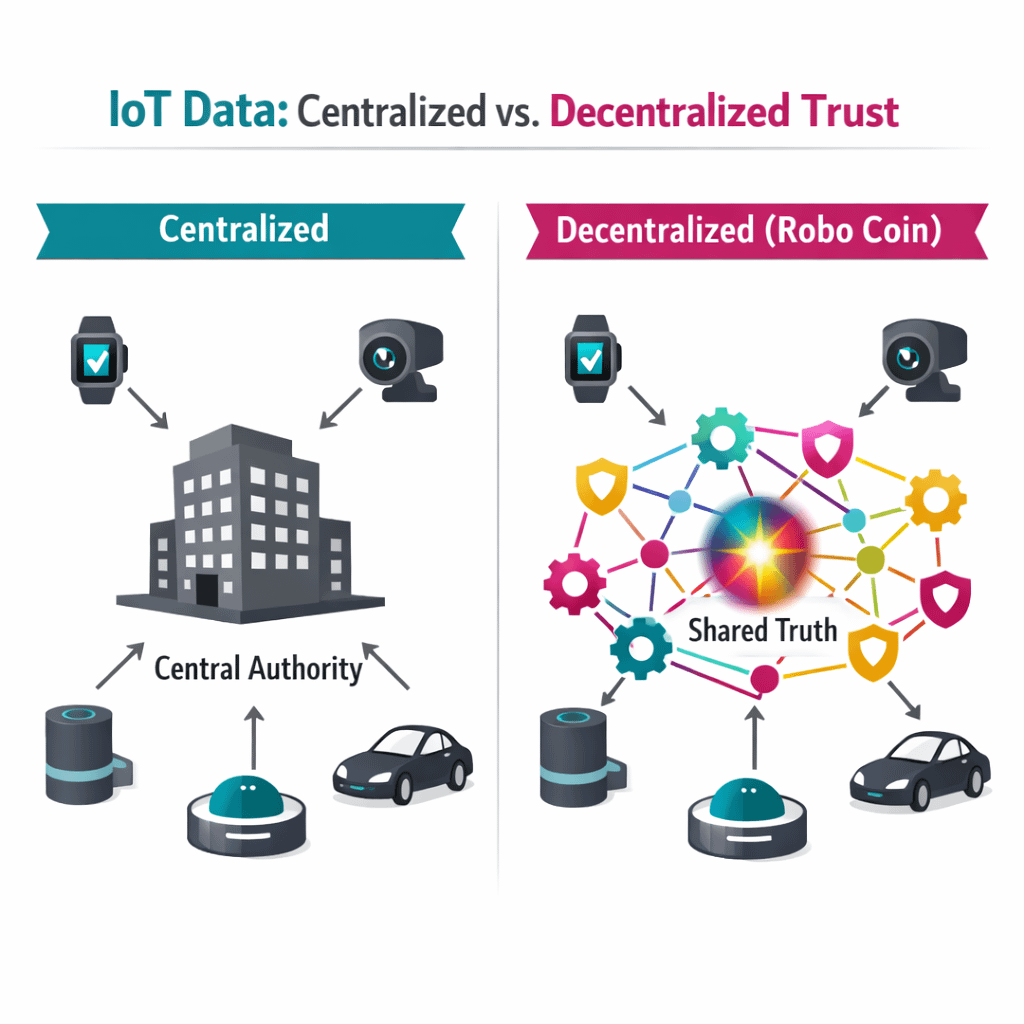
What keeps the concept compelling is the broader direction technology seems to be moving.
Physical infrastructure is becoming increasingly digital. Machines communicate with each other, sensors track environmental conditions continuously, and automated systems coordinate operations across industries. As these networks expand, the data they produce becomes more valuable and more influential.
If that data remains locked inside centralized platforms, coordination across organizations may remain limited.
But if machine-generated records can be verified through shared infrastructure, new forms of collaboration could emerge. Logistics networks, robotics ecosystems, and industrial IoT systems might eventually rely on neutral verification layers rather than trusting individual platform operators.
Whether Robo Coin ultimately becomes part of that infrastructure remains uncertain. Integrating blockchain systems with IoT environments requires careful engineering and real-world experimentation.
For now, I see Robo Coin’s integration with IoT devices less as a finished solution and more as an exploration of how decentralized verification might connect digital networks to the physical machines generating data around us. As the number of connected devices continues to grow, the need to trust the information they produce may become increasingly important.
And if that happens, the systems responsible for verifying those machine-generated records could quietly become some of the most important infrastructure in the connected world.