
I have watched enough tokens rip on no volume to know that when volume expands faster than price, the market is sorting something out quietly. ROBO closed today at 0.04492 USDT, up 4.95 percent in the last 24 hours, with an intraday range between 0.04237 and 0.05018. That price move is fine, but it is not the part that made me pause. What caught my attention was the volume explosion. ROBO printed 510 million tokens traded in 24 hours, which at current price translates to roughly 23.44 million USDT. That is a forty percent jump from yesterday's 15.86 million USDT, and it arrived while price only moved five percent. Volume expanding that fast while price stays relatively calm usually means one of two things. Either accumulation is happening ahead of information the broader market does not have yet, or the token is being repriced by participants who care more about Fabric Protocol's structural positioning than they do about short term chart momentum. I am leaning toward the latter, and here is why that matters for anyone tracking ROBO as more than just another AI robotics narrative play.
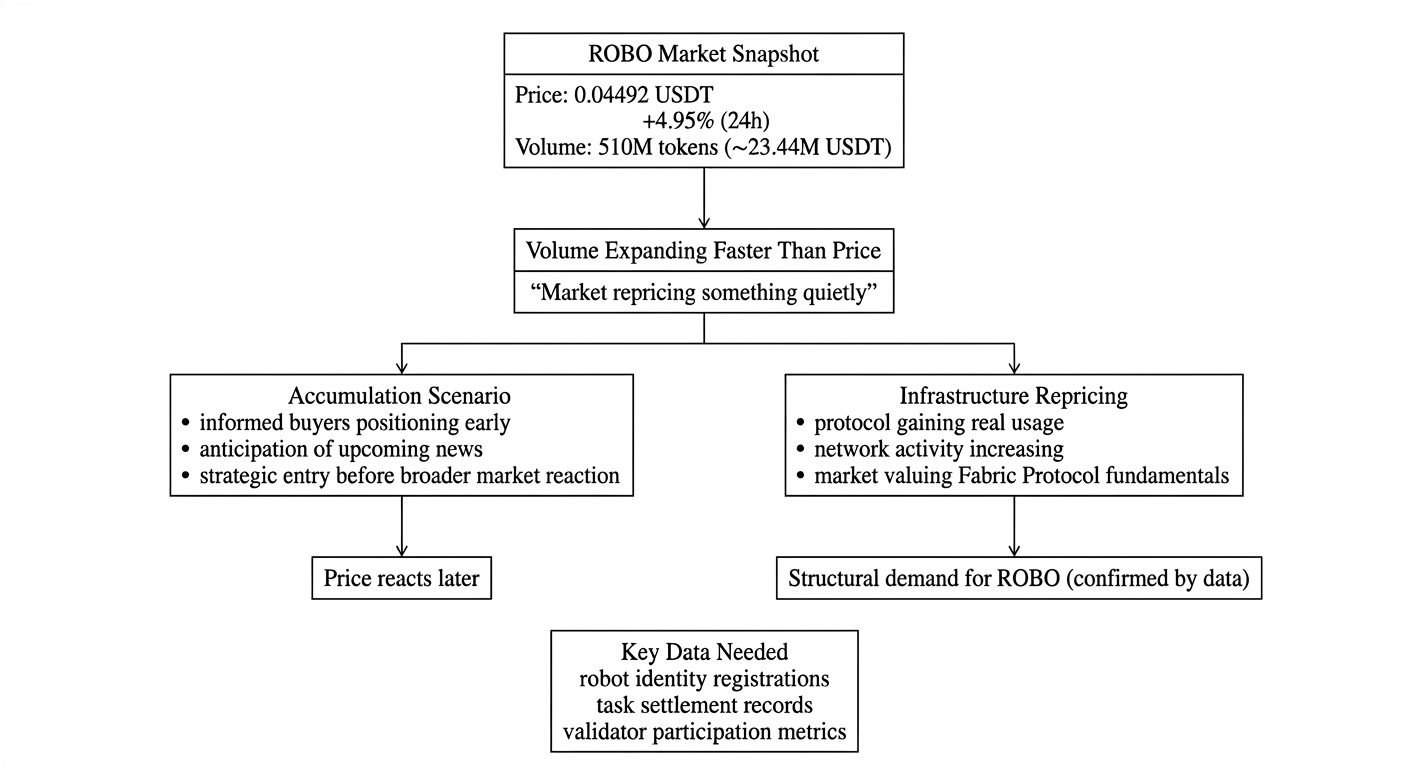
Fabric Foundation is not pitching ROBO as governance theater or staking yield. The whitepaper frames the network as infrastructure designed to coordinate data, computation, and oversight through public ledgers rather than closed corporate stacks, with ROBO functioning as the token used for network fees, identity verification, staking, and governance. That sounds abstract until you think about what it actually means in practice. Autonomous systems generate messy internal state. Sensor streams, model outputs, operator interventions, edge case decisions that are too heavy, too sensitive, or too chaotic to put directly onchain. But markets still need some compressed proof layer that shows what got executed, what risk was taken, and whether the result was legitimate. Fabric seems to be building exactly that compression layer. Keep the machine side complexity where it belongs, but expose enough identity, task settlement, validation, and policy logic onchain that people can inspect outcomes instead of just believing the operator. That is the shift from private data to public proof, and it is the reason I think volume expansion today is not just noise.
The technical setup is improving in ways that suggest buyers are defending a base. ROBO reclaimed and is holding above the EMA 20 at 0.04348, which tells me short term momentum has shifted back toward accumulation. The RSI at 54.73609 is sitting in neutral territory, not overbought but also not showing signs of exhaustion. The MACD is starting to curl positive with a value of 0.00049, which is early but suggests momentum could be building underneath price. The moving averages are compressing with the MA 5 at 76.14 million and MA 10 at 74.34 million tokens, which usually precedes either a breakout or a breakdown depending on which direction volume tips the scale. Right now, volume is tipping decisively toward expansion, and that makes me think the next move could be larger than the five percent we saw today. But here is the part I keep circling back to. Volume without retention fades fast in crypto. If this expansion is just speculative repositioning after the launch cycle cooled off, then ROBO risks giving back these gains as quickly as it made them. If this expansion is tied to actual network activity that Fabric Foundation has not publicized yet, then we might be seeing the early signal that retention is starting to show up onchain where it matters.
That distinction is critical because Fabric Protocol is positioning itself as infrastructure for accountability in autonomous systems, not as a meme coin or a Layer 1 competing on transaction speed. The Fabric Foundation roadmap for 2026 moves from identity, task settlement, and structured data collection in early 2026 toward verified task execution, broader data submission, repeated usage, and larger data pipelines later in the year. That sequencing tells me the team understands that one successful robot action is not the asset. The retained record of repeatable, validated actions is the asset. Traders should care because retained proof is what turns a story into something the market can reprice over multiple quarters instead of one listing cycle. But retained proof only matters if it actually accumulates, and right now I do not have the onchain metrics that would let me verify whether robots are registering identities, whether tasks are settling, whether validators are participating, or whether the x402 protocol integration with Circle is processing meaningful USDC transaction volume. Without those numbers, I am left interpreting volume and price action, which is a weaker signal than I would like for a token positioning itself as critical infrastructure.
The allocation structure also tells me to stay cautious about supply pressure over the next year. Fabric allocated 29.7 percent of ROBO to ecosystem and community, 24.3 percent to investors, 20 percent to team and advisors, and 18 percent to foundation reserve, with much of that supply locked under cliff and vesting schedules. The circulating supply is currently around 2.23 billion tokens out of a 10 billion maximum, which means roughly 78 percent of total supply is still locked. That is fine for price stability in the short term, but it also means that as vesting unlocks start hitting the market in late 2026 and into 2027, ROBO will need genuine demand from network usage to absorb that supply without collapsing. Volume expansion today is encouraging, but volume expansion in a bull cycle is easy. The harder test is whether ROBO can sustain liquidity and usage during quieter market conditions, and whether Fabric Foundation can prove that the network is growing organically rather than just riding the broader crypto narrative about AI and robotics.
Here is where I still have friction with the Fabric story. The whitepaper is honest about the fact that several design parameters are still open, including how sub-economies are defined, what metrics should count as non-gameable success, and whether the initial validator set starts permissioned, permissionless, or hybrid. The document also admits that revenue can be faked through self dealing among robots, which is exactly the kind of sentence I actually like seeing because at least it means they are looking at the right failure modes. But it also means nobody should pretend this is solved. If the verification layer is weak, if the evidence trail is too thin, or if retained records become expensive and fragmented, then public proof becomes branding instead of infrastructure. The other thing I am watching is incentive quality. Fabric says rewards are tied to verified work, data contributions, compute, and validation, and it explicitly contrasts that with passive proof of stake style reward models. Good. In theory, that should push value toward actual service and away from idle capital. But incentives can still get weird. If participants optimize for whatever is easiest to verify rather than whatever is economically meaningful, you end up with clean proofs of low value activity. I have seen versions of that across crypto enough times to know it is not a side issue. It is the issue.
The governance question is also unresolved, and I think that matters more than most traders are pricing in. Fabric's whitepaper says token holders can signal on network upgrades and protocol parameters, but it also says governance rights do not extend broadly beyond protocol operations, and that early stage decision making may involve a limited set of stakeholders. That language tells me that in practice, governance over Fabric Protocol is likely centralized for now, with the foundation or a small coalition of early participants making the decisions that actually shape the network. I am not saying that is wrong. Early stage protocols often need tighter control to avoid governance gridlock or attack vectors. But if you are buying ROBO thinking you are getting meaningful governance influence, you should read the fine print carefully, because the token may not give you the power you think it does. What ROBO does give you is exposure to network growth if Fabric Foundation executes, and exposure to dilution if they do not. That is the trade, and traders should price it accordingly.
So what would change my mind in either direction? If Fabric Foundation publishes transparent onchain metrics in the next two to four weeks showing hundreds of robots registered, thousands of tasks settled, and growing validator participation, then this volume expansion starts looking like early positioning ahead of a retention breakout. If we see sustained daily volume above 20 million USDT without needing constant new catalysts, that tells me there is genuine two-sided interest in ROBO beyond just launch week speculation. If the price can hold above the EMA 20 and build a base in the mid 0.04s while volume stays elevated, then technically we are setting up for a move toward the 0.05 level we tested earlier today and potentially a push toward the mid 0.05s if momentum compounds. On the other hand, if Fabric Foundation stays quiet on metrics, if volume fades back below 15 million USDT, or if governance decisions continue happening behind closed doors without transparency, then I start worrying that ROBO is infrastructure in name only, and that the real control and value capture is happening at the foundation level rather than at the token holder level.
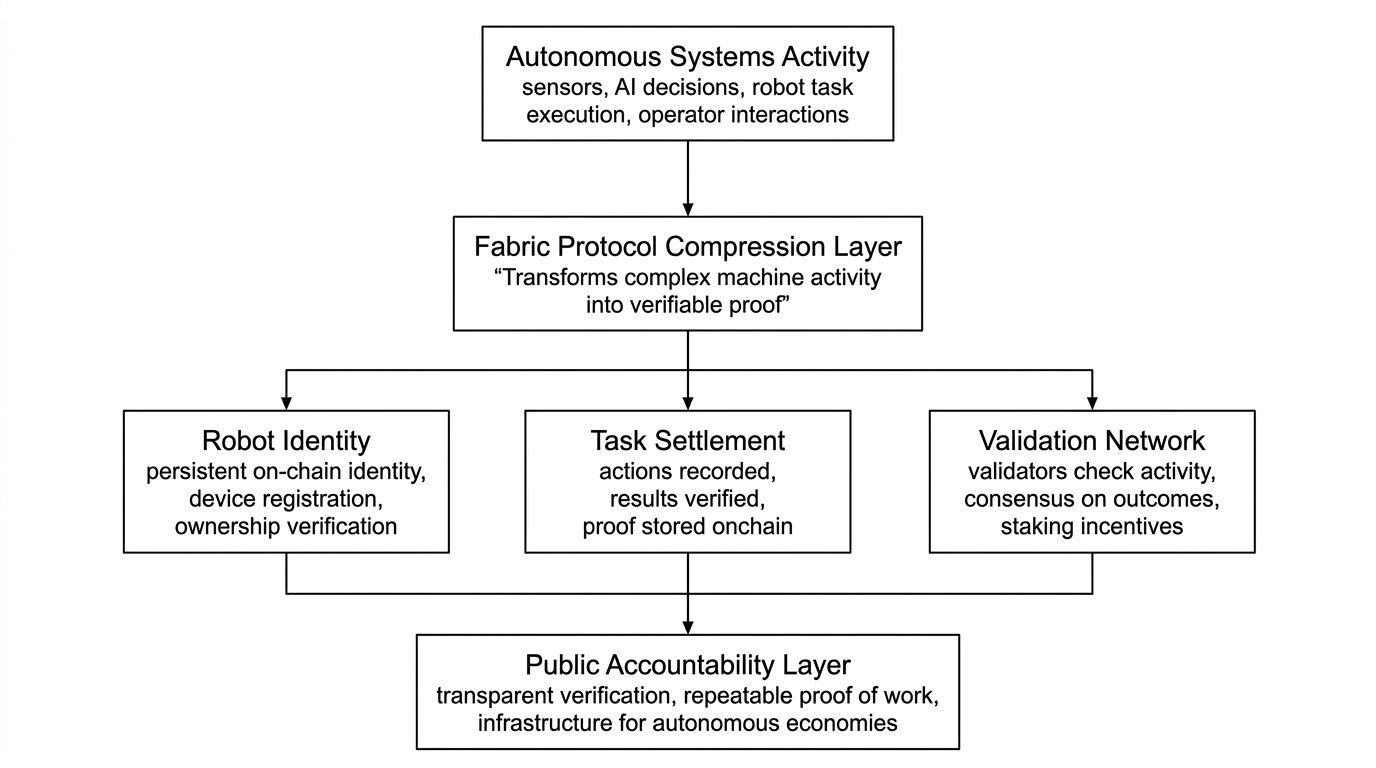
For now, I am watching ROBO with more conviction than I was two days ago. The volume expansion is real, the technical setup is improving, and the project is positioned in a sector that could genuinely matter if robotics adoption accelerates over the next few years. But I am not confusing potential with proof. Fabric Protocol is still early, the metrics are still opaque, and the governance structure is still centralized. That does not make ROBO uninvestable. It makes it a bet on whether Fabric Foundation can turn a compelling vision into a network that people actually use, and whether they can do it fast enough to justify the current valuation before vesting unlocks start pressuring price. The token is up today, volume is surging, and the chart looks better than it has in days. What happens next depends on whether Fabric Foundation can show us the retention data that proves this is not just another well packaged idea waiting for the next narrative cycle. Track whether retained proof is actually accumulating, whether repeated verified work starts to matter more than launch volume, and whether the accountability layer becomes harder to fake over time. Watch it like a trader, not a fan, because in this sector the winners will not be the loudest machines. They will be the ones that can prove what they did and keep proving it.
#ROBO $ROBO @Fabric Foundation
