

The more time I spend exploring emerging technologies, the more I realize that robotics still lives in a surprisingly closed world. Most robots today operate inside systems designed and controlled by a single company. The hardware, the software, the data flow everything sits inside one ecosystem. That approach works well in factories or controlled environments, but it starts to feel limiting when robots move into real-world settings where machines from different organizations need to interact.
As AI continues to improve, robots are slowly becoming more autonomous. They can observe, make decisions, and act without constant human supervision. But that raises a deeper question that doesn’t get discussed enough: how do we verify what these machines are actually doing? If an AI-driven robot makes a decision that leads to a mistake, how do we trace that decision? And if multiple machines interact in the same environment, how do we coordinate them safely without relying on a single authority controlling everything?
These questions were on my mind when I started researching projects working at the intersection of robotics and decentralized infrastructure. One project that caught my attention during that process was Fabric Protocol.
What I found interesting about Fabric is that it doesn’t focus on building robots themselves. Instead, it focuses on something more foundational: the infrastructure that allows robots and autonomous agents to interact, coordinate, and evolve within a shared network.
Fabric Protocol is supported by the non-profit Fabric Foundation and is designed as an open global network. Rather than treating robots as isolated machines controlled by private systems, the protocol treats them as “agents” that can operate within a broader ecosystem. These agents can exchange information, request computational resources, and coordinate actions through a common infrastructure.
If that sounds abstract at first, it helps to think about how the internet works. Before common communication standards existed, computers built by different companies struggled to interact. The internet created shared protocols that allowed machines to communicate regardless of who built them. Fabric seems to be exploring a similar idea, but for robotics and autonomous systems.
One of the biggest challenges in AI and robotics today is the lack of transparency behind machine decisions. Many AI systems operate like black boxes. We see the result, but the reasoning process that produced it is often difficult to inspect or verify. That becomes especially problematic when machines start making decisions in physical environments.
Fabric approaches this challenge through something called verifiable computing. In simple terms, it means that actions performed by robotic agents can be validated by the network. Instead of trusting that a machine behaved correctly, the system provides a way to verify the computational process behind its actions.
To coordinate these activities, the network uses a public ledger that records proofs and coordination signals between participants. Importantly, the ledger does not attempt to store every piece of raw robotics data. That would be impractical. Instead, it focuses on recording the information necessary to verify actions and maintain transparency across the network.
Another design choice that stands out is the protocol’s modular structure. Fabric isn’t designed as a rigid framework that forces developers to adopt everything at once. Instead, it offers a set of infrastructure components that handle different roles within the network. Some modules manage validation, others coordinate computation, and others help agents communicate with each other. Developers can integrate the pieces they need while still remaining compatible with the broader ecosystem.
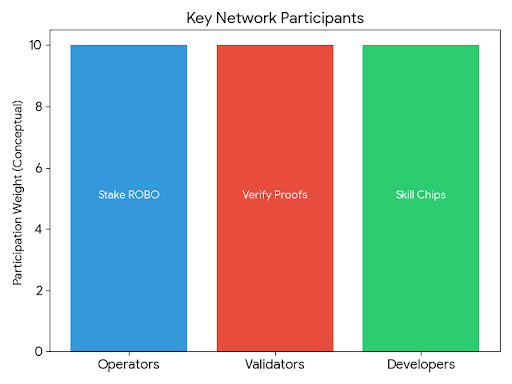
Like many decentralized systems, Fabric also introduces economic incentives to help keep the network reliable. Participants who provide resources — such as computation, validation, or coordination services — may need to stake tokens in order to take part in certain roles. This staking mechanism creates accountability. If participants behave dishonestly or fail to fulfill their responsibilities, the system can penalize them economically.
This type of structure is common in proof-of-stake blockchain networks, where financial incentives help maintain system integrity. In Fabric’s case, the token functions more as a coordination tool rather than the center of the narrative. Its purpose is to align incentives between participants and ensure that the network operates reliably.
Looking at the bigger picture, Fabric Protocol sits at an interesting intersection of technological trends. Artificial intelligence is becoming more capable of autonomous decision-making. Robotics is expanding into industries like logistics, healthcare, research, and public infrastructure. At the same time, decentralized networks are increasingly being used to coordinate distributed systems.
When these trends begin to overlap, the need for shared coordination infrastructure becomes more obvious. If autonomous machines from different organizations are expected to operate within the same environments, they will need systems that allow them to exchange information, verify outcomes, and maintain accountability.
Fabric appears to be exploring that possibility.
While researching the project, I spent time reading through documentation and observing discussions within the community. One thing that stood out was the type of conversations taking place. Many of the discussions revolve around infrastructure design, verification models, and validator responsibilities rather than short-term price speculation. For early-stage infrastructure projects, that kind of focus often indicates that participants are more interested in building the system than simply trading around it.
Of course, the project still faces several challenges.
Robotics systems generate large volumes of data, and coordinating many machines through a distributed network could create scalability pressures. Even if heavy computation happens outside the ledger, the network still needs to process verification signals and coordination events efficiently.
Adoption is another open question. Many robotics companies prefer closed ecosystems because they offer greater control over their technology stacks. Convincing these organizations to adopt shared infrastructure may take time and will likely depend on whether Fabric can demonstrate clear advantages.
Governance is another area that will become more complex as the network grows. As more developers, operators, and validators participate, the process of upgrading the protocol and maintaining stability will require careful design.
Despite these uncertainties, Fabric Protocol highlights an important shift in how people think about robotics infrastructure. Instead of focusing only on building smarter machines, the industry may eventually need systems that coordinate those machines across organizational boundaries.
If autonomous systems continue to expand into everyday environments, the infrastructure that manages their interaction could become just as important as the machines themselves.
Fabric Protocol is one attempt to build that coordination layer — a framework where machines, data, and computation interact through verifiable infrastructure rather than isolated systems.
Whether it ultimately succeeds will depend on adoption, technical execution, and real-world integrations. But the problem it is trying to solve — how autonomous machines coordinate in an open environment — is one that will likely become more relevant over time.
@Fabric Foundation #ROBO #robo $ROBO
