I look at open-source foundations the same way I look at power grids. You don’t judge a grid by the aesthetic of the lightbulbs; you judge it by who controls the switch and whether the current flows when the main provider goes dark.
In the robotics world, the "grid" has historically been a series of walled gardens. If you buy a robot from Company A, you use Company A’s brain, Company A’s data silo, and Company A’s payment rail. The moment Company A decides to pivot or hike licensing fees, your fleet becomes a collection of expensive paperweights.
This is the lens I use for the Fabric Foundation.

I am not trying to decide whether open-source sounds virtuous. I am trying to decide whether it changes the cost curve of building agent-native and robotics systems in a way that compounds over time. Open-source is not a philosophy badge. It is a coordination strategy. If it works, it compresses duplication, accelerates iteration, and widens the contributor base beyond payroll.
Fabric Foundation positions itself as open infrastructure for agent and robot operations — a shared base layer for coordination across data, compute, and regulatory constraints. The question is not whether that story is compelling. The question is whether openness makes the system stronger every time someone builds on it.

Closed systems scale revenue. Open systems scale participation.
Most people think "open source" ends at the code. Fabric extends it to the economy.
The Foundation’s protocol solves a boring but lethal problem: Robots have no legal personhood, so they cannot own bank accounts. In a closed system, the manufacturer handles the money. In Fabric’s system, the robot owns an on-chain wallet and a verifiable digital identity (ERC-7777/8004).
A robot in the Fabric ecosystem can independently pay for its own charging station (demonstrated via their work with Circle/USDC) or negotiate "right of way" with another machine.
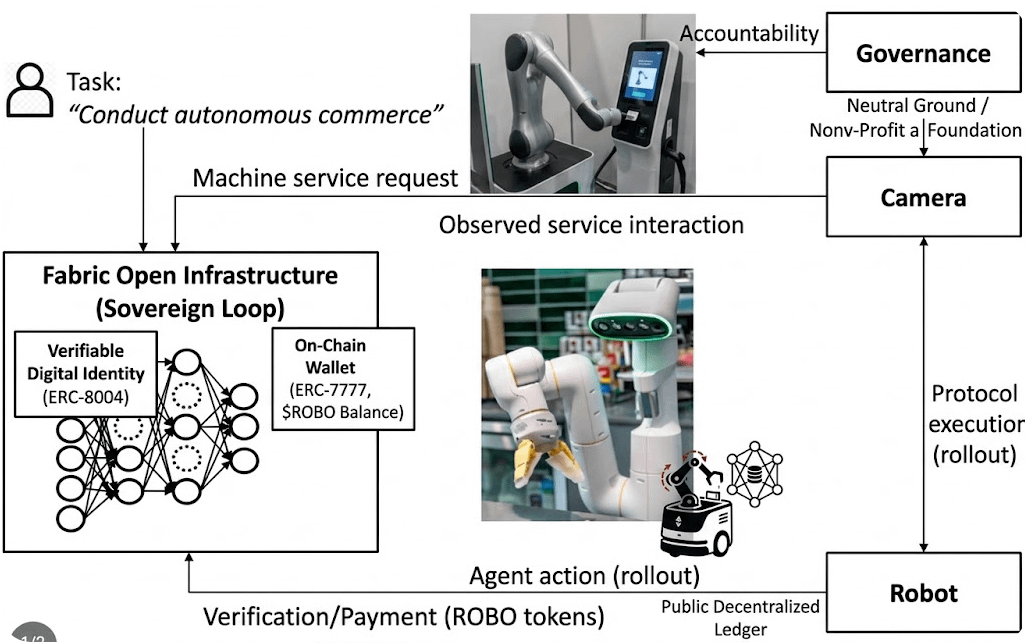
By using a decentralized ledger ($ROBO), the "trust layer" is a public good, not a corporate service. If the Foundation disappeared tomorrow, the machines would still have their identities and their wallets. That is the definition of a sovereign loop.
Open code does not eliminate power. It makes it accountable.
Another overlooked shift is talent flow.
The best engineers in AI and robotics increasingly expect to work in environments where code can be inspected, forked, and improved. An open foundation attracts contributors who value reputation built in public. Instead of hiring every expert, Fabric can create an ecosystem where experts choose to build because the base layer is accessible.
That transforms the hiring problem into a community problem.

The reason Fabric’s ethos matters isn’t for the high-activity "hype" weeks. It’s for the cold weeks.
Closed systems require constant corporate subsidies and sales teams to stay alive. An open-source, decentralized network like Fabric is designed to be un-killable infrastructure. Because the Foundation is a non-profit, its success isn't measured by quarterly earnings, but by the persistence of the loop.
If you believe the future of GDP is "agentic" - driven by machines and AI - you have to ask: Who owns the rules?
Fabric’s answer is: Nobody and Everybody. They aren't building a product to compete with Tesla or Boston Dynamics. They are building the neutral ground where those companies (and everyone else) have to meet if they want to participate in a global, transparent, and repeatable machine economy.
That isn't just a "game changer." It’s the only way to ensure the machines work for us, rather than for the person who owns the gate.
$ROBO #ROBO @Fabric Foundation