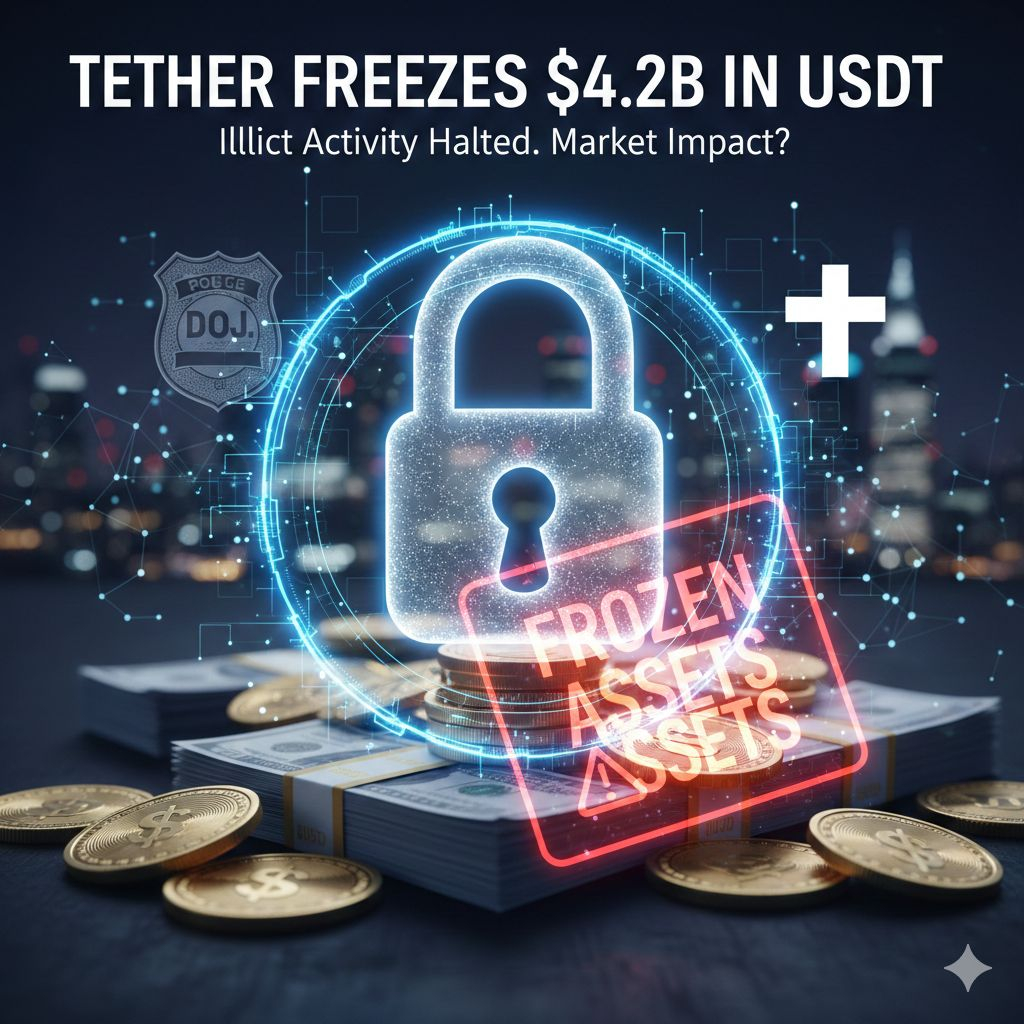
In a move that’s turning heads across crypto, Tether has frozen approximately $4.2 billion worth of $USDT connected to criminal investigations, according to reporting from Reuters.
What’s even more notable is the timeline. Roughly $3.5 billion of that total has been frozen since 2023, suggesting that enforcement efforts have significantly intensified over the past two years. This isn't just a ripple; it's a clear signal of where the industry is heading.
Cooperation With U.S. Authorities
This week, Tether confirmed it assisted the U.S. Department of Justice in ongoing investigations. Among the most recent actions was the freezing of nearly $61 million tied to so-called “pig-butchering” scams — a form of long-term social engineering fraud that has increasingly targeted crypto users worldwide.
The scale of these enforcement measures signals something important: stablecoin issuers are no longer passive infrastructure providers. They are actively participating in compliance and law enforcement coordination. This shifts the narrative significantly; it’s no longer just about the tech, but about the robust regulatory frameworks being built around it.
USDT’s Growing Footprint
Despite these freezes, $USDT continues to expand. Its circulating supply has now surpassed $180 billion, reinforcing its position as the dominant stablecoin in the market.
That contrast is worth pausing on. On one hand, billions are being frozen due to illicit use. On the other, adoption continues to climb. This reflects a broader reality in crypto: scale brings scrutiny. As digital assets integrate deeper into global finance, the line between decentralization and regulatory oversight becomes more defined. It's a fascinating tension to watch unfold.
The Bigger Picture
For our industry, this development carries two profound implications.
First, enforcement capability within centralized stablecoins is real. Wallets can be blacklisted. Funds can be frozen. Whether that’s viewed as a feature or a risk depends on your philosophy — but it’s undeniably part of the current infrastructure. This isn't just theoretical anymore; it's practical reality.
Second, collaboration between crypto firms and regulators is accelerating. We are no longer in the “wild west” phase. Oversight is here, and large players are adapting accordingly. This is a maturing market, and with that maturity comes greater accountability.
The question isn’t whether compliance will shape crypto’s next chapter. It’s how the balance between transparency, control, and decentralization will evolve from here.
As the market grows, so does accountability. And that dynamic will continue to define stablecoins moving forward. It’s a brave new world, and we're all watching it unfold.#BTC #MarketRebound $BTC