The other night my younger cousin asked me why his online game sometimes “feels slow” even though his internet speed test shows perfect numbers. I tried explaining that speed on paper and coordination in practice are not the same thing. A system can move fast and still trip over itself. That small conversation stuck with me because it mirrors something I keep thinking about when I look at Fogo and its push for very low latency.
In blockchain terms, latency just means delay. The time between sending a transaction and seeing it confirmed. Fogo talks about extremely short block times that blocks being produced in fractions of a second. On the surface, that sounds like pure improvement. Who wants to wait? Traders don’t. Gamers don’t. Even casual users don’t want to stare at a pending spinner.
But here’s the part people don’t always sit with long enough: decentralization doesn’t naturally move at the same speed as performance engineering. Decentralization means many independent validators that separate computers, often in different parts of the world to agreeing on the state of the network. Agreement takes communication. Communication takes time. Even if we’re talking milliseconds, it’s still time.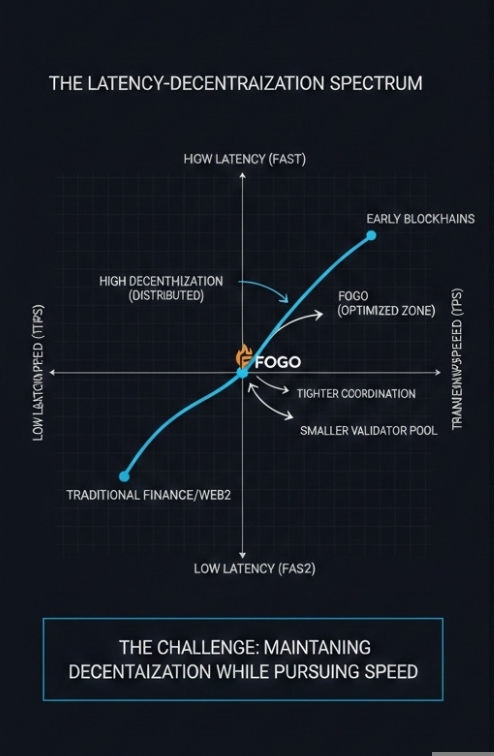
And physics doesn’t care about token price.
If a network wants to shave latency down to almost nothing, it usually tightens coordination. Maybe fewer validators. Maybe this is more demanding hardware. Maybe the both. High-performance machines, strong connectivity, low geographic spread. None of that automatically means the system is centralized in a dramatic way. But it does narrow the field of who can realistically participate.
I don’t think decentralization is a moral badge. It’s more practical than that. It’s about distribution of power. Who can validate? Who can influence upgrades? Who can censor, if they tried? Those questions sit quietly underneath all the talk about block times.
Fogo seems to be leaning toward performance. That’s not irrational. Fast finality, meaning the point where a transaction can’t be reversed, changes user behavior. In trading especially, delay is a cost. If blocks are produced every 40 milliseconds, that means new state updates happen 25 times per second. That’s not just “faster.” That starts to reshape how strategies work. Arbitrage windows shrink. Bots operate in tighter cycles. Slippage, which is the gap between expected price and execution price, can narrow because there’s less time for the market to move in between.
Still, something else happens when you compress time like that. Micro-volatility increases. You don’t remove competition; you condense it. The fastest actors adapt first. Smaller participants don’t necessarily get a better deal just because the chain is quicker. In some cases, they’re now competing in a higher-frequency environment whether they wanted to or not.
I’ve seen similar patterns on Binance Square. When dashboards highlight transaction throughput, TPS, or confirmation speeds, those numbers travel fast. Ranking systems amplify them. AI-driven visibility tools reward activity that looks efficient. Engagement metrics respond to growth signals. But none of those dashboards show validator concentration ratios or hardware barriers. What’s visible shapes perception. What’s structural often stays off-screen.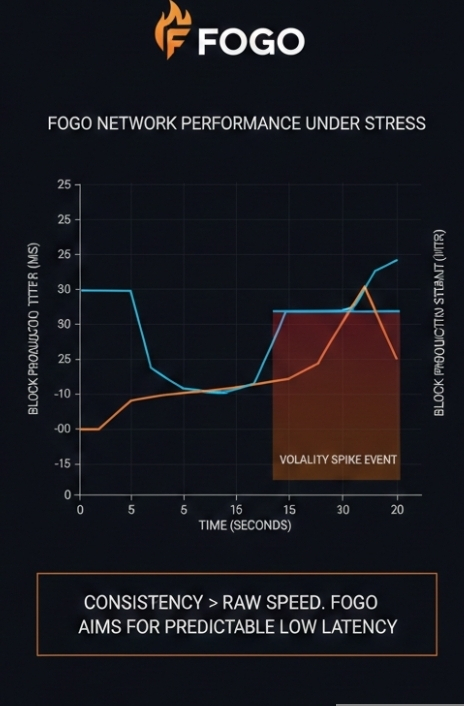
That disconnect matters.
I don’t buy the idea that latency versus decentralization is a clean two-axis graph where you just pick a point. It’s messier. There’s governance in the middle. There’s economic incentive design. There’s validator onboarding friction. You can design a low-latency system that still maintains meaningful decentralization but it requires conscious guardrails. Transparent validator requirements. Clear upgrade processes. Open monitoring.
And honestly, incentives change everything. If validators must invest heavily in infrastructure to compete at Fogo’s speed, then only well-capitalized operators will remain long term. Over time, that shapes influence. Not because the protocol says so. Because economics does.
At the same time, I don’t think slower automatically means safer. We romanticize large validator counts sometimes. But decentralization without performance can push users toward centralized exchanges anyway. If retail traders already execute through Binance or similar platforms, then base-layer latency improvements may simply make the backend more efficient without changing perceived decentralization at the user level.
That’s the uncomfortable thought I keep circling back to: for many users, decentralization is abstract until something breaks. Speed, on the other hand, is immediately felt. You notice a delay. You don’t notice resilience until there’s a crisis.
So what is Fogo really optimizing for? Possibly it's experience first. Real-time applications. On-chain trading that feels like Web2. Maybe gaming integrations where delay kills immersion. Those are legitimate goals. But every millisecond saved through tighter coordination nudges the system into a narrower validator profile. Not catastrophically. Just incrementally.
And incremental shifts compound.
I don’t see this as good or bad. It’s a curve. Push one side down, the other rises. What interests me more is whether Fogo can hold predictability steady while compressing latency. Consistency matters more than raw speed. A slightly slower chain that behaves reliably under stress might outperform a faster one that occasionally fractures during high load. Markets forgive slowness more easily than instability.
When volatility spikes and it always does the real test begins. Can the validator set maintain coordination without hidden central points? Can governance remain transparent when upgrades are urgent? Can block production stay smooth when incentives shift?
Those questions won’t show up on marketing graphics. They won’t trend on dashboards. They’ll surface quietly, over time.
I don’t think the trade-off between latency and decentralization is something to solve once and move on from. It’s ongoing. It evolves with hardware, with network design, with user behavior. Fogo’s low-latency push is a strong statement about what it values. The more interesting story will be how it manages the side effects not in ideal conditions, but when conditions are messy.
Speed is attractive. It feels like progress. But resilience is quieter. And in this space, the quiet properties usually end up mattering longer than the loud ones.

Articol
The Trade-Off Curve: Latency vs. Decentralization in Fogo
Declinarea răspunderii: Include opinii ale terților. Acesta nu este un sfat financiar. Poate include conținut sponsorizat. Consultați Termenii și condițiile

FOGO
0.02722
+1.03%