

I’ve been in crypto long enough to see the patterns repeat. I’m watching new stories pop up every few months. First it was DeFi summer. Then NFTs. Then the metaverse. Now it’s AI agents. I’m seeing the same rhythm each time. People rush in, prices move fast, excitement explodes and then things cool down just as quickly.
So when I started looking into Vanar and $VANRY, I wasn’t trying to get caught up in the “AI-native chain” headline. I’ve learned not to chase labels. Instead, I’m asking myself a simple question: what actually makes people stay? What keeps builders building after the hype fades?
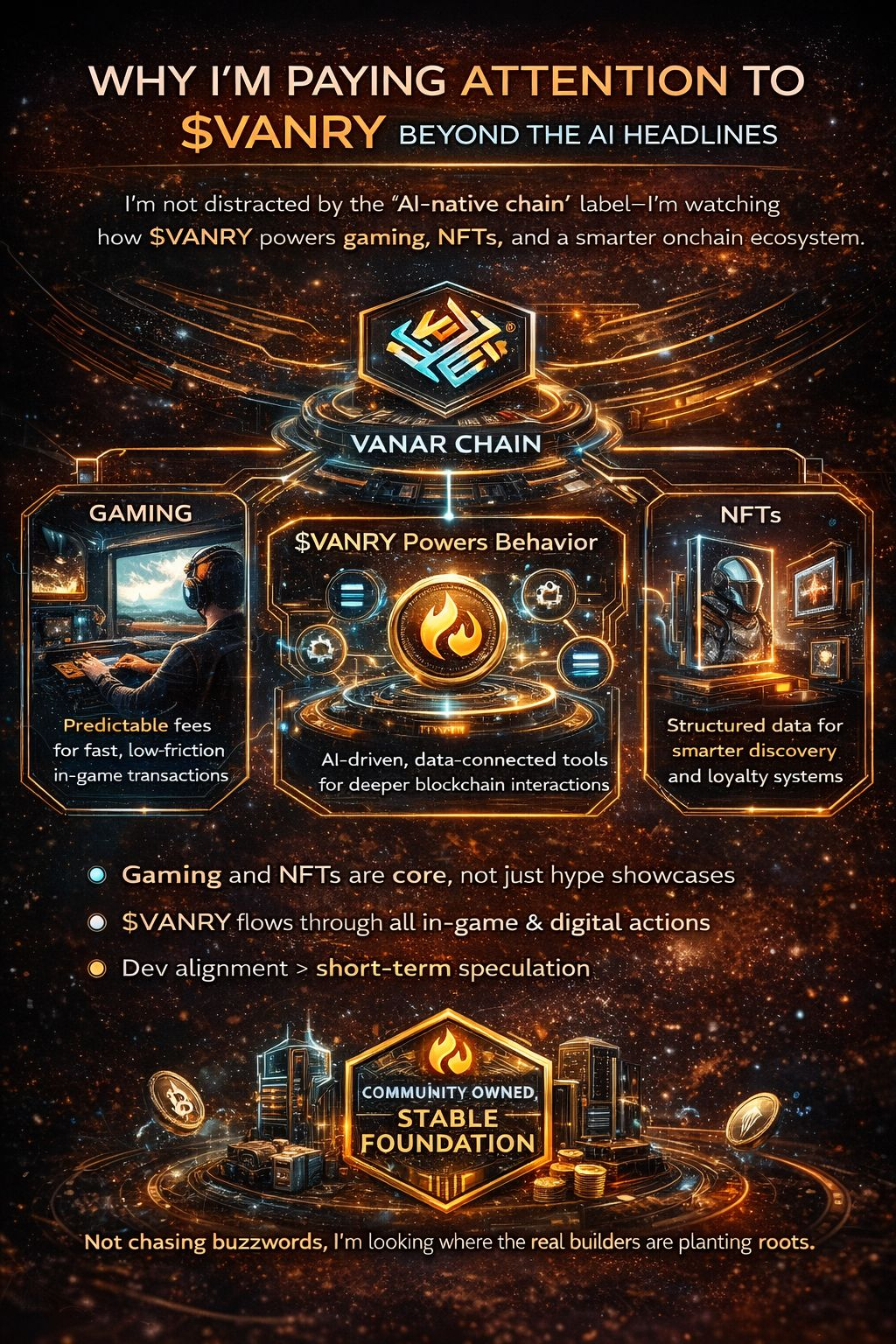
When I’m digging into Vanar, I’m noticing something that feels different. They’re not treating gaming and digital assets like side experiments. I’m not seeing them use games as flashy demos just to show how fast the chain is. I’m seeing them position gaming and NFTs as core demand as the main reason the network exists.
And to me, that matters more than big promises.
If you’ve ever used a blockchain game during peak traffic, you know the pain. I’m clicking something in-game, and I’m waiting. The transaction is pending. Fees suddenly spike. Sometimes it fails completely. In gaming, that kills the experience instantly. Players don’t care about TPS charts. They don’t care about whitepapers. They care about whether their action goes through right now.
When I’m looking at Vanar, I’m seeing a focus on reducing that friction. Predictable low fees. Fast confirmations. I’m watching them try to make the infrastructure boring in the best way possible. Because when the base layer just works, people stop worrying about whether their transaction will succeed. They start thinking about what they can build next.
That shift is subtle, but I think it’s powerful.
When developers know what fees will look like and don’t have to worry about sudden congestion, they experiment more. I’m imagining a game studio working on a new feature. If they can clearly estimate costs, they’re more willing to test ideas. If users aren’t hesitating before every click, interaction becomes natural. And ecosystems grow from experimentation, not from marketing campaigns.
So when I’m thinking about $VANRY in that context, I’m not seeing it as just another gas token. I’m seeing it as something more connected to activity itself.
Every transaction runs through it. Every NFT mint. Every in-game action. But what really catches my attention is how the token sits inside a broader system. There’s structured data through Neutron. There’s reasoning through Kayon. There are automation layers coming. I’m watching this stack form, and I’m thinking about how that expands what the token can do.
It’s not just about sending tokens from one wallet to another. I’m imagining AI-driven features inside games. I’m thinking about compliance tools built directly into apps. I’m picturing intelligent workflows where the system reacts to user behavior automatically.
If gaming projects start using on-chain AI in real ways not just demos that changes the picture. If NFT marketplaces use structured data to improve discovery, that adds another layer. If digital brands build loyalty programs on top of this infrastructure, then $VANRY isn’t just powering transactions. It’s powering interactions and behaviors.
That’s a different kind of demand.
I’m also paying attention to how the ecosystem handles community and distribution. I’ve seen chains where most tokens sit with early insiders who are just waiting to sell. That creates a certain culture. Short-term thinking. Quick flips. Constant pressure.
But when builders, testers, and early supporters are aligned long term, I’m noticing the difference. The tools improve. Uptime gets better. Documentation becomes clearer. The community gets more serious. A chain often reflects who owns it.
When I’m looking at Vanar’s messaging, I’m not seeing constant hype about being “the fastest chain in the world.” I’m seeing something more operational. Fixed low fees. Public RPC endpoints. Clear integration paths. These are not exciting headlines. They’re boring details.
But I’ve learned that boring infrastructure is what real products are built on.
Especially for gaming and NFTs, stability beats hype every time. Players want smooth experiences. Creators want reliability. Developers want clarity. I’m watching whether Vanar keeps delivering on those basics.
When people ask me about $VANRY, I’m not immediately thinking, “Will it pump?” I’m asking a different question: “Will developers choose to stay?”
Because that’s what really matters.
If games launch and don’t leave after three months, that’s a strong signal. If NFT creators keep building collections instead of jumping chains, that’s meaningful. If AI-powered features are actually used by real users instead of shown in demo videos, that tells me something real is happening.
I’m watching for that loop.
Activity leads to utility. Utility leads to demand. Demand supports the token. And if that loop is steady, it doesn’t need explosive hype to survive.
I’m not looking for narrative-driven spikes anymore. I’ve seen how those play out. I’m more interested in steady groundwork. I’m watching whether developers feel comfortable building here. I’m watching whether users feel comfortable interacting without second-guessing every transaction.
If Vanar keeps focusing on usable infrastructure for creators and interactive environments, I can see $VANRY evolving. It could move from being just a transaction token to becoming more of a participation token.
And participation feels important in this cycle.
Speculation can move prices quickly, but participation builds ecosystems. When people are actively creating, playing, trading, experimenting that’s when a network starts to feel alive. I’m paying attention to whether Vanar is building that kind of environment.
Because at the end of the day, hype fades. I’ve watched it happen again and again. But products that work, tools that developers trust, and communities that stay engaged those are harder to shake.
So when I say I’m paying attention to $VANRY, it’s not because of flashy AI headlines. It’s because I’m watching how the pieces fit together. I’m looking at gaming. I’m looking at NFTs. I’m looking at structured data and AI layers. I’m asking whether all of this connects into something developers actually want to use.
If it does, growth won’t need to be forced. It will happen naturally as more people build and participate.
And that’s the kind of story I’m more interested in following.
