
A quiet realization that changed how I saw crypto
There was a time when I looked at blockchains in a very simple way. Faster chains looked better. Cheaper transactions sounded impressive. Every new project promised to fix the problems of the last one.
But slowly something started to feel empty.
I’m watching new networks launch. I’m seeing announcements and marketing everywhere. Yet after some time, many of those chains become quiet. Activity fades. Communities move on.
That made me think about a simple question.
What actually keeps a blockchain alive
The answer was not speed. It was people.
The world outside crypto was moving faster than we noticed
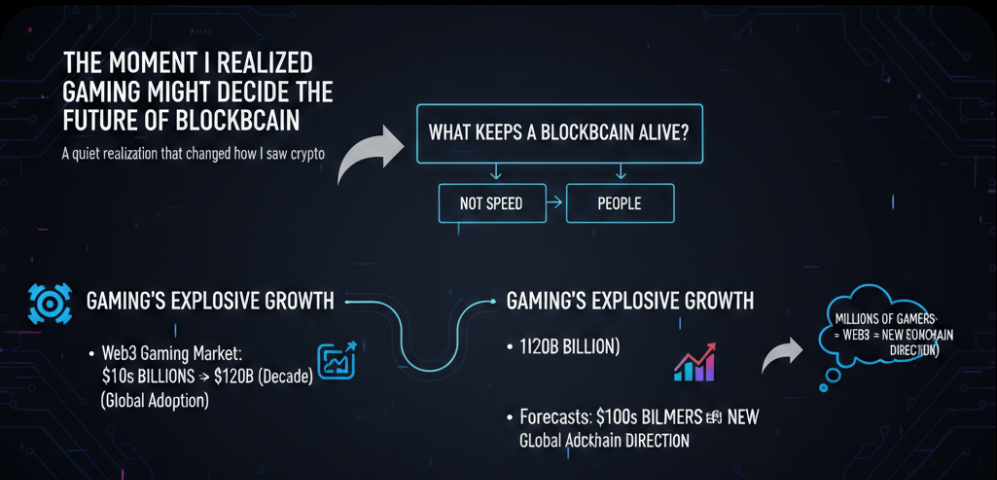
While many blockchains were competing over technical details, something much bigger was happening in another industry. Gaming was growing at an incredible pace.
Research shows the Web3 gaming market alone was valued in the tens of billions and could grow beyond 120 billion dollars within this decade as NFTs and digital ownership expand.
Some forecasts are even more dramatic. Analysts estimate blockchain gaming could reach hundreds of billions in value over time as adoption spreads globally.
When I first saw numbers like that, I stopped for a moment.
Gaming is not a small niche. It is one of the largest digital industries on Earth.
And suddenly a thought appeared in my mind.
If millions of gamers enter Web3, the entire direction of blockchain could change.
Why gaming feels natural while finance feels distant
I started thinking about human behavior.
Most people do not wake up excited to use financial tools. But they do open games. They explore worlds. They compete. They collect items.
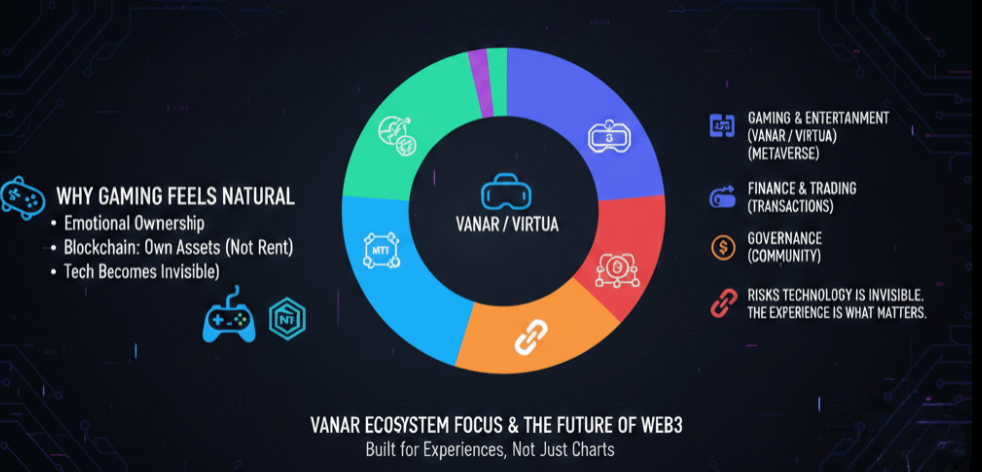
Ownership matters here in a very emotional way. Players spend time and money building characters and collecting digital items. Blockchain gives a way to actually own those assets instead of renting them inside closed systems.
That is a powerful shift.
It means blockchain becomes invisible. It becomes part of the experience instead of the main attraction.
The day I discovered Vanar
During this time of thinking and reading, I came across Vanar.
At first I assumed it was just another Layer 1. I had seen many of those before.
But something felt different as I read more.
Vanar was not talking only about finance or trading. It was built around gaming, entertainment, and immersive digital experiences.
That small difference changed how I looked at the project.
They were not trying to bring users to blockchain. They were trying to bring blockchain to where users already are.
Looking deeper into the origins
As I kept learning, I discovered that Vanar grew from earlier work connected to Virtua, a metaverse and digital collectibles platform built around interactive experiences and communities.
That history matters.
It means the team did not start with a blockchain and then search for use cases. They started with experiences and then built infrastructure to support them.
That is a very different direction.
Understanding the technology in a simple way
When I try to understand blockchain systems, I imagine them like cities.
The blockchain is the land and roads.
Applications are the buildings.
Users are the citizens.
Vanar functions as a Layer 1 blockchain designed for scalable applications, digital assets, and real world use cases.
It also powers platforms like the Virtua metaverse and gaming networks where users interact in real time.
That helped me see the bigger picture.
This was not only infrastructure. It was infrastructure designed for experiences.
The role of the token in the ecosystem
Every blockchain needs an internal economy.
Vanar uses the VANRY token as the core of its ecosystem, supporting transactions, applications, and services built on the network.
At first that sounds similar to many other projects.
But when tokens are used inside games and digital environments, they stop feeling abstract. They become part of everyday activity inside those worlds.
That is where utility becomes real.
Governance and the idea of shared direction
One thing I have always found interesting in blockchain is governance.
Traditional digital platforms are controlled by companies. Decisions are made privately.
Blockchain experiments with a different model where communities can influence development and ecosystem direction.
This idea is still evolving. But if gaming ecosystems grow large enough, shared governance could become one of the most important parts of digital worlds in the future.
Watching the ecosystem grow
Vanar is not only a theoretical idea.
It connects gaming platforms, immersive environments, and entertainment ecosystems designed to attract real users rather than only traders.
We’re seeing across the industry that the projects which survive are usually the ones with real activity, real communities, and real experiences.
Technology alone is not enough anymore.
The risks that cannot be ignored
As hopeful as this future sounds, there are still real risks.
Research into blockchain games shows that many struggle with player retention and sustainable economies.
Some games attract attention quickly but fail to keep players engaged once incentives disappear.
That means success in this space depends on something deeper than token rewards.
It depends on whether people genuinely enjoy the experience.
Thinking about the long term
Sometimes I step back and try to imagine the future.
The broader Web3 market itself is expected to grow rapidly as tools mature and adoption spreads across industries.
If gaming becomes one of the main entry points into that world, the infrastructure built for immersive experiences may shape how millions of people interact with blockchain.
Not through charts.
Not through speculation.
But through stories and worlds.
A final thought that stays with me
I often imagine someone ten years from now playing a game online.
They are exploring a city. Trading items. Talking with friends.
They are using blockchain every minute, but they do not even realize it.
The technology is invisible. The experience is what matters.
And sometimes I wonder if that is the real goal of all this.
Not to make people think about blockchains.
But to build worlds where people simply live, play, and create, while the technology quietly works in the background.
