
Key takeaways
Crypto futures contracts allow traders to speculate or hedge against the price of digital assets without directly owning them , offering both long and short opportunities.
Perpetual contracts have no expiry date and use a funding rate to keep prices aligned with the spot market, making them ideal for active or short-term trading.
Futures trading involves leverage , margin and risk management , meaning that while it offers flexibility and capital efficiency, traders must understand the potential for amplified losses.
What are crypto futures contracts?
A crypto futures contract is an agreement between two parties to exchange either the fiat value of a crypto asset, or the asset itself, at a future date and price.
Many traders view futures contracts as a bet on the future price of an asset such as bitcoin (BTC) or ethereum (ETH) :
A trader who believes the price will rise takes a long position .
A trader who believes the price will fall takes a short position ("short selling").
If a trader's prediction comes true, he profits from the difference between the futures price and the actual market price at settlement.
Futures trading platforms like Binance connect buyers and sellers of each futures contract. Binance is not a counterparty to your transaction; instead, it facilitates the agreement between traders. The "loser" of the transaction pays the "winner" the price difference between the settlement price and the current spot price of the asset.
Why futures trading is important in crypto
Crypto futures contracts are among the most popular types of derivatives in digital asset markets. They allow traders to take positions on crypto price movements without owning the underlying asset , often with reduced fees and leverage that amplifies the position size .
Derivatives represent a significant part of the crypto economy. They now account for more than half of all cryptocurrency trading volume , representing billions of dollars traded daily.
The three main types of crypto futures contracts on Binance
Binance now offers three distinct types of crypto futures products:
1- USDT-Margined Futures (Linear Futures)
Example: BTC/USDT, ETH/USDT
Settled in USDT (or USDC)
Profit & loss in stablecoin
Easier for beginners
Most liquid markets
💡 Best if you want to avoid holding volatile collateral.
2- Coin-Margined Futures (Inverse Futures)
Example: BTCUSD, ETHUSD
Margined & settled in crypto (BTC, ETH, etc.)
PnL paid in the same coin
Good for long-term holders who want to increase their coin stack
💡 Used more by advanced traders or miners hedging exposure.
3- Delivery Futures (Quarterly Contracts)
Example: BTCUSD_240628
Have a fixed expiration date (quarterly)
Settle at maturity (not perpetual)
Less common than perpetual futures
Useful for long-term hedging strategies
💡 Price converges to spot at expiration.
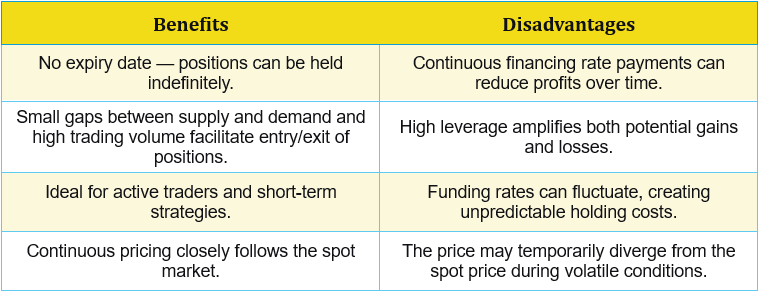
Perpetual Futures Contracts
Definition
A perpetual futures contract (more simply, a perpetual contract or P&P ) is a type of futures contract with no expiration date . You can hold the position indefinitely, provided you meet the margin requirements.
How do perpetual futures work?
Because perpetual contracts never expire, they rely on a financing rate mechanism to keep the contract price close to the spot market price.
When the perpetual price is above the spot price , longs pay shorts .
When the perpetual price is below the spot price , shorts pay longs .
Example
A trader takes a long position on a perpetual BTC contract, expecting Bitcoin to rise in price. If BTC rises, the contract's value increases, and the trader makes a profit. If BTC falls, the trader incurs a loss. The position remains open until it is closed (either voluntarily or through liquidation).
Options trading
1- Definition
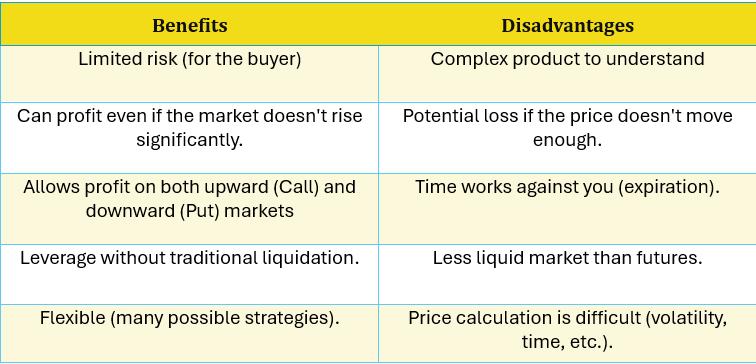
An option is a financial contract that gives the holder the right (but not the obligation) to buy or sell an asset (BTC, stock, gold, etc.) at a price fixed in advance (strike price) before or on a given date.
There are two types of options:
Call option → right to BUY
Put option → right to SELL
2. How it works (simple principle)
Example (Call option on BTC):
BTC is worth: $60,000
You buy a Call option with:
Strike price = $62,000
Expiry date = 1 month
Premium = $500
👉 Two scenarios:
1️⃣ BTC rises to $70,000
You can buy at $62,000 → you make a profit
Profit = ($70,000 - $62,000) - $500 = $7,500
2️⃣ BTC remains below $62,000
You do not exercise your right
Loss = $500 (the premium)
➡️ Your risk is limited to the premium paid.
3. Advantages and disadvantages
Essential components of futures contracts
Crypto futures trading involves an agreement between two traders: one who expects the price of a crypto asset to rise (the buyer , or long ) and the other who expects it to fall (the seller, or short ). When the price of the futures contracts moves in the direction predicted by one trader, that trader makes a profit. The other trader incurs a corresponding loss.
Because a futures contract is a direct agreement between traders, both parties must agree on key details before the contract is executed. These details define how the contract behaves, how it is settled, and what value it represents.
Each cryptocurrency futures contract consists of four main components.
1. Expiration date
The expiry date determines when the contract will end and when the value will be exchanged between the parties involved.
In fixed-duration futures contracts, the expiration date is agreed upon when traders enter the contract at a predetermined price. On that date, the contract is automatically settled based on the difference between the agreed-upon futures price and the spot price of the underlying crypto asset.
For example, if two traders agree to exchange the value of 1 BTC at a price of $60,000 in December and the price of BTC is $65,000 at that time, the buyer makes a profit of $5,000 while the seller suffers the same loss.
Some platforms (like Binance) also offer perpetual futures contracts. As discussed, these allow traders to maintain their positions indefinitely, provided they maintain sufficient margin to cover potential losses.
2. Contract Batch Size
The contract lot size defines how much of the underlying assets each futures contract represents.
A single contract can be valued in terms of the underlying crypto asset (e.g., 1 contract = 1 BTC) or in terms of its notional fiat value (e.g., 1 contract = $1 of BTC).
Most platforms (including Binance) allow fractional trading. This means a trader doesn't need to commit to a full unit of a contract. For example, even though a futures contract might represent 1 BTC, a trader could open a position for as little as 0.0001 BTC. Fractional sizing allows for greater flexibility and risk control , especially for traders with smaller portfolios or those testing strategies.
The notional value of a position is determined by the contract size multiplied by the current futures price . This makes lot size a key determinant of a trader's exposure to the underlying market.
3. Leverage effect
Leverage allows traders to control a position larger than their initial deposit (called margin ). This feature increases the efficiency of capital, making it possible to amplify potential returns, but it also amplifies potential losses.
For example, a trader could open a Bitcoin futures contract worth 5 BTC (approximately $150,000) with only an initial margin deposit of 10%, or $15,000. This gives them leverage of 10x .
If the price of Bitcoin increases by 5%, the notional value of the position rises to $157,500, resulting in a profit of $7,500 (a 50% gain on margin). However, if Bitcoin falls by 5%, the trader would lose the same $7,500, or half of their margin, and risks liquidation if the loss exceeds maintenance requirements.
Different cryptocurrency exchanges apply different leverage limits depending on the asset, volatility, and region. Binance provides traders with integrated risk management systems to prevent excessive exposure and manage liquidation thresholds .
4. Payment Method
The settlement method determines how the contract is closed when it expires or when a trader exits the position.
Cash settlement: In most cases, crypto futures are settled in cash. The losing trader pays the winning trader in fiat currency such as USD or EUR, or in stablecoin. This is the most common method for both perpetual and fixed-term futures contracts because it is efficient and does not require the transfer of the underlying crypto asset.
Physical Settlement: Some regulated exchanges and institutional venues also offer physical delivery. Here, the seller must deliver the actual digital asset to the buyer at the agreed-upon settlement price. For example, if a contract stipulates the delivery of 1 BTC at $60,000, the seller transfers 1 BTC and receives $60,000 from the buyer.
The difference between the contract settlement price and the spot price at the time of settlement determines each trader's profit or loss. On platforms such as Binance, this process occurs automatically upon contract closure , ensuring that both parties to the transaction are fulfilled according to the agreed terms.
Margin, collateral and liquidation
As mentioned earlier, the platforms require collateral margin —usually cash, stablecoins, or cryptocurrencies. If a position moves against a trader and the margin falls below maintenance levels, a margin call may be issued.
Failure to comply with this by increasing the margin may trigger liquidation , where the platform automatically closes the position to avoid further losses.
What are the advantages of trading crypto futures contracts?
Despite their complexity, futures contracts offer numerous advantages over the spot market, which many traders find useful. They can be used in various ways depending on a trader's experience, strategy, and risk tolerance.
Speculation : Futures contracts allow traders to profit from price fluctuations in both directions. Opening a long or short position allows you to profit from both rising and falling markets. Short selling a futures contract is one of the simplest ways to profit when the price of an asset decreases.
No asset ownership : Futures contracts offer exposure to the prices of digital assets without requiring traders to own or store the actual cryptocurrency. This can be attractive to investors who want to participate in the cryptocurrency market without managing wallets or private keys.
Fees : Futures trading fees are generally lower than those of spot markets. Some exchanges offer trading fees as low as 0.01%, helping active traders manage costs more effectively.
Leverage : Futures contracts typically include built-in leverage, allowing traders to control larger positions with smaller deposits. Leverage increases potential profits but also amplifies losses if the market moves against a trader's position.
Hedging : Traders who already hold cryptocurrencies can use futures contracts to protect against adverse price movements . For example, opening a short position in futures contracts can offset losses from a long position in the spot market during a market downturn, without requiring the sale of the assets.
Arbitrage opportunities : Futures contracts create opportunities to profit from temporary price differences between markets. A trader can open offsetting long and short positions on different exchanges or contract types, capturing a profit when prices converge .
Broader market access and flexibility : Futures contracts allow traders to access a wide range of digital assets and trade 24 hours a day. The ability to go long or short offers a flexibility that spot trading cannot provide.
Liquidity and capital efficiency : Futures markets tend to have deep liquidity, allowing traders to enter or exit large positions with minimal impact on prices. Because only a margin deposit is required, traders can allocate capital more efficiently than in spot markets.
Diversification of strategies : Futures contracts support advanced trading approaches such as hedging, spread trading, and portfolio diversification. This allows traders to build more sophisticated strategies and manage risk across multiple positions.
What is the difference between futures markets and spot markets?
On spot exchanges, a purchase results in immediate ownership or delivery . You exchange one asset, such as USDT, for another, such as BTC, and the transaction is settled immediately. Because you hold the actual asset, you are directly exposed to its price movements and market risk.
Futures trading works differently: you enter into a contract to buy or sell the asset at a predetermined future date and price. Instead of owning the underlying asset, you trade a derivative whose value tracks the price of that asset .
Another major difference is exposure: in spot trading, you have direct exposure to the asset and custody responsibilities (ownership, portfolios, transfers). In futures trading, you gain indirect exposure to the asset's price without actually owning it, outsourcing custody to the platform of your choice (at the cost of increased complexity).
Due to the mechanisms of contracts, leverage and pricing of futures contracts (including concepts like contango/backwardation), futures markets often require a more advanced understanding and stronger risk management, and are generally better suited to more experienced or institutional traders.
Conclusion
Cryptocurrency futures trading opens up new ways to access digital assets without owning them directly.
Whether through perpetual contracts on Binance, traders can choose the product that best suits their objectives, time horizon and risk tolerance.
Understanding how each type of futures contract works, as well as key concepts like leverage, financing rates and settlement, is essential before trading.
As crypto and traditional markets continue to converge, Binance aims to provide clients with the trading tools, education, and access they need to navigate both confidently and responsibly.
Ready to start trading derivatives? Binance has you covered with over 100 futures markets — and a seamless experience that makes trading effortless, whether you're on the go or at your desk.



