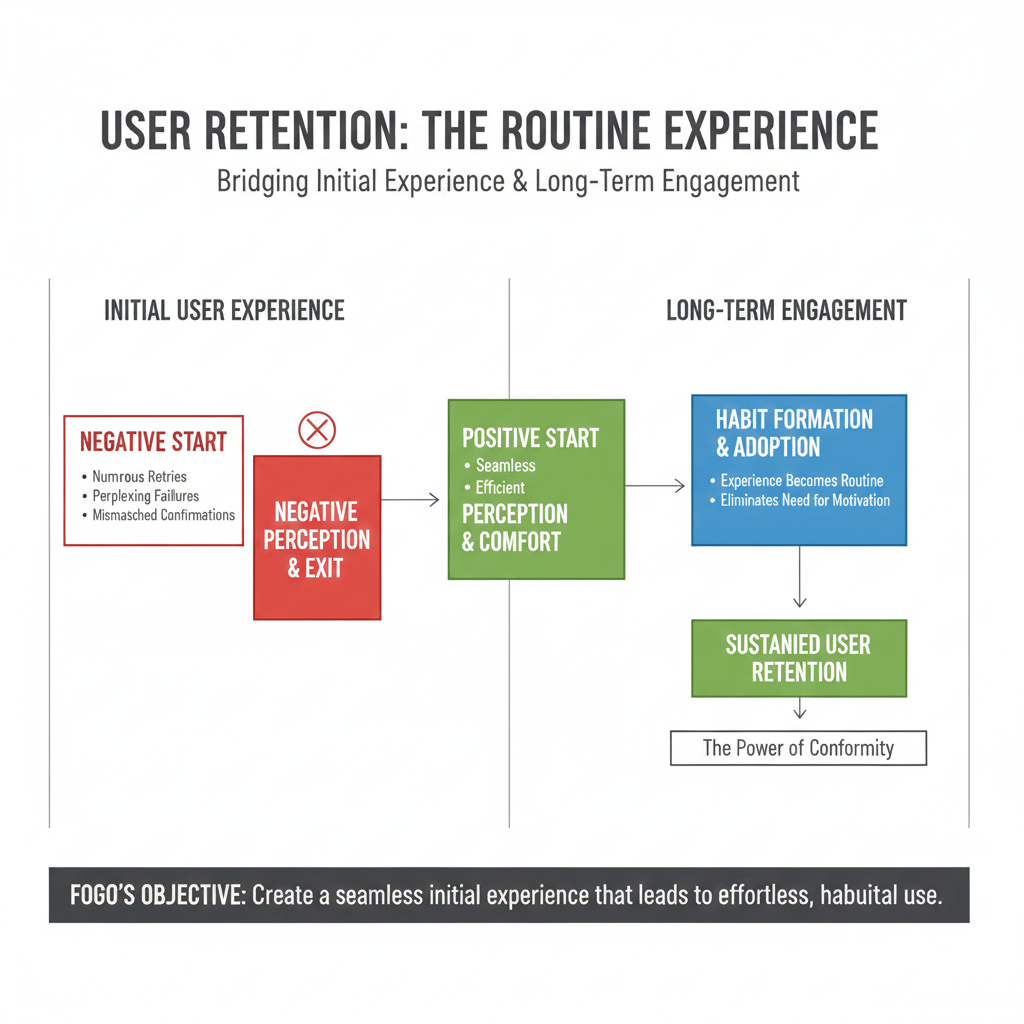
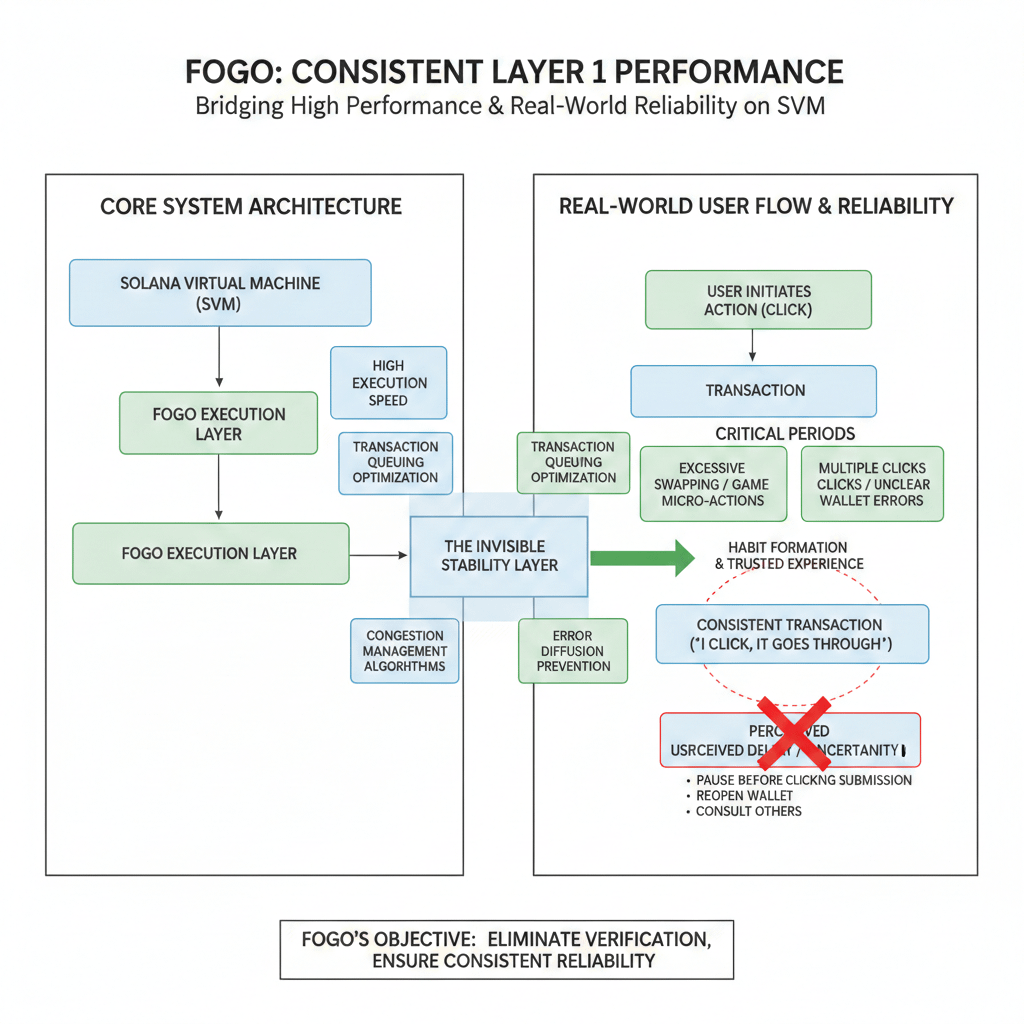
The day @Fogo Official starts feeling boring is the day it starts winning the adoption race. I do not judge a serious Layer 1 by how fast it looks when everything is clean and quiet. I judge it by what happens when real users show up in messy conditions, when everyone is swapping at once, when a game is firing off constant micro-actions, when people click twice because the UI hesitated, when wallets throw vague errors, when the app and the wallet disagree about what just happened. That is the moment the chain stops being an abstract claim and becomes a lived experience. If it stays coherent there, users return tomorrow. If it doesn’t, speed becomes a party trick.
A lot of teams get stuck selling the idea of high performance plus SVM as if that alone is the product. It is not. Execution speed is only useful if execution consistency is the default. The fastest chain in the world still loses if it trains users to doubt it. You can feel that doubt immediately. The pause before the click. The refresh after signing. The wallet reopen just to confirm reality. The message to a friend asking if the transaction is supposed to take this long. That is not a user problem, that is a reliability problem. Fogo’s real opportunity is to make the experience so repeatable that nobody needs to check.
This is where the hidden cost of speed shows up. It is not a technical question first, it is an economic one. When demand spikes, where does the value go, who gets paid for keeping the system stable, and who quietly absorbs the long-term costs when growth compounds. A high-throughput network earns legitimacy only if usage pressure converts into something durable, not if it merely produces impressive moments.
I watch three pressures because they are what create real demand, and they are also what break chains that only optimize for headlines. The first pressure is security. Under load, credible finality is not a metric on a dashboard, it is the promise that honest behavior stays profitable and dishonest behavior is punished. If the chain is going to feel dependable during stress, operators need incentives that match the job. Staking or bonding has to mean something. Penalties have to be real. Reliability has to be rewarded. Otherwise you end up with a system that is fast until the day it matters, and then it becomes ambiguous, which is the one thing users cannot build habits on.
The second pressure is blockspace. People talk about blockspace like it is just capacity, but demand shows up as urgency. Traders need priority inclusion because timing changes outcomes. Games need predictable inclusion because rhythm is the product. Apps need stable throughput because user experience falls apart when confirmations wobble. Congestion is not just inconvenience, it is scarcity revealing itself. The question is whether that scarcity is priced in a way that strengthens the network, or captured in a way that turns the user experience into a constant negotiation with the chain.
The third pressure is state, and this is where a lot of fast networks quietly take on debt. Every app that actually succeeds grows state. Accounts, positions, orders, inventories, receipts, proofs, metadata, it all has to be stored, served, replayed, indexed, and carried forward. If state growth is treated as free, you are not eliminating costs, you are postponing them. The bill arrives later as centralization pressure because only the largest operators can afford to keep up, or as performance decay because the network becomes heavier to run and harder to keep consistent. This is how a chain loses its edge without any single dramatic failure.
If Fogo is going to win on adoption, it needs a clean value flow loop that turns pressure into resilience. Users take actions, those actions generate $fees, $fees become operator rewards, rewards make it rational to invest in better hardware, bandwidth, monitoring, and operational discipline, that reinvestment improves uptime, latency, and finality, the experience becomes predictable, trust increases, and usage grows. When this loop is healthy, the chain gets boring. You click, it goes through, you move on. That is not a lack of excitement, that is a sign the system is doing its job.
This is why people misunderstand the fee conversation. Low fees do not automatically create a good experience. Predictable fees do. You can hand someone a tiny number, but if the real cost includes failures, retries, repeated signatures, and time spent deciphering what went wrong, the chain is expensive in the only way that matters, it drains attention. A stable fee surface reduces cognitive load. It lets users stop asking whether this is a bad moment to do something. It also protects them from the hidden cost of congestion, the moments where they think an action did not work, so they do it again, and again, and the chain gets noisier because user anxiety becomes traffic.
Finality sits right in the middle of this, and it is usually discussed in the wrong way. Finality is not only about speed, it is about closure. It is the difference between an action feeling complete and an action feeling like it is still in limbo. When finality is fast and dependable, users change how they behave. They stop panic-clicking. They stop refreshing. They stop resubmitting just in case. That reduces network noise, which makes the system more stable, which reinforces the behavior. This is one of the rare cases where good user experience and good network health align perfectly, but only if the chain is reliable enough to earn that trust.
Operator economics determines whether that reliability can survive reality. A network that wants to stay smooth under load needs operators who can afford to run it properly. That means baseline rewards that keep participation healthy during quiet periods, because most days are not peak demand days. It also means fee upside when demand spikes, because that is when operating costs and operational complexity rise. If the incentives do not match the costs of doing the job well, the network will eventually select for a smaller set of professional operators by default, even if the narrative says otherwise.
Delegation culture becomes part of the product here. In a healthy system, stake follows reputation and performance, not loud yield. Operators who deliver consistent execution should attract more backing, because they are literally producing the reliability users feel. If stake instead chases short-term incentives that do not correlate with execution quality, you get fragile operators, uneven performance, and a network that looks fine until it becomes the place everyone tries to use at the same time.
Then there is MEV, which cannot be treated like a moral debate if Fogo is serious about high-throughput activity. MEV is structural. It appears wherever ordering has value. The only real question is who captures the surplus created by speed and ordering, and what that does to the experience for normal users. Ordering policy decides whether operators, searchers, or users capture that value. It also decides whether execution feels predictable or adversarial when the network is hot. If fast quietly means someone else can cut the line in ways you cannot see, demand rots from the inside because users feel disadvantaged and confused. Execution quality is not just latency, it is predictability.
State growth is the long-duration version of the same problem. Unchecked state is hidden debt. It does not show up in a benchmark, it shows up a year later when hardware requirements creep upward, when running a full node becomes a specialized job, when fewer participants can verify the system independently, when decentralization becomes a claim rather than a reality. If Fogo wants to stay fast for years, it needs to treat state as a priced resource, not an ignored cost. Priced state does not have to mean punitive user experience. It means the protocol acknowledges that permanence and serving costs are real, and it designs incentives so growth does not silently convert into fragility.
When I try to validate whether a chain’s token utility is real instead of rhetorical, I look for a few concrete linkages. I want to see the token tied to security through staking or bonding and credible penalties. I want to see inclusion and priority actually mediated through $fees in a way that resists spam without turning usage into chaos. I want to see state and long-term storage treated as an explicit economic resource so the system does not accumulate unpaid bills. I want transparency in rewards and an operator set that can grow without turning into a tiny club. And I want the fee experience under load to feel stable enough that users stop timing the network like it is a gamble.
If Fogo can deliver that kind of reliability, where $fees are predictable, finality feels immediate, failures are rare, signing does not become a constant interruption, and apps remain responsive even during peak usage, then SVM performance stops being a debate and becomes a habit. That is how Layer 1s actually win. Not by being talked about, but by disappearing into the routine, because everything just works. Performance is the headline, token design decides the ending.