
Here’s the latest overview (as of today, Saturday, February 14, 2026) on efforts to overturn, block, or roll back tariffs that former U.S. President Donald Trump imposed on Canadian imports, especially steel, aluminum and other goods — including recent legislative and political actions:
CBS News
Financial Times
House votes to rescind Trump's Canada tariffs, with 6 Republicans joining Democrats
Donald Trump plans to roll back tariffs on metal and aluminium goods
February 12
Yesterday
🇺🇸 U.S. House Moves to Overturn Trump’s Canada Tariffs
Major bipartisan vote in the House of Representatives:
On February 11–12, 2026, the U.S. House voted 219–211 to approve a resolution aimed at rescinding Trump’s tariffs on Canadian goods — a rare bipartisan rebuke of his trade policy. Six Republicans joined Democrats in support. �
CBS News +1
This resolution specifically challenges the national emergency declaration Trump used to justify imposing tariffs on Canada. �
AP News
What this vote means:
The House action is largely symbolic — it does not immediately undo the tariffs because:
The measure must still pass the U.S. Senate.
President Trump is expected to veto it, and overriding a veto would require a two-thirds majority in both chambers — unlikely given current party numbers. �
Financial Times
🏛️ Ongoing Political Tensions & Trump’s Response
Trump’s administration stance (Feb 2026):
The White House has said tariffs will remain unless President Trump officially announces changes — and there has been no formal rollback order yet. �
Reuters
Meanwhile, reports indicate possible internal discussions about altering or refining tariffs such as steel and aluminum duties to ease consumer costs — but no formal change has been adopted as policy. �
The Wall Street Journal
📉 Current Status of Canada-Related Tariffs
As of early 2026:
U.S. tariffs on Canadian steel and aluminum and other goods first imposed under national emergency economic powers remain in effect, raising duties on many Canadian imports. �
Reuters
Canada’s retaliatory tariffs — introduced in 2025 in response to U.S. duties — largely remain in place, though Canada has already removed some counter-tariffs on U.S. goods outside metals and autos. �
Canada
📌 What Hasn’t Happened (Yet)
❌ There has been no formal executive rollback of tariffs by President Trump.
❌ The U.S. Senate has not yet approved (and may not approve) the House resolution.
❌ Trump has not signed any tariff repeal or remission order.
🧠 What’s Next
🔹 Senate action: The resolution now moves to the Senate — which would need a simple majority to pass.
🔹 Potential Trump veto: Even if passed by Congress, Trump is expected to veto the repeal.
🔹 Legal challenges: Trump’s trade measures have faced legal scrutiny in federal appeals courts — ongoing. �
🔹 Negotiations: Talks with Canada continue over tariff exemptions under trade agreements, but no final deal has been reported.
TIME
Summary:
✔️ The U.S. House voted to overturn Trump’s tariffs on Canada — an unprecedented bipartisan rebuke.
✖️ The tariff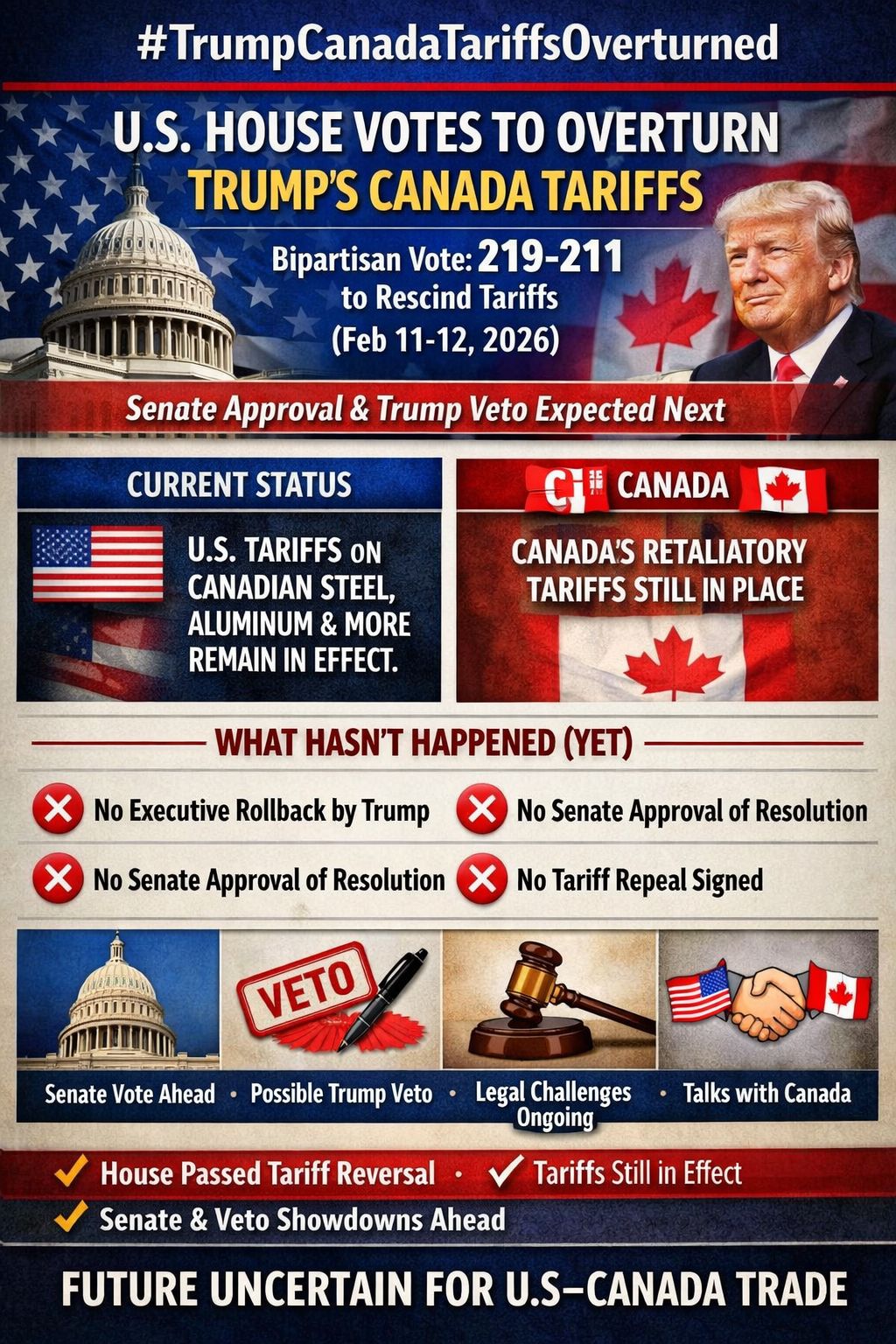
 s themselves are still legally in effect and enforceable.
🟡 The outcome depends on Senate action, possible vetoes, and negotiations/legislation later in 2026.
If you want a timeline or details on which products are affected and tariff rates by category (metals, autos, energy, etc.), just let me know!