
FOGO's most misunderstood feature is not speed itself, but geography. @Fogo Official reorganizes consensus around physical proximity, and that decision quietly changes everything. Instead of pretending the internet is flat, FOGO acknowledges latency as a physical constraint and engineers around it. Validators inside a FOGO zone operate near hardware limits, compressing communication delay to the smallest measurable window. Consensus stops being an abstract coordination game and becomes a tightly synchronized mechanical process.
Traditional distributed systems stretch validators across continents and then attempt to optimize around distance. FOGO inverts that assumption. FOGO clusters validators within defined zones, where network round-trip times approach data-center thresholds. The result is not incremental acceleration but structural latency compression. I think this is less about performance marketing and more about respecting physics as a design principle.
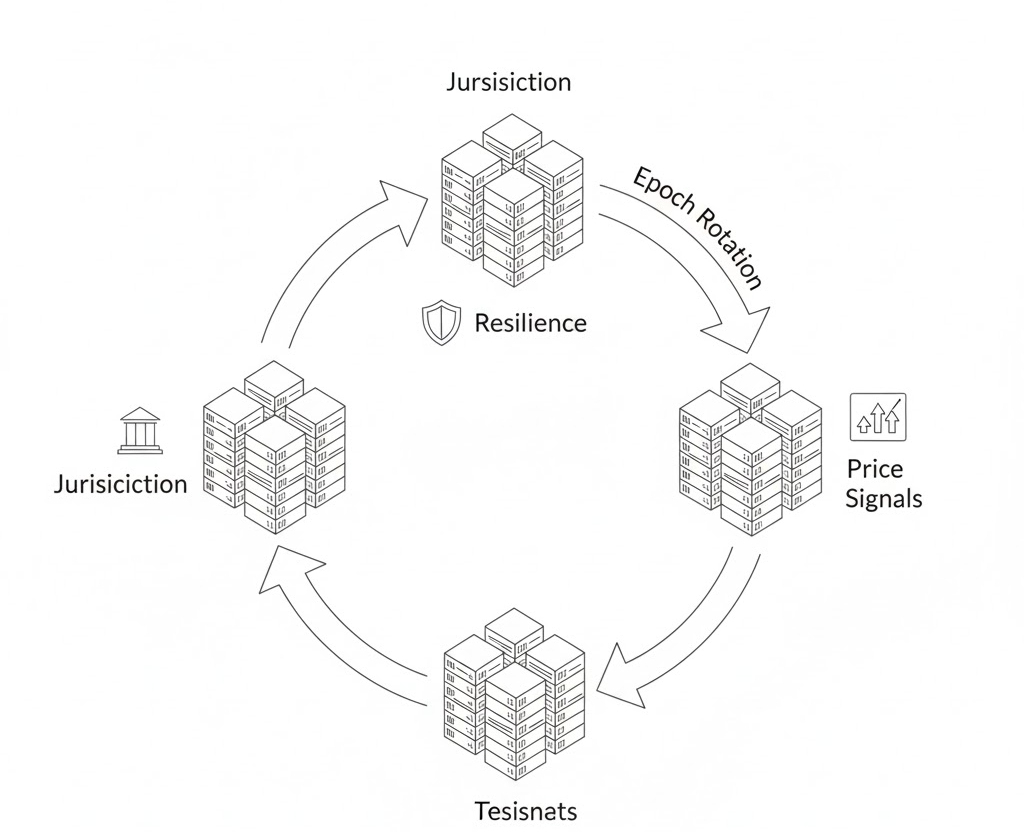
Critics might interpret clustering as centralization, but FOGO offsets this through dynamic zone rotation. Zones shift across epochs through on-chain coordination, redistributing physical concentration over time. FOGO maintains jurisdictional decentralization not by scattering validators randomly, but by rotating proximity strategically. Infrastructure resilience becomes temporal rather than spatial.
This approach reframes decentralization as a moving equilibrium. Instead of maximizing distance at every moment, FOGO maximizes performance locally and distributes power longitudinally. I acknowledge that this introduces operational complexity, yet it transforms decentralization from static ideology into an adaptive system.
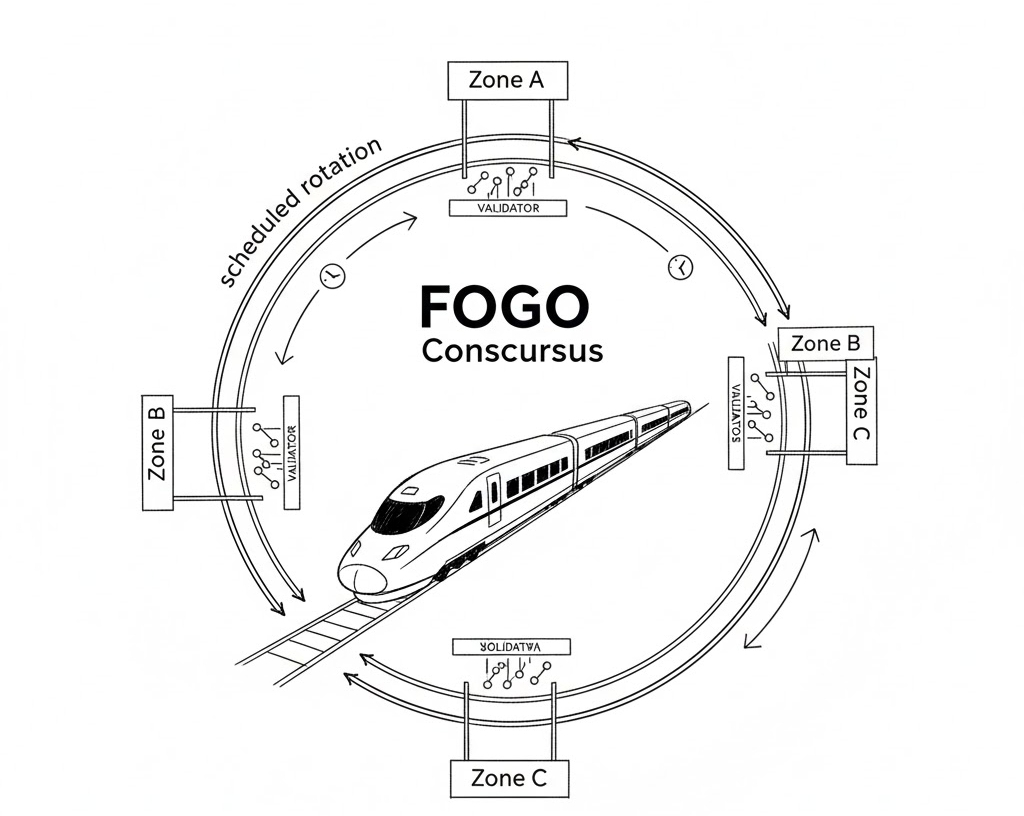
FOGO treats consensus like high-speed rail: compress distance where it matters, then rotate routes deliberately. The insight is subtle but profound. Performance does not require abandoning decentralization; it requires redefining how and when decentralization is expressed. Over time, FOGO suggests that the future of high-frequency on-chain systems will not be won by code alone, but by how intelligently networks negotiate the physical world they inhabit.