
$XRP Blockchain innovation rarely announces itself with noise. Instead, meaningful progress often appears through quiet protocol improvements that gradually redefine how digital finance operates. A recent upgrade to escrow functionality on the XRP Ledger reflects this pattern, signaling a deeper shift in how assets, liquidity, and compliance mechanisms can function within a single decentralized environment.
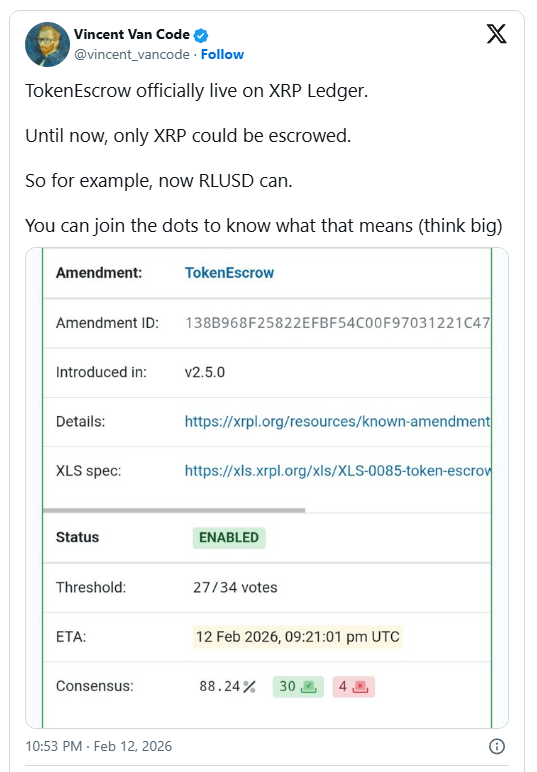
Information shared by Vincent Van Code highlights that escrow on the XRP Ledger has moved beyond its original limitation. Until now, only XRP could be placed in escrow using native ledger features.
The newly introduced TokenEscrow capability extends this function to issued tokens, allowing assets such as RLUSD to benefit from the same time-locked and condition-based settlement structure that previously applied only to the network’s native currency.
💥Expanding the Ledger’s Financial Architecture
This development does more than add convenience. It fundamentally expands the XRP Ledger’s financial design. Native escrow for issued tokens enables programmable lockups, staged releases, and automated settlement without external smart-contract layers. That change reduces reliance on intermediaries while preserving the ledger’s core strengths—speed, low cost, and deterministic execution.
Financial institutions require these characteristics to manage transactions that are subject to regulation. Escrowed issued assets can now support compliance-driven payment timing, transparent audit trails, and conditional fund releases directly on-chain. These features move the ledger closer to real-world financial infrastructure rather than experimental blockchain tooling.
💥RLUSD and Institutional Utility
The ability to escrow RLUSD carries particular importance within Ripple’s broader strategy around regulated digital liquidity and tokenized finance. Stablecoins connect traditional money to blockchain transactions. Adding native escrow strengthens their role in enterprise scenarios such as collateral management, trade finance execution, and cross-border treasury coordination.
Enterprises get predictable settlement processes using escrow, releasing funds only when specific conditions are met. This certainty reduces counterparty exposure and improves operational efficiency—two requirements that institutional finance treats as non-negotiable.
💥A Step Toward Fully Tokenized Markets
TokenEscrow may appear incremental, yet its structural implications remain significant. By removing the restriction that confined escrow to XRP alone, the XRP Ledger now supports programmable coordination across multiple asset types within a unified system. This capability aligns with the broader industry transition toward tokenized securities, real-world assets, and automated financial workflows.
Infrastructure maturity ultimately determines which blockchain networks achieve large-scale adoption. The evolution of escrow on the XRP Ledger demonstrates steady progress toward production-grade readiness. Quiet upgrades like this often shape the future of digital finance long before the wider market recognizes their importance.
🚀🚀🚀 FOLLOW BE_MASTER BUY_SMART 💰💰💰
Appreciate the work. 😍 Thank You. 👍 FOLLOW BeMaster BuySmart 🚀 TO FIND OUT MORE $$$$$ 🤩 BE MASTER BUY SMART 💰🤩
🚀🚀🚀 PLEASE CLICK FOLLOW BE MASTER BUY SMART - Thank You.