
There is a specific moment that most people who have interacted with financial or medical systems will recognize. You need to confirm one thing — that you qualify, that you are who you say you are, that a condition is met — and the system responds by asking for everything. Not because everything is relevant. Because the system has no mechanism for anything less. It cannot accept partial truth. It cannot verify a single fact without consuming the full picture. So you hand over more than you intended, more than was necessary, and more than you will ever be able to take back. That experience is so common it has stopped feeling like a problem. It just feels like how things work.
It does not have to work that way.
Midnight Network is not the first project to notice this problem, but it may be the first to approach it with the right kind of restraint. Before going further, it is worth being direct about what Midnight is not. It is not a privacy coin built around the premise that all activity should be hidden from everyone at all times. It is not recycling the argument that anonymity and utility are the same thing. And it is not trying to build a shadow system where the absence of accountability is dressed up as a feature. Those versions of privacy have existed in crypto for years and have spent most of that time explaining themselves to regulators rather than building useful products.
Midnight Network is doing something more disciplined. It is building a blockchain where privacy is a programmable decision rather than a fixed state. The project calls this rational privacy — the idea that information should be revealed selectively, to the right parties, under conditions that the user or developer defines, rather than being either fully public or completely invisible by default. That distinction sounds subtle until you think about what it actually unlocks.
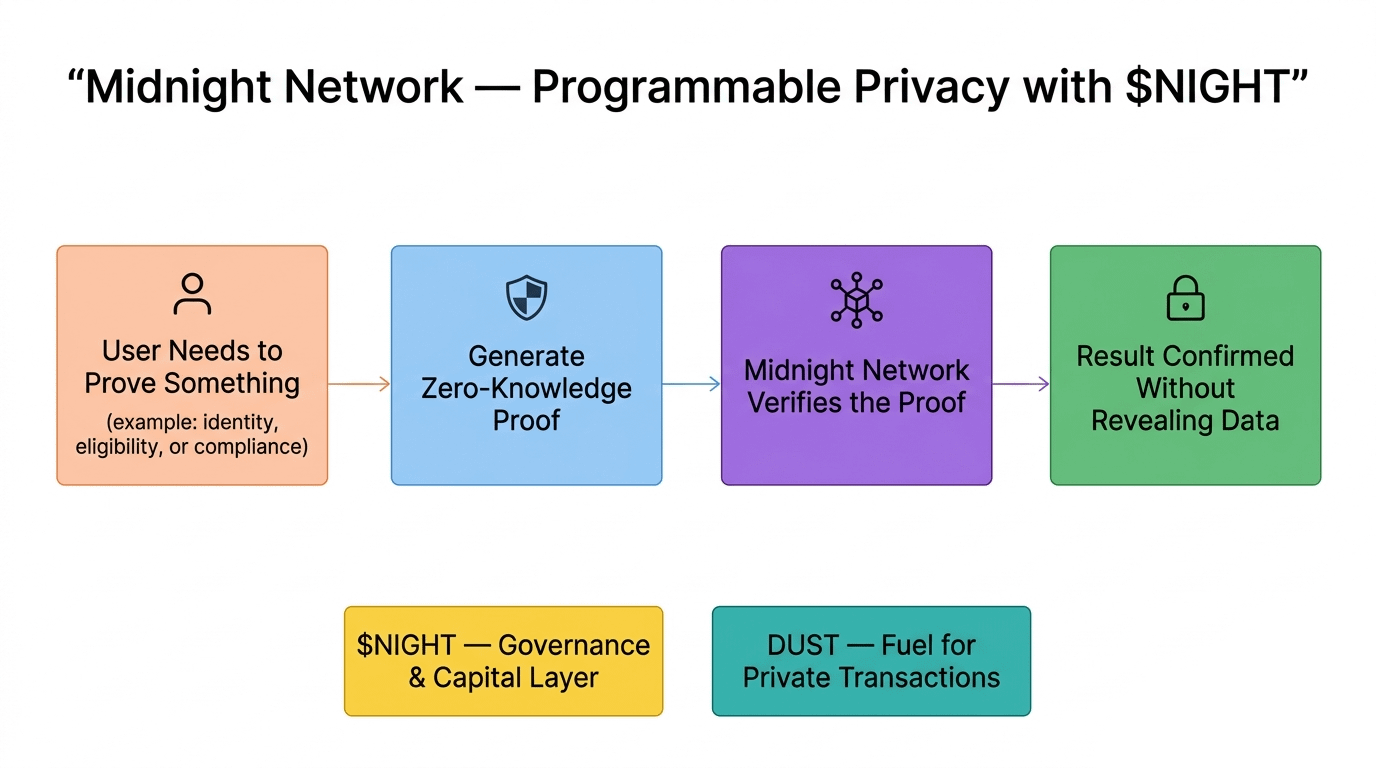
Zero-knowledge proofs are the mechanism that makes this real. Here is how I think about it. Imagine a sealed envelope that can answer questions without being opened. You can ask it whether the number inside is greater than ten, whether the name inside matches a list, whether the amount inside qualifies for a threshold — and it will answer accurately every single time without ever revealing what is written on the paper. The envelope proves. It does not confess. That is what ZK proofs do inside Midnight Network. On-chain verification happens without on-chain exposure. The computation runs, the result is confirmed, and the underlying data never touches the public ledger.
That changes the scope of what blockchain can realistically support. Selective disclosure — the ability to prove eligibility, compliance, or correctness without surrendering the full data set — is not a premium feature for edge cases. It is a basic requirement for any system that wants to handle sensitive real-world information. Finance, identity, healthcare, legal agreements — none of these belong on a fully transparent ledger. Midnight Network is building the privacy layer that makes them possible on-chain for the first time in a way that does not require choosing between verifiability and protection.
What interests me about the economic design is how deliberately it separates two things most networks keep tangled together. $NIGHT is the governance and capital asset — publicly traded, currently sitting around $0.0493 after pulling back from a peak of $0.05523 reached earlier this week following its Binance listing. The correction is orderly. Volume remains significant at over 2.4 billion NIGHT traded in the past 24 hours. The price is consolidating just above its 7-period moving average, which suggests the market is digesting the listing surge rather than abandoning the position. But NIGHT is not what powers the private layer. Holding NIGHT generates DUST — a shielded, non-transferable resource that is consumed when executing private transactions and replenishes passively over time. DUST cannot be traded or transferred between wallets. It exists purely as operational fuel for the privacy layer. That design choice removes speculation from the transaction fee mechanism entirely, which is a more thoughtful approach to network economics than most projects at this stage are willing to commit to.
The mainnet — the Kūkolu phase — is weeks away. This is the moment where Midnight Network transitions from a token with a thesis to a network with actual activity. That transition is the only thing that matters now. Not the price, which will move on its own logic. Not the architecture, which has already been designed. What matters is whether developers find the programmable privacy model useful enough to build products that people come back to without being incentivized by emissions or dragged in by attention cycles.
I think the design is serious. I think the problem is real. What I cannot tell yet is whether the market for rational privacy is as large as the architecture deserves.
That gap — between a well-built system and a well-used one — is where every promising network either proves itself or quietly disappears. Midnight Network is standing at that gap right now. And the next few months will say more about its future than anything written about it today.
#night @MidnightNetwork $NIGHT
