
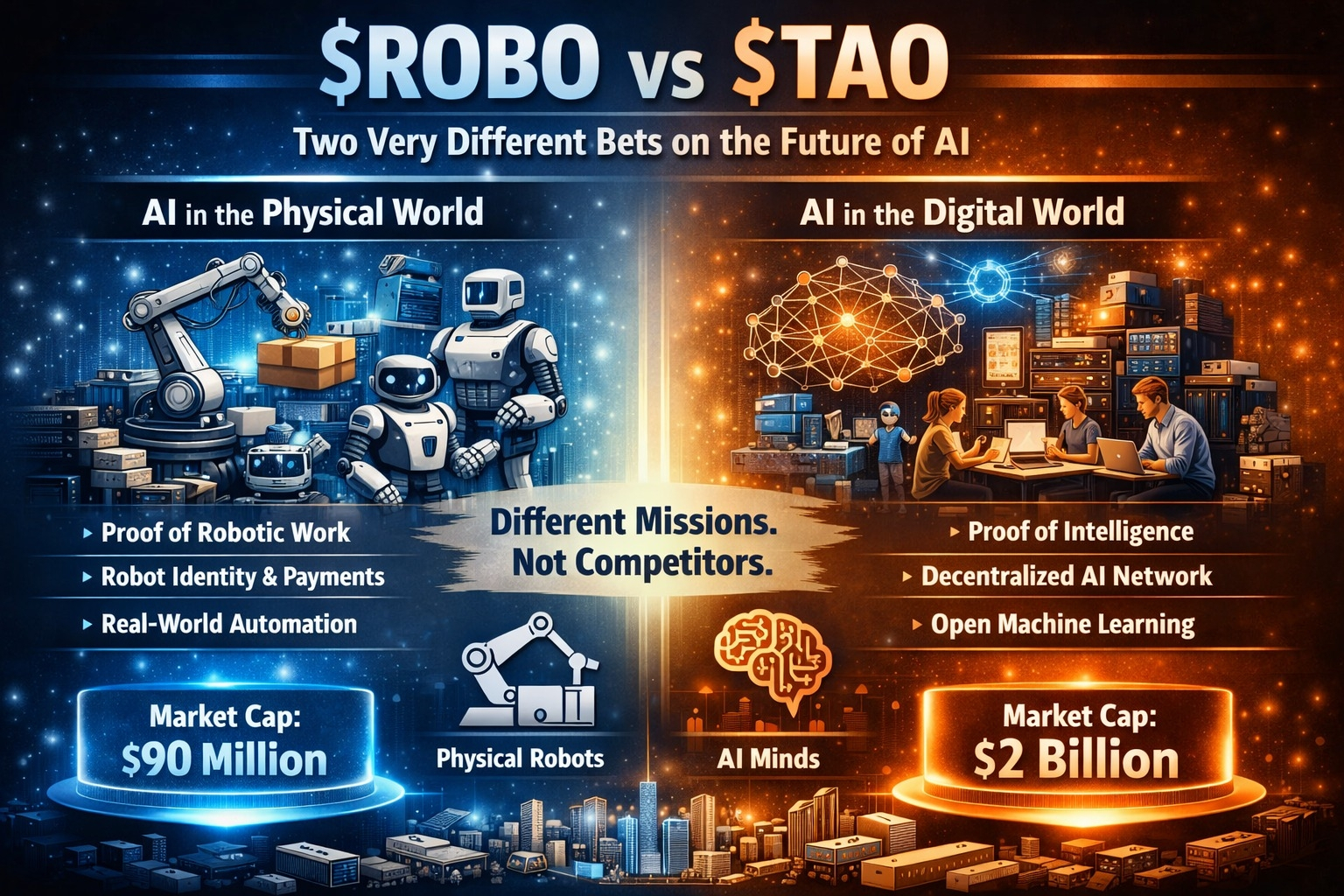
Both tokens have AI in their DNA. Both have serious backing. Both are building something that did not exist five years ago. But when you actually sit down and compare Robo and $TAO side by side, you realize these two projects are not really competing at all. They are solving completely different problems and understanding that difference is what separates informed holders from people just chasing narratives.
What TAO Actually Is
Bittensor has been around since 2021 and it has earned its reputation. The core idea is genuinely clever. Instead of a handful of tech giants controlling AI development behind closed doors, Bittensor creates an open decentralized marketplace where anyone can contribute machine learning models and get rewarded for the quality of their work.
The reward mechanism is called Proof of Intelligence. Miners contribute AI models. Validators score those models on quality. The better your contribution the more TAO you earn. It is essentially a stock market for artificial intelligence where the best ideas win and mediocre ones get weeded out naturally.
TAO currently sits at a market cap of around $2 billion and is ranked inside the top 50 projects globally. It has 128 specialized subnets covering everything from text generation to drug discovery. Grayscale even filed for a Bittensor Trust with the SEC in December 2025, which if approved would open a regulated pathway for institutional capital. That is not a small detail for a project still considered early stage.
TAO's supply model mirrors Bitcoin. Maximum 21 million tokens ever. A halving event expected later in 2026 that will cut daily emissions in half. Decreasing supply meeting growing demand is a simple story that historically ends well.
What $ROBO Actually Is
Robo launched on February 27, 2026 and it is solving a completely different problem. Not AI in the digital world but AI in the physical world.
Right now millions of robots are doing real work in warehouses, hospitals, delivery networks and factories around the globe. They generate genuine economic value every single day. And they cannot get paid, cannot hold a wallet, cannot prove their work history to a new employer, and cannot operate independently without a human acting as the financial middleman every single time.
@Fabric Foundation is fixing that. Through Fabric's on-chain identity system robots get a verifiable global passport, a wallet, and a reputation score built entirely from verified on-chain task completions. The reward mechanism is called Proof of Robotic Work. No real verified task completed, no reward. Simple and honest.

The supply picture is very different from TAO. Only 22.3% of the 10 billion total supply is currently circulating with investor and team tokens locked for 12 months. The Adaptive Emission Engine adjusts token issuance in real time based on actual network usage rather than a fixed schedule. And a portion of all protocol revenue is used to buy back $ROBO on the open market creating steady usage-driven demand.
The Real Difference
Here is the simplest way to think about it.
TAO is the infrastructure for AI minds. It is building the marketplace where machine intelligence gets created, improved, and rewarded. The participants are developers, miners, and validators contributing to a global AI brain.
Robo is the infrastructure for AI bodies. It is building the economic and identity layer for physical machines that already exist and are already working in the real world today. The participants are robot operators, hardware manufacturers, and businesses deploying autonomous machines at scale.
One is digital. One is physical. One rewards intelligence. One rewards verified real world work. They are not competitors. They are two different layers of the same machine economy that is building underneath all of us right now.
The Market Cap Conversation
TAO sits at $2 billion. Robo sits at roughly $90 million.
That gap is enormous and it reflects the fact that TAO has three years of proven execution, a large developer community, and institutional attention already flowing in. Robo is thirteen days old with its biggest milestones still ahead in Q2 and Q3 2026.
Buying TAO at $2 billion is a bet on continued growth from an already established position. Buying Robo at $90 million is a bet that physical robotics infrastructure becomes as important as digital AI infrastructure over the next two to three years.
Neither bet is wrong. They are just different risk profiles with different time horizons.
Which One?
Honestly, this is the wrong question. The more interesting question is what the machine economy looks like when both TAO and robo are fully operational. Decentralized AI models being trained and rewarded on-chain. Physical robots executing verified real world tasks and settling payments autonomously. Both running on open infrastructure that no single company controls.

That is not science fiction. That is what is being built right now.
TAO is already partway there. Robo is just getting started. Where you put your conviction depends entirely on where you think the bigger gap between current price and future value actually sits.
Do your own research. But at least now you understand what you are actually choosing between.