
I was scrolling through some of the latest Web3 announcements today and stumbled upon the ongoing discussions about Midnight Network. Honestly, privacy in crypto is becoming more crucial each year. Most blockchains are built around the principle of transparency, and while transparency builds trust, it sometimes overshares information. That’s where Midnight Network seems to stand out — it’s addressing a problem that many blockchain enthusiasts, including myself, are starting to feel more acutely.
The core of Midnight Network is its foundation on zero-knowledge proof (ZK) technology. For those unfamiliar, zero-knowledge proofs allow you to verify that a claim is true without revealing the underlying details. At first, it may sound technical, but the implications are huge. It’s a way to prove something is accurate without exposing sensitive data. Essentially, this technology offers the best of both worlds: confirmation and privacy.

I recently experienced a situation that highlighted this importance for me personally. Last week, I made a small trading mistake and shared my wallet interaction publicly, not thinking much about it. Almost immediately, I noticed that others could track more of my activities than I intended. Fortunately, nothing disastrous happened, but it was an eye-opening moment about how transparent blockchain technology can be and how that transparency can sometimes feel intrusive. In this context, Midnight Network’s privacy-focused approach makes a lot of sense. It feels like the next logical step in the evolution of blockchain — a way to combine decentralization with user privacy.
What excites me the most about Midnight is that its emphasis on privacy doesn’t compromise utility. Developers can still create decentralized applications (dApps) and other digital services on the network. Privacy and functionality are often seen as trade-offs, but Midnight Network appears to strike a balance that could be transformative for the Web3 ecosystem. From my perspective, this balance could define the next stage of blockchain adoption. Users want the benefits of blockchain ownership, decentralization, and transparency without giving up personal data or exposing their activities to unnecessary scrutiny.
Midnight Network is, in many ways, building toward a new model of digital trust. In traditional blockchains, every transaction is visible, meaning activity can be tracked and analyzed. This transparency is vital for trustless systems, but it also introduces privacy concerns. Midnight Network offers a solution: maintain the decentralized, trustless nature of blockchain while giving users control over what information is revealed. It’s privacy without compromise.
The potential use cases for this technology are enormous. Beyond trading and wallets, I can see Midnight Network enabling private voting systems, confidential supply chain tracking, and secure healthcare data sharing. Imagine decentralized social networks where users’ interactions are verified but not fully exposed, or finance systems where transaction proofs exist without revealing the amounts or parties involved. These are areas where zero-knowledge proofs can genuinely change the game.
From my standpoint, this is not just about technology — it’s about redefining digital rights in the Web3 era. Users increasingly expect control over their own data, and projects that ignore this reality may struggle to gain adoption. Midnight Network seems to understand this deeply. By allowing privacy to coexist with transparency and utility, it aligns with the evolving expectations of the crypto community.
I also find the design philosophy fascinating. Midnight doesn’t force developers into cumbersome workarounds. Privacy is embedded into the system rather than being an afterthought. That’s important because adoption often hinges on simplicity. Developers want networks that are powerful but accessible, and users want privacy that doesn’t feel restrictive. Midnight Network seems to address both, and I find that combination rare in the blockchain space.
Reflecting on my own experience with public wallet exposure, I now appreciate how vital this approach is. Transparency is essential, but so is individual security and control. Blockchain has always promised empowerment, but if users are forced to sacrifice privacy to participate, the promise is only partial. Midnight Network could help close that gap, giving users the tools to engage safely and securely without fear of unnecessary exposure.
Another aspect worth noting is the community potential. Privacy-focused blockchains naturally attract users who value discretion, security, and autonomy. I think Midnight Network could foster a strong, privacy-conscious ecosystem that encourages thoughtful innovation. Developers and users alike could collaborate in a space where sensitive data is respected, yet innovation isn’t hindered. This could become a defining feature of the network, differentiating it from other blockchains that prioritize transparency above all else.
Moreover, the long-term implications for Web3 are significant. If projects like Midnight succeed, the industry could shift toward a paradigm where privacy is a standard expectation rather than an optional feature. I see a future where blockchain technologies don’t just enforce transparency — they respect personal boundaries, empower users to own their data, and enable applications that were previously difficult due to privacy concerns. It’s an evolution that feels overdue.
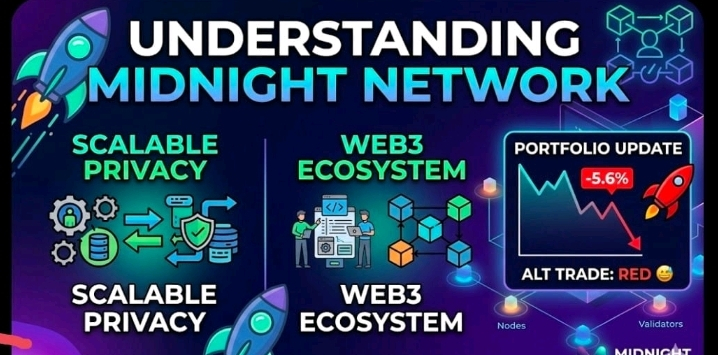
From my analysis, the Midnight Network journey reflects a larger trend in blockchain: converging transparency with user privacy. This convergence could redefine what it means to interact in a decentralized system. Users may increasingly choose networks not only for speed, scalability, or decentralization, but also for the trust that their sensitive actions remain confidential. Privacy could become a primary criterion in evaluating blockchains, and Midnight Network is positioning itself at the forefront of this shift.
I also believe the timing is perfect. As more people and institutions explore blockchain adoption, concerns about privacy and data protection are growing louder. Governments, businesses, and individuals are all recognizing that while transparency is powerful, unchecked exposure carries risks. Midnight Network could become a model for future blockchain architectures, showing that privacy doesn’t have to compromise utility or security.
In conclusion, my view is clear: Midnight Network is not just another blockchain project. It’s a potential milestone in the evolution of Web3. By using zero-knowledge proofs to secure privacy while maintaining functionality, it addresses a fundamental tension in blockchain adoption. From my perspective, the balance it strikes could become a major theme in the coming years, defining how we interact, transact, and innovate online.
I’m genuinely excited to follow this project’s trajectory. I believe that if the team continues focusing on development, community engagement, and real-world utility, Midnight Network could set a new standard for privacy in blockchain. And honestly, that’s exactly the direction the crypto world needs to go. As I reflect on my own experiences, I can’t help but feel that privacy-focused innovations like this are not just beneficial — they’re essential. Blockchain has the potential to be transparent, secure, and user-centric all at once. Midnight Network may well be leading us toward that future, and I, for one, am watching closely.