
While I sat with cold coffee staring at the Midnight Explorer stats, a single transaction hash — 0x2e99e5948863d14e14ad1ee5a35af01b500c9b56563809282987175c141cb509 — settled quietly in epoch 985,194 on the preprod network. Nothing flashy. Just another shielded interaction ticking through. Yet it made me pause on how privacy-focused protocols are truly evolving in Web3, especially here in the Midnight Network with its $NIGHT token.
The $NIGHT itself stays public for governance and alignment. Hold enough and it steadily mints DUST behind the scenes. That DUST then powers every private call. No separate gas market. No opt-in toggle. The shielded layer simply is the execution environment.
I caught myself smiling at the simplicity. Earlier in the CreatorPad dive I had expected another privacy coin story — hide everything, reveal nothing. This felt different. One quiet personal story from that night: I had just closed a routine position on another chain, nothing to do with Midnight, and switched tabs. The contrast hit harder because the chain kept humming without me.
Two actionable insights jumped out right away. First, developers now design assuming privacy by default instead of bolting it on later. Second, the resource model ties long-term commitment to NIGHT holdings directly to usable privacy capacity.
the contrast that stuck with me
Older privacy protocols treated shielding like a premium feature. You paid extra, proved extra, hoped the network stayed live. Here the default is complete shielding. Only what you choose to reveal ever surfaces — through zero-knowledge circuits that cost nothing beyond the DUST already accruing.
I watched two timely market examples unfold on the same preview chain. One DeFi team ran payroll logic that proved total compliance to auditors without exposing individual salaries. Another supply-chain pilot verified carbon data across borders without leaking vendor margins. Both stayed invisible until the exact proof was needed.
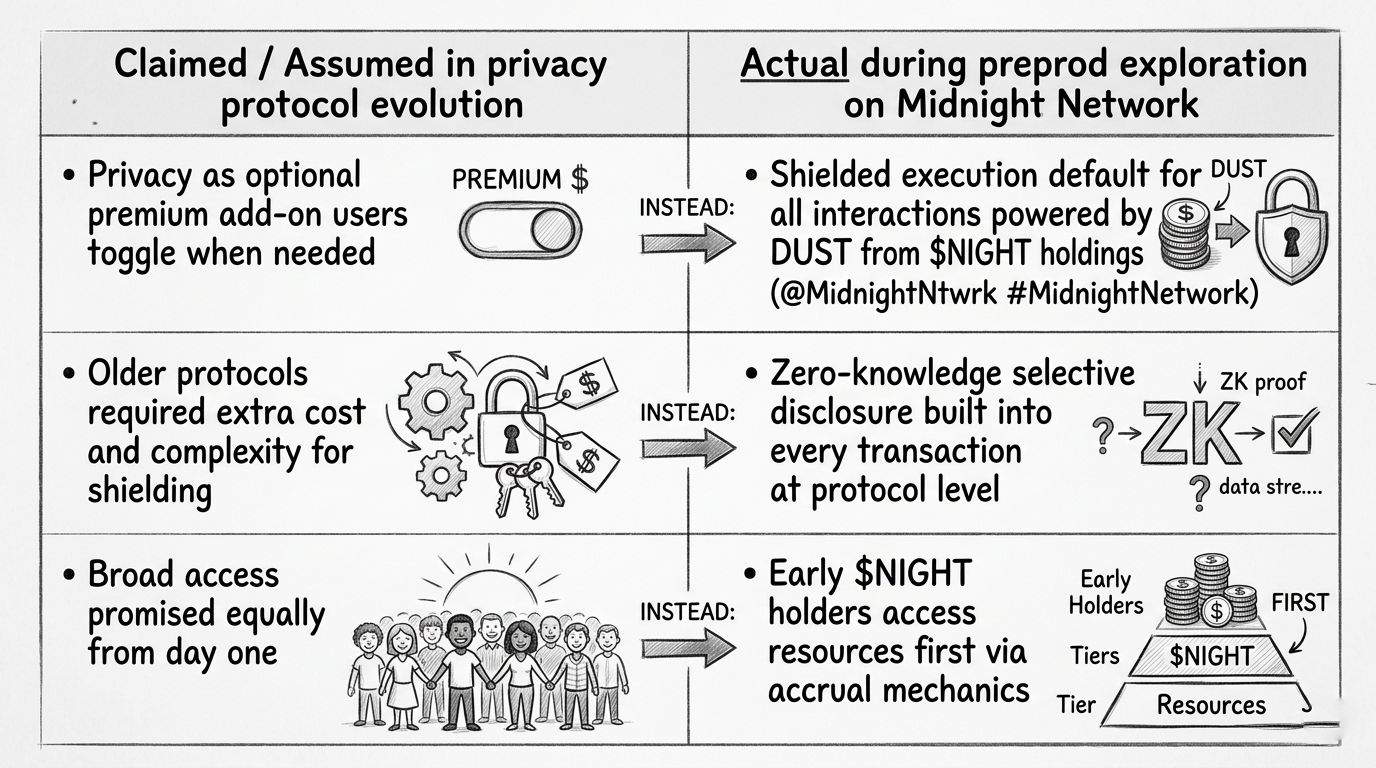
The evolution feels less about secrecy and more about control. You decide the visibility at the moment of truth. Regulators get what they require. Counterparties get what they need. Everything else stays yours.
Actually — that shift changes the whole risk conversation in Web3. Institutions that once walked away from public ledgers might finally step in.
Three quiet interconnected layers clicked for me. Public NIGHT layer for governance and consensus. Private DUST layer for execution resources. Selective disclosure layer for programmable proofs. Together they form a feedback loop that older privacy projects never quite achieved.
hmm... this mechanic in practice
Hmm… the distribution still nags at me. Over 4.5 billion NIGHT already claimed through earlier drops. Early holders generate DUST first. That’s rational — skin in the game matters — yet it does mean the widest privacy access opens first for those who arrived earliest.
I keep turning it over. Is this the price of a stable launch? Probably. Still, I catch myself wondering how later builders will feel when the resource engine is already running smoothly at mainnet.
On-chain behavior I observed was steady. Ninety to one-hundred-twenty transactions per day, mostly unremarkable. No viral spikes. No sudden governance drama. Just the chain quietly proving it can handle shielded workloads without drama.
The federated operators — Google Cloud, Blockdaemon, others — added weight recently ahead of the late-March push. You could feel the network settle a little firmer.
still pondering the ripple
Here’s the part that lands heavier at this hour. Midnight isn’t chasing anonymity for its own sake. It’s building rational privacy as infrastructure. You get to keep what should stay private while proving what must be proven. That selective control rewrites the exposure equation entirely.
I’m not convinced every regulator will read it that way at first. Some will still see the word “privacy” and pause. Others might notice the auditable NIGHT layer and the programmable proofs and decide to test it themselves.
Either way, the on-chain reality I watched last night already answers a question most protocols dodge: can privacy scale without asking users to trust a black box?
The federated phase winds down soon. Community block production follows. Governance moves fully on-chain. The mission — privacy as default infrastructure, not gimmick — either proves itself or it doesn’t.
Developers who gave up on earlier privacy chains because audits were impossible might finally build here. Teams that avoided crypto over compliance fears might lean in.
What happens when the first enterprise application moves real value through those shielded circuits and the disclosure model actually satisfies regulators instead of alarming them? That’s the question I can’t stop turning over.
@MidnightNetwork #night