
On a weekday morning in a cloud region you’ll never visit, a rack of servers is doing work on your behalf. The air is dry and cold. Fans spin at a pitch that makes conversation feel slightly rude. A payment clears. A model returns an answer. A batch job finishes “successfully.” We accept the result because the system says it’s done.
That quiet leap of faith is the hinge point of modern computing. The pipeline turns green. The wrong thing ships.
Verifiable computing is an attempt to replace “trust me” with “show me.” Not in a moral sense, and not as a courtroom drama. In the narrow, technical sense: can a system produce evidence—cryptographic, checkable evidence—that a specific computation was performed correctly on specific inputs under a specific program? Evidence that a third party can validate without repeating the whole job. That last part matters. If you have to rerun a week-long workload to check it, you haven’t really changed the economics of trust.
People sometimes assume this is a niche concern, like academic cryptography looking for a problem to adopt. Spend time around regulated industries and it stops feeling theoretical. Hospitals want to share analytics across institutions without exposing raw patient data and without taking on the risk of “we ran your query, just believe us.” Financial firms want a way to verify that a risk calculation used the agreed model version, not a slightly altered one. Governments want procurement systems where auditability is built in, not bolted on after an incident. Even inside a single company, the same tension shows up when teams don’t share the same incentives. A fraud group needs to trust an ML score computed by a platform team. A legal team needs to trust that a deletion job actually deleted what it claimed to delete. “We logged it” isn’t always enough, because logs can lie, or drift, or simply omit the inconvenient parts.
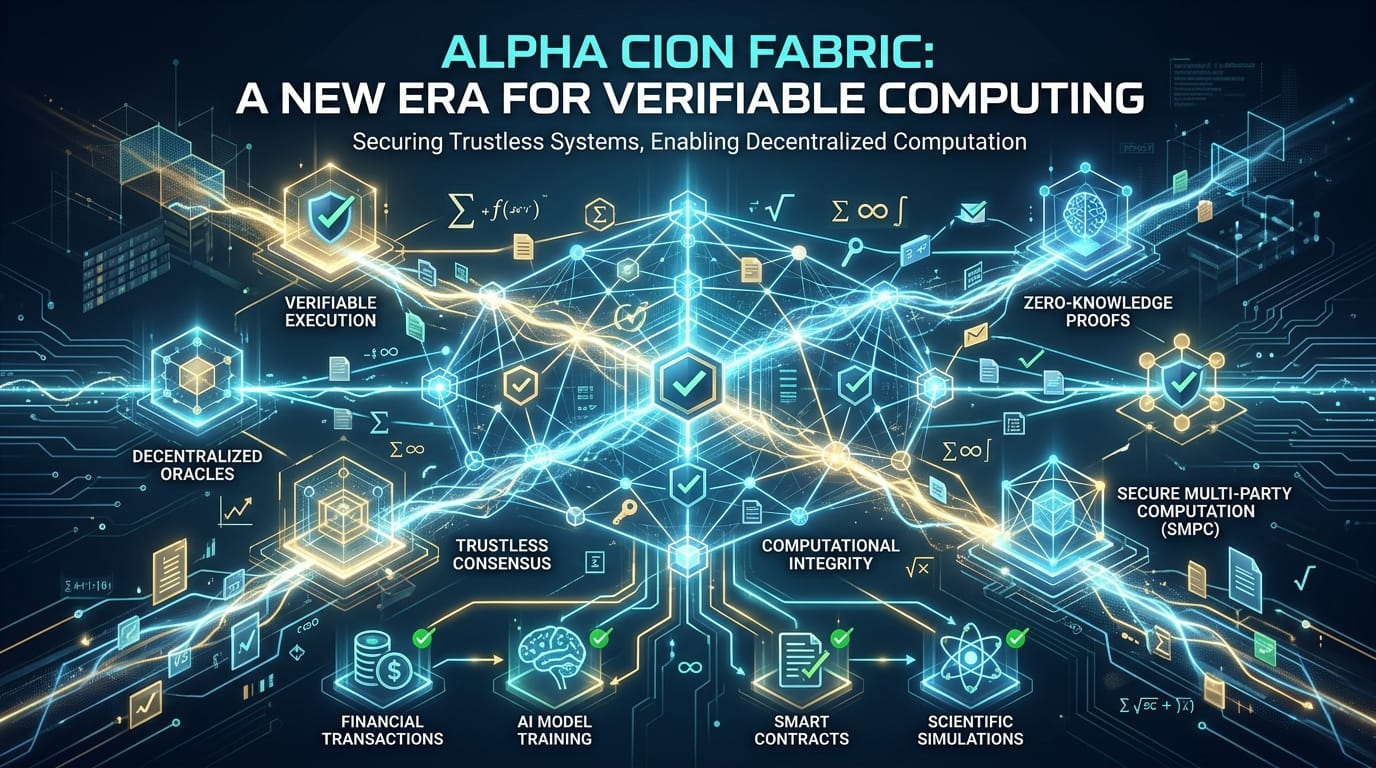
In that landscape, something like Alpha CION Fabric makes sense as an organizing idea: a fabric not in the fashionable sense of a rebrand, but as a literal weave of mechanisms that make computation legible and checkable. Verifiability is never a single trick. It’s layers, and the seams between layers are where projects usually fail.
One layer is identity and provenance. It’s a Git commit hash that actually corresponds to what was deployed, not just what someone merged. It’s a container image digest, not a mutable tag. It’s a record of compiler versions and flags. Anyone who’s tried to reproduce last quarter’s model training run knows how quickly “the same code” turns into a myth.
Another layer is execution integrity .TEEs have had a history of side-channel issues, and operationally they add their own friction: restricted memory, different debugging workflows, and a dependency on vendor microcode updates that arrive on someone else’s schedule. They also answer a narrower question—“did this code run in this type of enclave?”—not “was the output correct in the mathematical sense?”
That’s where proof systems come in. Zero-knowledge proofs and succinct arguments—SNARKs, STARKs, and their relatives—can let a prover convince a verifier that a computation was performed correctly without revealing inputs, and often with verification that is much cheaper than recomputation. But those systems have constraints that show up fast in real work. You have to express the computation in a form the prover can handle. Some operations are expensive to prove. Memory access patterns can be painful. Floating‑point arithmetic is notoriously tricky, which is awkward in a world where so much “computation” is ML inference and training. Proving a large neural network end-to-end remains costly, and the engineering around it is still maturing.
A credible “fabric” approach acknowledges those tradeoffs instead of pretending they don’t exist. You don’t prove everything. You choose what must be proven and what can be attested, logged, or sampled, based on risk and cost. A payroll calculation with strict rules is a good proof target. A streaming recommendation model might be better served with attestation for the runtime plus spot-checkable proofs on smaller invariants—“this model hash,” “these inputs bounds-checked,” “this post-processing applied.” The art is in deciding where the boundary sits, and making that decision explicit rather than accidental.
Then there’s the question of how humans and systems consume the evidence. Proofs are only useful if they’re attached to something the rest of the world can understand. A verifiable result needs metadata: which dataset version, which parameter set, which policy. It needs a place to live, whether that’s an append-only log, a database with strong audit properties, or a ledger. It needs a stable interface so downstream systems can reject results that arrive without valid proofs or attestations, the way a browser rejects an invalid TLS certificate. This is the part that touches routines: an engineer adding a check in CI that fails a build if the artifact isn’t reproducible; an SRE wiring an alert when attestations stop arriving; an auditor sampling proofs the way they sample transactions today.
Alpha CION Fabric, if it’s worth the name, would be judged in those small moments. Not in a demo where everything is perfectly configured, but on a Tuesday when a dependency breaks and someone has to decide whether to pin, patch, or roll back. When a proof generator slows down a job and the business wants the latency back. When a security team asks for enclave updates and the platform team has to schedule downtime. When a developer tries to debug a failing proof circuit at 2 a.m. and discovers the tooling is still built by researchers for researchers.
What makes verifiable computing feel newly urgent isn’t ideology. It’s the shape of modern systems. We are increasingly relying on remote execution, on third-party APIs, on AI systems that produce outputs that can’t be sanity-checked by eyeballing a few lines of text. A number comes back from a model and it might be right for reasons that are hard to explain, or wrong in ways that are hard to detect. That’s not a moral failure. It’s a mismatch between how much we outsource and how little we can independently confirm.
A new era, if there is one, won’t arrive because the cryptography got prettier. It will arrive when verifiability becomes a practical default in the places where trust is currently an assumption: when proofs and attestations are cheap enough, tools are boring enough, and workflows are ordinary enough that people stop noticing them. That kind of progress tends to look anticlimactic from a distance. Up close, it’s a string of careful choices. It’s admitting what can’t yet be proven, and proving what matters anyway.