Fundamental Analysis of Fabric Foundation (ROBO)
1. Introduction
The @Fabric Foundation Fabric Foundation is a non-profit organization focused on building infrastructure that connects artificial intelligence, robotics, and blockchain technology. Its main goal is to create an open economic system where intelligent machines and humans can work together safely and productively.
As AI systems move from purely digital environments into the physical world through robots and autonomous agents, the need for governance, identity, and economic coordination becomes critical. Fabric aims to solve this by creating decentralized infrastructure that allows robots to participate in the economy.
---
Fundamental Analysis
1. Vision and Mission
@Fabric Foundation Fabric Foundation’s mission is to ensure that intelligent machines remain aligned with human values and accessible globally. It focuses on building systems that allow machines to act as economic participants while remaining transparent and accountable.
The foundation emphasizes:
Human-machine alignment
Decentralized governance
Global participation in robotics networks
Transparent economic coordination between machines and humans
This vision positions Fabric at the intersection of AI, robotics, and Web3, which are three of the fastest-growing technology sectors.
---
2. Technology Overview
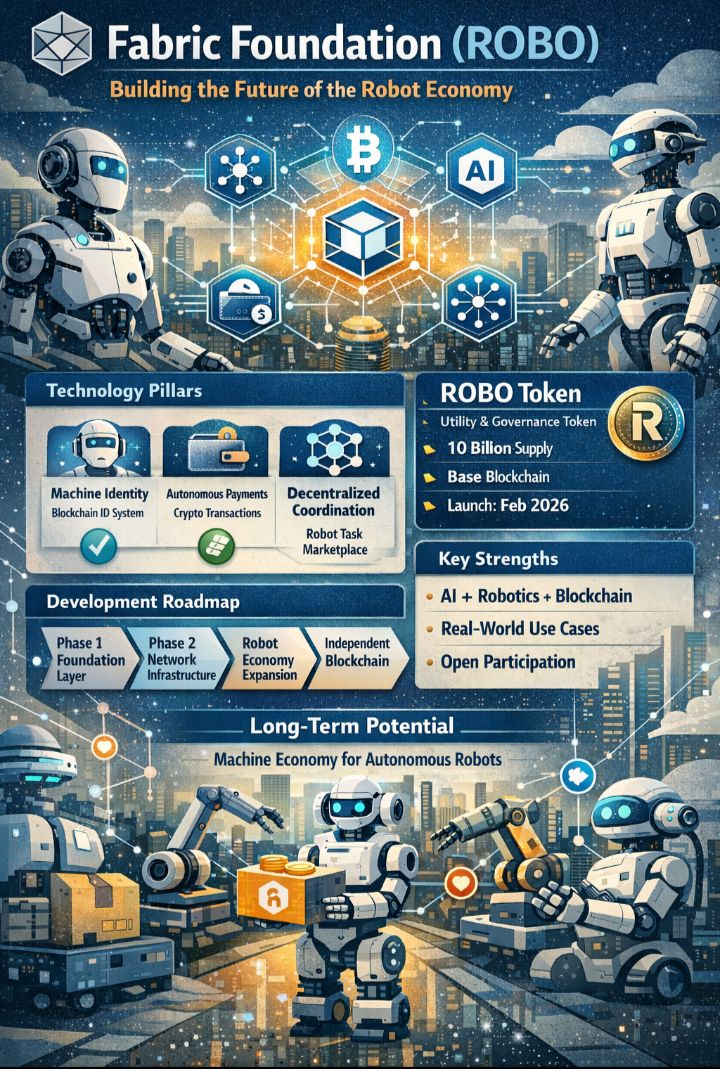
Fabric aims to build a robot economy infrastructure consisting of three key components.
1. Machine Identity System
Robots need verified digital identities so they can operate in real-world environments. Fabric proposes using blockchain-based identity registries to track robot ownership, permissions, and performance.
2. Autonomous Payment System
Robots cannot open bank accounts, but they can hold crypto wallets. Fabric enables robots to receive payments, pay for services, and interact economically through blockchain.
3. Decentralized Coordination
Fabric provides a marketplace where participants can deploy robots, coordinate tasks, and receive rewards for verified work such as maintenance, training, or data contributions.
3. Tokenomics – ROBO Token
The ecosystem uses the $ROBO ROBO token as its native utility and governance token.
Key Functions
Payment for robotic services
Network transaction fees
Governance voting
Incentives for contributors
Supply Details
Total Supply: 10 billion ROBO
Initial launch: February 2026
Blockchain: Base (Ethereum Layer-2)
Token Distribution
Category Allocation
Ecosystem & Community 29.7%
Investors 24.3%
Team & Advisors 20%
Foundation Reserve 18%
Airdrops & Launch ~7.5%
The vesting structure is designed to align long-term incentives for developers and investors.
4. Development Progress
Fabric Foundation is currently in an early development stage, focusing on building foundational infrastructure.
Current Progress
Launch of the ROBO token
Initial deployment on Base blockchain
Development of robot identity and coordination frameworks
Research on human-machine alignment systems
These steps are important because robotics networks require both technical infrastructure and governance frameworks before large-scale deployment.
5. Roadmap
Although the project is still evolving, the roadmap can be divided into several phases.
Phase 1 – Foundation Layer
Launch of the ROBO token
Initial blockchain deployment
Research in robotics governance and machine alignment
Phase 2 – Network Infrastructure
Machine identity registry
Decentralized robotic task marketplace
Machine-to-machine payment systems
Phase 3 – Robot Economy Expansion
Large-scale robotic fleet deployment
Integration with industries like logistics, healthcare, and manufacturing
Decentralized governance of robot networks
Phase 4 – Independent Blockchain
Fabric plans to eventually transition from a Layer-2 network to its own Layer-1 blockchain as the ecosystem grows.
6. Strengths
1. Strong Narrative
The project combines AI + robotics + blockchain, which is a powerful technological narrative.
2. Real-World Use Case
Instead of focusing only on digital assets, Fabric targets real-world robotics and automation markets.
3. Open Infrastructure
The network aims to allow anyone to contribute to robot deployment and earn rewards.
7. Risks
1. Very Early Stage
Most infrastructure is still under development.
2. Complex Execution
Building a global robot economy requires integration of:
robotics hardware
AI systems
blockchain networks
regulatory frameworks
3. Adoption Challenges
Real-world deployment of robots is capital-intensive and slow compared to typical crypto projects.
8. Long-Term Potential
If Fabric succeeds, it could become core infrastructure for the machine economy, enabling robots to:
own wallets
perform autonomous work
receive payments
interact economically with humans
This concept could reshape industries such as logistics, manufacturing, and urban services.
Overall Fundamental Score (Analyst Perspective)
Factor Rating
Technology Vision ⭐⭐⭐⭐
Market Potential ⭐⭐⭐⭐
Adoption Risk ⭐⭐
Development Stage ⭐⭐
Overall: High potential but high risk due to early-stage development.
Visual Illustration
Below is a conceptual image representing Fabric Foundation’s Robot Economy infrastructure.
(Concept: Robots connected through blockchain networks and AI infrastructure.)
#IranianPresident'sSonSaysNewSupremeLeaderSafe