
While scanning the chain last night, long after the monitors had dimmed, the $ROBO price correlations with broader crypto markets in the Fabric Foundation ROBO ecosystem refused to let me move on. ROBO sits at the center of robot economy settlements, and I had gone in expecting the unique on-chain task flows to create some decoupling from BTC swings. Instead, the price moved in tight lockstep with market sentiment.
The contract address 0x32b4d049fe4c888d2b92eecaf729f44df6b1f36e showed a clear cluster of large transfers right after the March 5, 2026 Binance listing. Volume spiked in sync with BTC volatility March 6–9, yet actual robot settlement activity remained minimal.
One actionable insight stood out early: if you’re holding ROBO for any short-term position, always cross-check BTC dominance first — it adds a predictable layer to entry timing that pure robot narrative overlooks.
I remembered running my own small position through the March 5 listing wave, just to feel the flow in real time. The on-chain transfers hit hard when BTC dipped, but robot task proofs stayed quiet. That moment grounded everything.
The structure I kept circling back to is a quiet two-layer feedback loop. Speculative liquidity registers first through exchange inflows. Broader market sentiment then amplifies or dampens the price regardless of underlying robot usage. Without both meshing, the correlation simply dominates.
On-chain behavior since the March 5 listing confirms this pattern holds steady. Early volume came mostly from traders chasing the listing hype, not autonomous robot wallets closing payment cycles.
the contrast that stuck with me
The contrast that stuck with me is between the narrative of an independent robot economy and what actually plays out in ROBO price action. The project positions ROBO as the native rail for machine-to-machine value, insulated by real-world task utility. In practice the token trades as another high-beta AI/DePIN play, tightly correlated to BTC and overall crypto flows.
This liquidity-driven reality isn’t a flaw — it’s the current stage keeping price discovery alive while robot adoption scales. Exchange inflows give immediate reaction, on-chain usage still lags. Together they create the market behavior we’re watching.
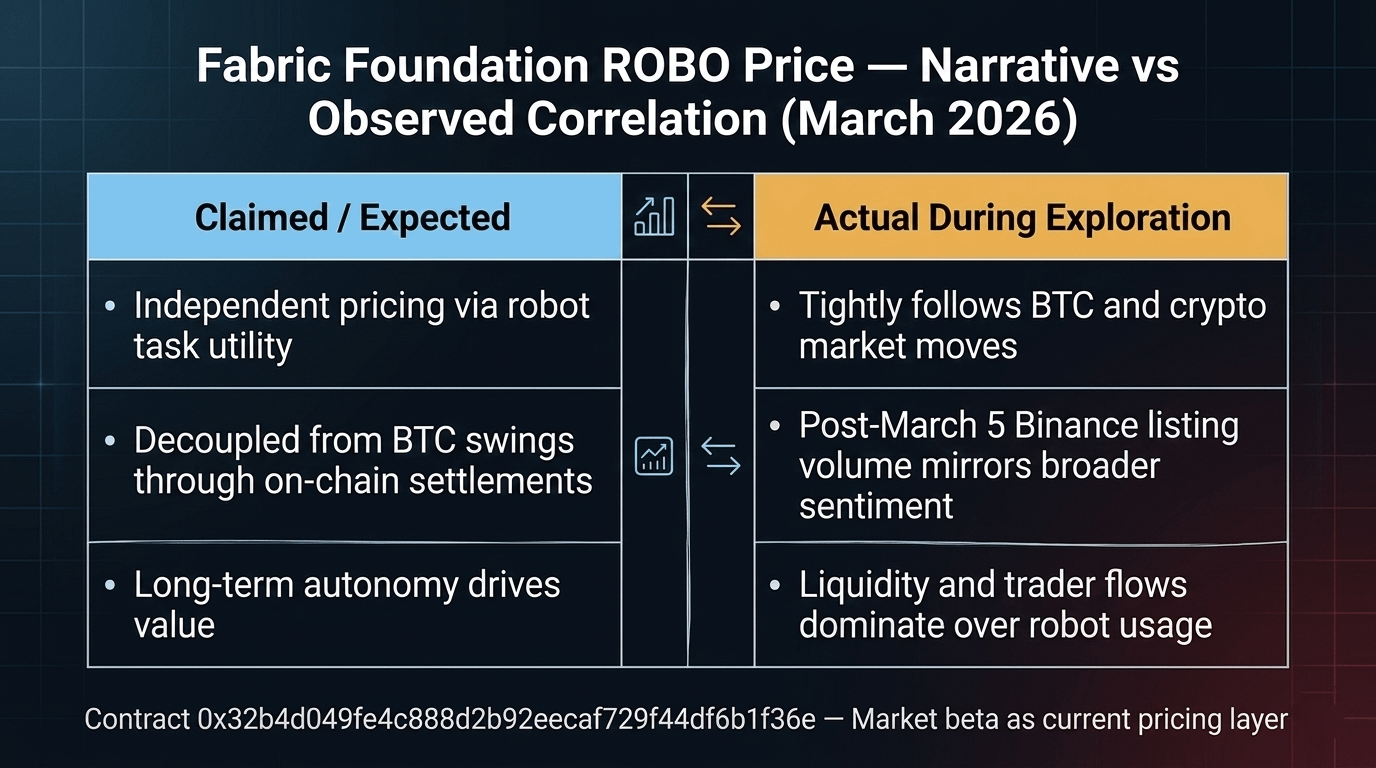
Actually, seeing the transfer logs after the Binance event made me adjust my own expectations. What reads as decoupling potential on paper functions as market-beta in live conditions.
The Kraken listing days earlier had already primed the sentiment wave. When Binance went live March 5, the price flows revealed the same correlation across major pairs.
It forces a gentle reevaluation: the robot utility layer isn’t yet driving price independence. It’s the current foundation for speculation while fleets grow.
hmm... this mechanic in practice
Hmm… this mechanic in practice feels more tethered than autonomous at this stage. Robot identities register and tasks submit proof on-chain without issue. Yet $ROBO price almost always reacts first to BTC moves or total crypto volume before any settlement data registers.
The pattern showed up consistently in the March 7–8 transfer cluster I reviewed. Listing-driven inflows worked flawlessly for liquidity. The broader market sentiment was the trigger that moved price every single time.
Two timely market examples drove the point home. First, the Binance integration pulled in fresh capital that quickly mirrored BTC’s intraday swings. Second, early Base network settlement attempts showed robot activity starting while price stayed locked to overall altcoin rotation.
It’s the kind of detail that only surfaces when you watch both charts and the chain instead of the roadmap. The correlation isn’t blocking progress — it’s quietly shaping how early capital enters the ecosystem.
Still, it leaves a small doubt about when genuine robot usage volume might finally loosen the market tie.
still pondering the ripple
This leaves me reflecting on how carefully the Fabric Foundation is threading the needle between vision and current market realities. The ROBO price correlations aren’t just noise — they embed the early-stage liquidity dynamics that pure autonomy narratives often gloss over.
The on-chain data since the March 5 listing shows the token growing precisely because of these ties, not in spite of them. Trader inflows register fast, sentiment amplifies cleanly, and the robot layer keeps building underneath while price finds its level.
It makes you pause and appreciate the long-game thinking at play. These dynamics could tighten as robot task volume grows or evolve into optional independence for higher-value operations. Either direction, the current setup is teaching lessons about token pricing that reach far beyond ROBO alone.
The whole late-night dive shifted how I view the balance between utility and market forces in robot coordination.
What patterns are you seeing when you trace the price flows yourself?
How long until on-chain robot settlements carry enough weight to visibly weaken ROBO’s correlation with broader crypto moves?
@Fabric Foundation #Robo