
Imagine waking up to find your bank account drained because a centralized AI, tasked with "verifying" your identity, was bypassed by a single developer with an "Admin Key." In the old world, we trusted the gatekeeper. In the new world, we trust the math.
As AI begins to manage real-world assets and execute financial decisions, the "black box" problem is no longer just a technical hurdle—it’s a systemic risk. If a single entity holds the keys to verify what is true, they hold the power to manipulate reality.
The "God Mode" Problem: Why Centralization Fails AI
Traditional AI verification relies on a central authority. Think of it like a courthouse where only one judge has the key to the evidence locker. If that judge is compromised, or if the locker is hacked, the entire system of justice collapses. This is the Admin Key vulnerability.
In 2026, we’ve seen that even the most "secure" centralized AI models are prone to:
• Single Points of Failure: One server breach can leak millions of private biometric records.
• The Incentive Gap: Centralized providers are incentivized to prioritize speed and profit over rigorous, transparent auditing.
• Opaque Logic: When an AI denies a loan or flags a transaction, you rarely get to see the "why" behind the "what."
Enter Decentralized Verification: The Power of many
Decentralized verification protocols (like those being pioneered in the Web3 space) replace the "Admin Key" with Consensus. Instead of one judge, imagine a network of thousands of independent "witnesses" (nodes) who must all agree on the validity of an AI’s output before it is recorded.
The Flow of Trust (A Visual Concept):
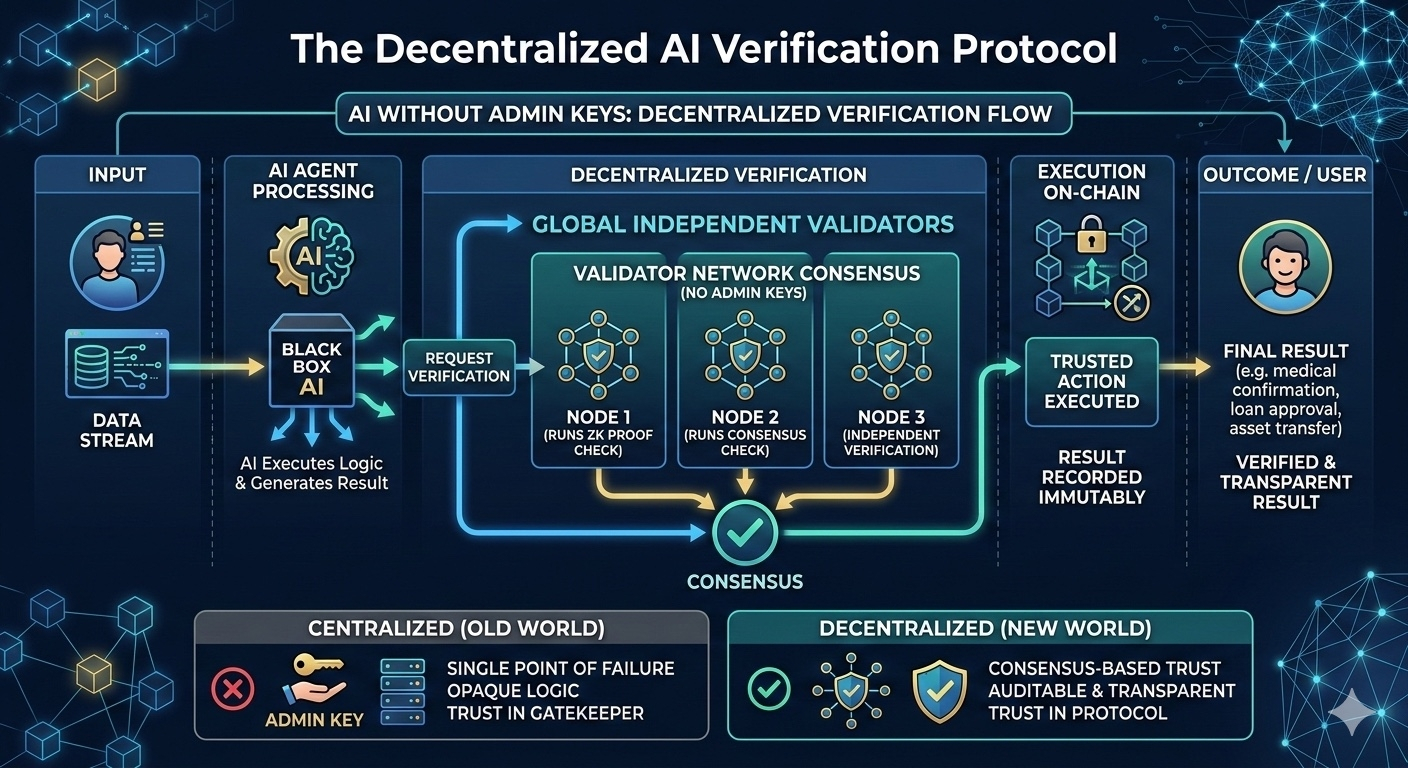
1. Input: User provides data/request.
2. Processing: AI generates a result.
3. The Challenge: Instead of instant acceptance, the result is sent to a Decentralized Validator Network.
4. Verification: Multiple independent models/nodes run a "check" using Zero-Knowledge Proofs (ZKPs)—proving the work was done correctly without seeing the private data.
5. Consensus: If the network reaches a majority agreement (>51\%), the action is executed on-chain.
6. Immutable Record: The verification is etched into the blockchain, forever auditable.
Real-Life Scenario: The Self-Driving Healthcare Agent
Consider a future healthcare DAO. You use an AI agent to analyze your genetic data and suggest a life-saving treatment.
• In a Centralized World: You send your DNA to a big-tech server. They give you a recommendation. You have no way to know if that recommendation was influenced by a pharmaceutical sponsor who "pushed" a specific drug through the AI's admin backend.
• In a Decentralized World: The AI's recommendation must be verified against a protocol of open-source medical logic. A network of nodes confirms that the AI followed the correct medical parameters without ever "seeing" your actual DNA. No admin can override the logic to favor a sponsor. The trust is in the protocol, not the provider.
Why Mindshare Principles Matter
This isn't just about "crypto" or "AI"—it’s about Sovereignty.
Creativity: From "Tools" to "Economic Peers"
We are moving from "AI as a tool" to "AI as an autonomous economic peer." Verification protocols are the "laws" that keep these peers honest.
• Real-World Example: Look at Mira Network. They treat AI outputs like legal claims, breaking them down and having a network of independent models verify each piece before it ever reaches you. It’s no longer about one AI's "opinion"; it's about a "jury" of AIs reaching consensus.
• Professionalism: "Verify Me" via On-Chain Analytics
By utilizing Zero-Knowledge Machine Learning (zkML) and EVM-compatible verification layers, we turn "trust me" into "verify me."
• Real-World Example: Projects like Brevis act as ZK co-processors, giving blockchains a "memory" and allowing them to verify complex historical data without exposing private details. This allows an AI to prove it’s making a trade based on real data without revealing your personal portfolio balance.
• Relevance: Securing the AI-Driven DeFi Economy
As DeFi moves toward AI-driven liquidity management, the lack of decentralized verification is the only thing standing between a "smart" pool and a multi-million dollar exploit.
• Real-World Example: The ASI Alliance (FET, AGIX, OCEAN) is building a "Machine Economy" where AI agents transact autonomously. Without decentralized verification, an agent could be "tricked" into a bad trade by a malicious admin. Decentralization ensures the agent’s logic is locked and verifiable on-chain, protecting billions in TVL.
The Shift from "Don't Be Evil" to "Can't Be Evil"
Centralized AI asks you to trust their motto: "Don't be evil."
Decentralized protocols use code to ensure they: "Can't be evil."
By removing the Admin Key, we ensure that AI remains a tool for the many, not a weapon for the few. We are building a world where truth isn't granted by a CEO—it's calculated by a network.
The Final Verdict
The "Admin Key" is a relic of a centralized past. In the decentralized future, the most successful AI projects won't be the ones with the best marketing—they'll be the ones that are the most auditable. When you remove the human gatekeeper, you don't lose control; you gain certainty.
If you had to choose between an AI that is 10% faster but controlled by one company, or an AI that is slightly slower but verified by a global, transparent network, which would you trust with your life savings?
@Mira - Trust Layer of AI #Mira #mira $MIRA
