
#Arbitrage trading takes advantage of market inefficiencies by simultaneously buying and selling an asset in two different marketplaces in order to profit from a price difference while "market neutral."
There are several types of #CryptoArbitrage , each with its own set of strategies and considerations.
🐋🐋🐋🐋🐋🐋🐋🐋🐋🐋🐋🐋🐋🐋🐋🐋🐋
1) Spatial arbitrage or cross-exchange: purchasing a coin on Exchange A (a less expensive exchange) and selling it on Exchange B (a more expensive exchange) because of price disparities.
Despite being considered "risk-free," there are risks associated with it, including transaction fees, execution delays, and rapid price swings (slippage). And, in order to execute such trading, it requires certain skills and high-speed and automated software with advanced algorithms to find and seize chances in milliseconds or to execute orders for you, e.g., bots, and substantial capital, and access to several trading platforms.
🐋🐋🐋🐋🐋🐋🐋🐋🐋🐋🐋🐋🐋🐋🐋🐋🐋
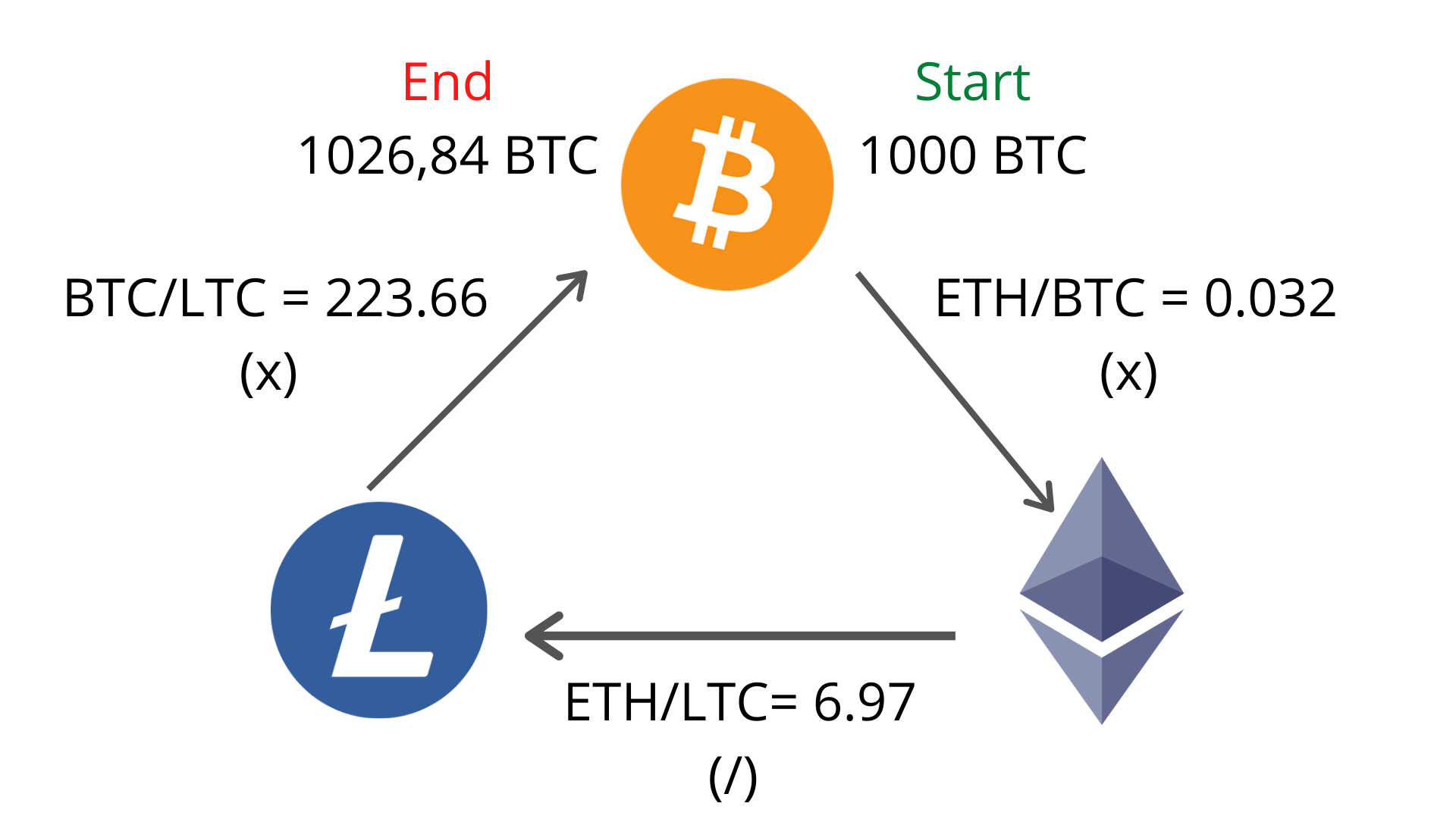
2) Triangular Arbitrage: Making three trades on the same exchange to take advantage of price differences between several pairs (e.g., trading BTC to ETH, ETH to LTC, and LTC back to BTC).
🐋🐋🐋🐋🐋🐋🐋🐋🐋🐋🐋🐋🐋🐋🐋🐋🐋
3) Merger arbitrage is the practice of purchasing stock in a target firm while selling stock in the acquiring company in order to wager on a merger's success. In the cryptocurrency world, merger arbitrage, also known as “risk arbitrage”, happens when two protocols combine their native tokens into a single new asset or when one project buys another.
For example, in 2024, Fetch.ai, SingularityNET, and Ocean Protocol merged to create the ASI token—the "Artificial Superintelligence Alliance" (FET, AGIX, OCEAN).
The arbitrage strategy was as follows:
The announcement: Fixed conversion rates were established by the Alliance. Holders of Ocean Protocol (OCEAN) tokens were given 0.433226 ASI. Let's say Fetch.ai was trading at $2.00. OCEAN should have been worth $0.86 ($2.00 x 0.433). However, OCEAN may have been trading at just $0.82 because of market uncertainty or a lag in liquidity.
The Trade of Arbitrage:
1. Purchase the cheap OCEAN at $0.82.
2. Await the new ASI token's migration.
3. Sell the generated ASI tokens (or hedge by shorting FET/ASI) to lock in the ~4.8% spread.
4. And make sure that the exchange you use supports the manual or automatic swap; otherwise, you could be left holding a "dead" legacy token.
The risks exist, however, e.g., deal failure, or if the community votes "No," or if due to a technical issues, the migration was stoped. In such cases, the target token usually crashes back to its pre-announcement price. Or if the duration for migration takes longer, it can affect your ROI.

🐋🐋🐋🐋🐋🐋🐋🐋🐋🐋🐋🐋🐋🐋🐋🐋🐋
4) Convertible Arbitrage: Profiting from mispricing by holding opposing positions in a company's convertible bond and underlying shares. The strategy has been adopted by the cryptocurrency sector too, with companies and protocols issuing hybrid debt instruments, where convertible senior notes (debt) issued by big public cryptocurrency companies are traded against their underlying common stock.
Example: In July 2025, $950 million in 0% convertible senior notes with a 2032 maturity date were issued by MARA Holdings (previously Marathon Digital). The notes were convertible into MARA common stock at an initial rate of around 49.36 shares for $1,000 principal, or about $20.26 per share.
The Strategy of Arbitrage:
Long Position: The convertible notes are purchased by a hedge fund. These notes are worth more if the price of MARA's stock rises since they feature an "embedded option" to convert to shares.
Short Position: The hedge fund is simultaneously shorting MARA's common stock. They deploy a "delta hedge," which involves shorting approximately $0.50 of stock for every $1.00 of bond exposure.
A trader earns from the "mispricing" of bond volatility in comparison to stock volatility. They "gamma trade" by adjusting their short positions, buying back shares when the stock falls and shorting more when it rises. This allows locking in tiny profits regardless of the overall market trend.
Risks involve the high borrowing cost and a liquidity risk.
🐋🐋🐋🐋🐋🐋🐋🐋🐋🐋🐋🐋🐋🐋🐋🐋🐋
5) Statistical/Pairs Trading: trading using quantitative models under the presumption that two assets with a history of correlation will return to their mean. Instead of predicting whether the market will rise, you can wager that the price difference between two comparable coins will eventually return to its historical average; in jargon, bet on the "mean reversion" of two strongly correlated assets.
Example: Layer 1 "Blue Chips" (SOL vs. ETH).
Solana (SOL) and Ethereum (ETH) have historically moved in tandem since they respond to the same "smart contract platform" market dynamics. A bot tracks the price ratio of $SOL/$ETH, which remained at 0.05 for a month, meaning that 1 $SOL costs 5% of 1 $ETH .
The ratio abruptly falls to 0.04 as a result of a localized liquidation event or a momentary network outage on Solana. Solana is now "statistically cheap" in comparison to Ethereum.
The Long/Short Arbitrage Trade:
Buy (long) $10,000 of SOL (the laggard).
Sell (short) $10,000 of ETH (the leader).
The Mean Reversion: Three days later, the market stabilizes, and the ratio returns to 0.05. Both positions are closed, and the gain on your SOL long exceeds the loss (or gain) on your ETH short, capturing about a 20% gap in the ratio.
Risks exist e.g., fundamental regulations or market sentiment can cause the ratio to never "return to the mean", or “legging risks"—in high-volatility market, one side of your trade might execute at a significantly worse price than the other.

🐋🐋🐋🐋🐋🐋🐋🐋🐋🐋🐋🐋🐋🐋🐋🐋🐋
There are other types of arbitrage strategies that I have not included here since they involve significantly greater risks and are better suited for experienced traders. However, if you're interested, you can explore this topic in more detail on your own.
And use the charts below to trade as usually 👇


#BitcoinVsGold #Write2Earn #AltcoinStrategies
Always "DYOR"