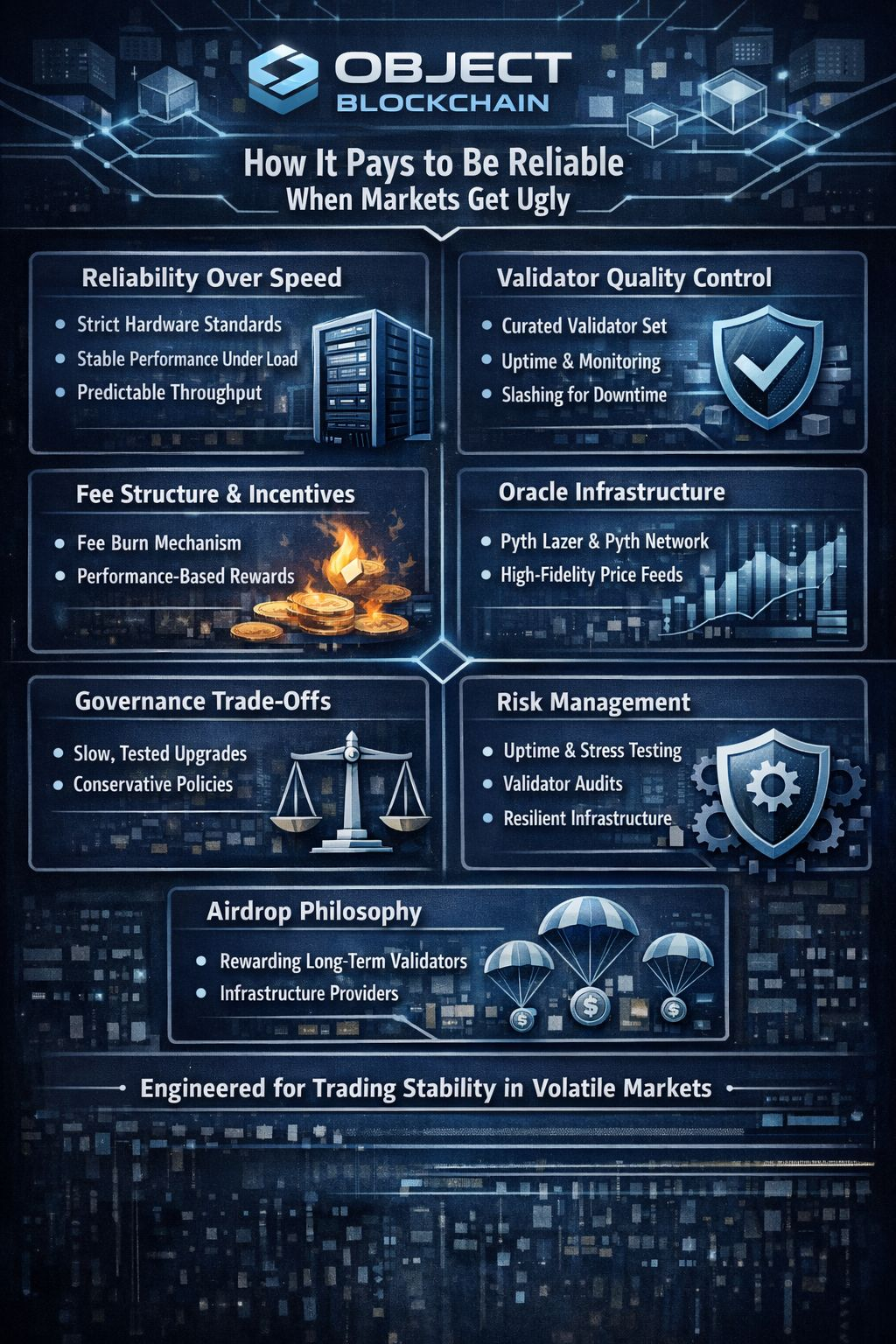
In calm market conditions, almost every blockchain appears fast, scalable, and efficient. Benchmarks look impressive, latency charts are clean, and transaction throughput becomes the dominant narrative. But those metrics often hide a more important question: what happens when the market becomes chaotic?
During market crashes, liquidation cascades, and sudden volatility spikes, trading infrastructure is tested in ways that synthetic benchmarks cannot simulate. Transaction queues explode, oracle updates arrive rapidly, and validators face sustained computational pressure. In these moments, speed alone is not enough. What matters is reliability: consistent execution, predictable fees, accurate price feeds, and validators that remain online under stress.
The Object blockchain positions itself less as a marketing-driven “fast Layer 1” and more as durable trading infrastructure. Its design emphasizes validator discipline, predictable performance under load, and a governance model that prioritizes stability over rapid experimentation. In volatile markets, these properties matter far more than headline transaction-per-second numbers.
This article examines how Object approaches reliability through validator incentives, fee mechanics, governance trade-offs, oracle infrastructure, and long-term trading stability.
Reliability Over Speed
Most modern blockchains compete around raw throughput. However, high peak throughput does not guarantee consistent performance when demand spikes.
Object’s architecture emphasizes predictable throughput rather than theoretical maximums. The system is designed so that:
Validators operate within strict hardware requirements
Network capacity is sized for realistic peak demand
Transaction confirmation remains stable during high load
The principle is simple: professional trading systems value determinism. Traders and protocols need to know that the network will behave similarly during both normal and stressed conditions.
When markets turn ugly, uncertainty around infrastructure becomes a systemic risk. Delayed transactions, inconsistent gas prices, or unreliable block production can trigger cascading failures in leveraged trading environments.
Object’s approach aims to reduce that uncertainty.
Validator Quality Control
One of the quiet but important design decisions in Object is the use of a curated validator environment with strict operational standards.
Rather than optimizing for the highest possible validator count, the network focuses on validator quality and uptime guarantees. This includes:
Minimum hardware specifications
Network bandwidth requirements
Performance monitoring
Slashing or removal for persistent downtime
High-frequency trading environments require validators capable of handling continuous high load and low-latency communication. Weak nodes introduce unpredictable delays and increase the risk of fork instability during stress.
By prioritizing validator reliability over maximum decentralization at the early stage, Object attempts to maintain infrastructure-grade performance.
This trade-off is not without criticism. A curated validator set reduces openness and raises governance questions. However, the design choice reflects a specific priority: consistent network behavior during extreme conditions.
Fee Structure and Economic Stability
Transaction fees play a critical role in maintaining network reliability during volatile market periods.
Object’s fee model is designed to avoid the two most common failure modes seen in other networks:
Fee spikes that make trading impossible
Fees too low to incentivize validator performance
To balance these pressures, the network uses a structure where:
Base transaction fees remain predictable
A portion of fees is burned, reducing supply
Validators receive performance-based rewards
Fee burning serves two purposes. First, it aligns long-term token economics with network usage. Second, it reduces the need to inflate validator rewards through excessive token issuance.
In volatile trading environments, predictable fees matter more than cheap fees. Liquidation systems, arbitrage bots, and derivatives protocols require cost certainty to function correctly.
Oracle Infrastructure and Price Integrity
Trading infrastructure is only as reliable as its price data.
Object integrates with professional-grade oracle systems such as Pyth Network and its low-latency feed architecture, including Pyth Lazer, which focuses on rapid market data updates from institutional data providers.
Oracle reliability becomes critical during periods of extreme volatility. If price feeds lag or become inconsistent, several risks emerge:
Incorrect liquidations
Arbitrage distortions
Protocol insolvency
Pyth’s model sources data directly from market makers, exchanges, and institutional trading firms. This creates a price discovery mechanism closer to traditional financial market infrastructure.
For Object, reliable oracle infrastructure is not an optional feature. It is central to positioning the network as serious trading infrastructure rather than a speculative platform.
Governance Trade-Offs
Every blockchain faces a tension between rapid governance flexibility and system stability.
Object leans toward the conservative side of this spectrum.
Frequent protocol upgrades and aggressive experimentation can introduce unexpected behavior under load. For networks hosting derivatives markets or high-frequency trading systems, this unpredictability is dangerous.
Object’s governance philosophy favors:
Slow, deliberate upgrades
Extensive testing before deployment
Validator consensus around infrastructure changes
This approach sacrifices short-term innovation speed but reduces the probability of catastrophic failures during volatile market periods.
Risk Management and Infrastructure Discipline
In traditional financial systems, exchanges and clearing houses spend enormous resources on risk management infrastructure.
Blockchains rarely adopt the same mindset. Many networks prioritize growth metrics—transactions, users, TVL—over operational resilience.
Object takes a more infrastructure-oriented approach, focusing on:
Network uptime guarantees
Hardware reliability standards
Monitoring of validator performance
Load testing for extreme market scenarios
These measures may appear unglamorous compared to new token launches or flashy DeFi applications. However, they address the exact problems that tend to appear during market stress.
Airdrops and Network Incentives
Another interesting element in Object’s philosophy is its more restrained approach to airdrops and incentives.
Many ecosystems rely on aggressive token distribution to rapidly attract users and liquidity. While effective in the short term, this strategy can attract temporary capital rather than long-term participants.
Object’s design favors incentives that reward:
Infrastructure providers
Long-term validators
High-quality applications
This aligns the network toward sustainable ecosystem growth rather than speculative bursts of activity.
Trading Stability During Market Stress
Ultimately, Object’s positioning becomes clearest during extreme market conditions.
When volatility surges, the network must simultaneously handle:
Rapid oracle updates
Liquidation transactions
Arbitrage trades
Collateral adjustments
A trading-focused blockchain must maintain:
Consistent block production
Predictable transaction inclusion
Reliable price feeds
Stable fee dynamics
Object attempts to engineer these properties directly into the infrastructure layer rather than relying on optimistic assumptions about network conditions.
Conclusion
Many blockchains market themselves as the fastest or most scalable networks in existence. Those claims are often based on controlled environments and ideal conditions.
Real markets are different.
Volatility, liquidation cascades, and sudden surges in trading volume place enormous stress on infrastructure. In those moments, reliability becomes the most valuable feature a blockchain can offer.
Object’s design philosophy reflects this reality. Through curated validator standards, predictable fee mechanics, professional oracle infrastructure like Pyth Lazer, and conservative governance, the network aims to provide durable trading infrastructure rather than short-term performance hype.
This approach involves trade-offs. It may limit rapid decentralization or slow down feature experimentation. But for serious financial applications, especially in high-volatility environments, stability often matters more than theoretical speed.
When markets get ugly, reliability is not just a technical advantage. It becomes a form of economic resilience.