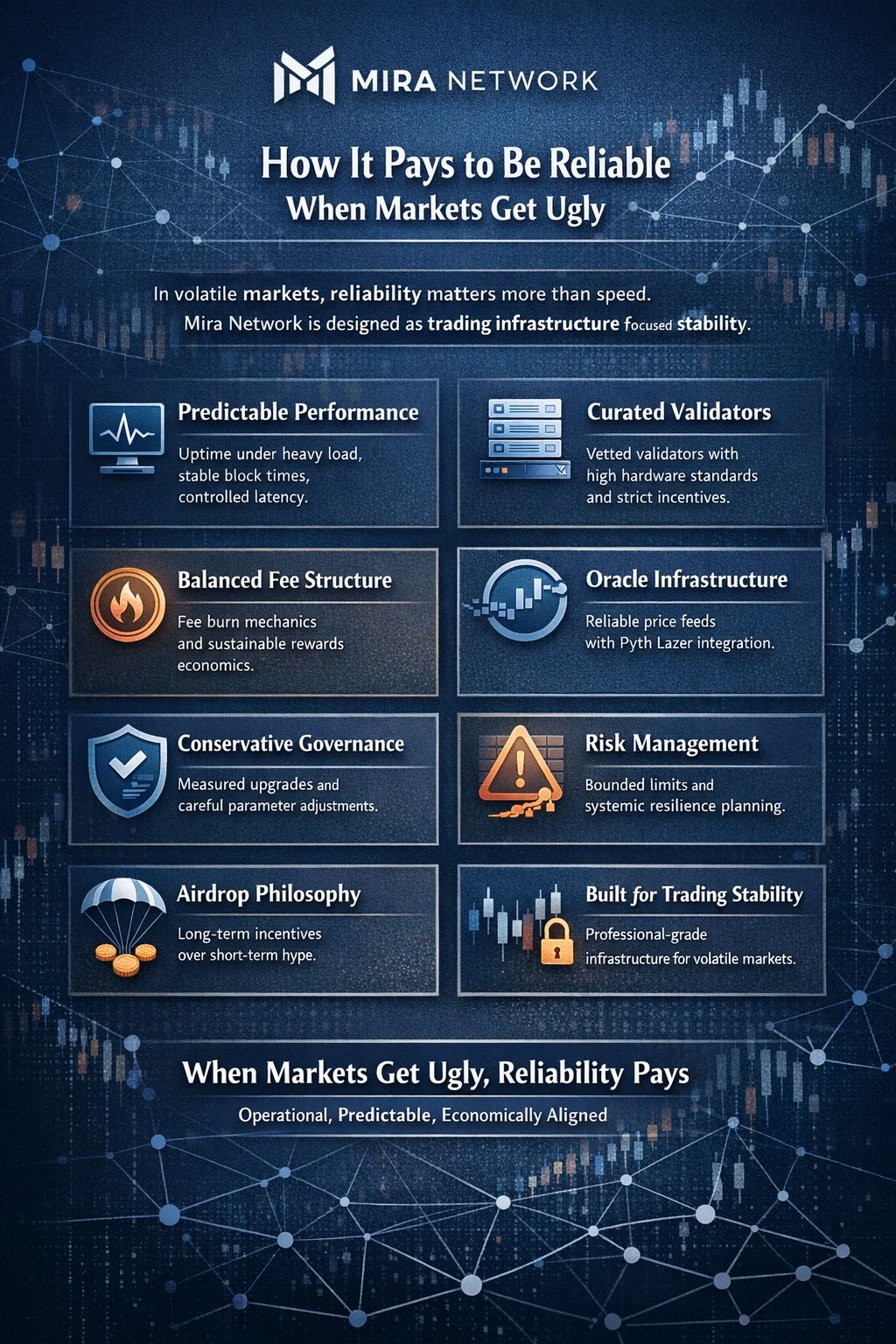
In strong markets, speed sells. Throughput numbers, transaction-per-second benchmarks, and flashy integrations dominate headlines. But when markets turn volatile—when liquidity fragments, spreads widen, and liquidations cascade—none of those metrics matter if the system cannot stay online, price assets accurately, and process transactions predictably.
Mira Network positions itself differently. It is not trying to win a race for raw speed. It is building verification infrastructure designed to remain reliable under stress. Its core premise is simple: artificial intelligence systems are powerful but error-prone. If AI outputs are to be used in trading, financial automation, or risk management, they must be verifiable, auditable, and economically secured.
This article explores how Mira Network approaches reliability as an economic principle, not a marketing slogan—particularly when markets become unstable.
1. Reliability Over Throughput: The Correct Trade-Off
When markets become disorderly, the system faces three simultaneous pressures:
Transaction spikes
Price feed volatility
Incentive stress on validators
In these moments, blockchain networks typically fail in one of two ways:
They halt.
They stay live but degrade in fairness (reordering, congestion pricing spikes, validator instability).
Mira’s architecture takes a different path. Rather than optimizing for maximum theoretical throughput, it prioritizes predictable performance. The focus is not on peak capacity, but on sustained uptime and verifiable output under heavy load.
By breaking AI outputs into discrete, verifiable claims and distributing validation across independent models, Mira reduces the risk of a single-point failure—whether computational, economic, or informational. This modular verification model becomes particularly valuable when trading systems depend on AI-processed insights in real time.
Reliability, in this context, is not just uptime. It is consistency of outcome under stress.
2. Validator Incentives: Security Through Economic Discipline
A blockchain is only as stable as its validators during periods of financial strain.
Mira emphasizes validator quality control over sheer validator quantity. This reflects a critical governance trade-off: open participation increases decentralization optics, but curated participation improves operational stability.
Key elements of this approach include:
Hardware standards that ensure validators can handle peak verification loads.
Performance-based incentives tied to accurate claim validation.
Slashing or penalty mechanisms for incorrect or malicious validation.
Economic rewards aligned with long-term network health rather than short-term activity spikes.
During market stress, validators face higher transaction volumes and potentially more complex verification tasks. If incentives are not properly calibrated, rational actors may prioritize profit over accuracy. Mira’s design attempts to minimize this by ensuring that correct validation is consistently more profitable than opportunistic behavior.
This is not ideological decentralization. It is operational decentralization with guardrails.
3. Fee Structure: Stability Through Predictability
In volatile markets, fee design becomes critical. Poorly structured fee markets can lead to:
Transaction bidding wars
Congestion spikes
Unpredictable execution costs
Validator manipulation incentives
Mira’s fee model focuses on predictability and sustainable validator compensation. A balanced structure may include:
A base verification fee
Dynamic components reflecting network load
Burn mechanics to reduce supply pressure
Reward redistribution to validators for high-quality performance
Fee burn mechanisms serve two purposes. First, they create long-term token supply discipline. Second, they reduce reliance on inflationary rewards that could destabilize validator economics over time.
For traders and institutions, the benefit is straightforward: cost predictability during volatility is more valuable than marginally cheaper fees during quiet markets.
4. Oracle Infrastructure and Price Integrity
Market ugliness exposes weak oracle design faster than any benchmark test.
Oracle failures during volatility lead to:
Incorrect liquidations
Arbitrage exploitation
Market manipulation
Loss of confidence in protocol integrity
Mira’s integration philosophy around high-performance oracle systems such as Pyth Network and real-time feeds like Pyth Lazer signals an emphasis on price integrity rather than convenience.
Low-latency oracle data is only useful if it remains accurate under extreme volatility. The combination of cryptographic verification and distributed AI claim validation creates an additional layer of scrutiny around price-sensitive outputs.
This layered approach reduces the probability of cascading liquidations triggered by a single bad data point.
In professional trading environments, price integrity is infrastructure—not a feature.
5. Governance Trade-Offs: Stability vs. Pure Permissionlessness
Every blockchain must choose between:
Radical openness
Controlled operational standards
Mira appears to lean toward structured governance. A curated validator set, hardware minimums, and performance monitoring are not popular in maximalist decentralization debates. However, in financial infrastructure, these trade-offs are often necessary.
Unrestricted participation can degrade network quality if underpowered or malicious nodes gain influence. By curating validator participation, Mira prioritizes:
Latency consistency
High uptime thresholds
Predictable block production
Reduced coordination failure risk
This does not eliminate decentralization; it narrows it to serious operators.
For institutional adoption, this distinction matters.
6. Risk Management: Designing for Stress, Not Sunshine
Most networks are tested in favorable conditions. True evaluation happens during:
Sudden liquidity drains
Derivatives liquidations
System-wide deleveraging events
Data feed inconsistencies
Mira’s model of breaking AI outputs into verifiable claims functions as internal risk segmentation. Instead of accepting a monolithic AI output, the network distributes responsibility across multiple validating agents.
If one validator model fails or miscalculates, consensus mechanisms reduce the probability of systemic error.
In effect, Mira applies portfolio diversification logic to information validation.
This matters most when AI-driven insights inform trading, settlement, or collateral valuation.
7. Airdrop Philosophy: Incentivizing Long-Term Alignment
Speculative airdrops often reward early hype rather than durable participation. Networks that reward short-term activity can unintentionally attract mercenary capital and transient validators.
A more disciplined airdrop philosophy would prioritize:
Long-term contributors
Validators meeting uptime thresholds
Participants supporting verification tasks
Developers integrating infrastructure rather than exploiting incentives
If token distribution aligns with sustained reliability, the economic base of the network becomes stronger over time.
Distribution design is governance in disguise.
8. Professional-Grade Infrastructure: Hardware and Operational Standards
Institutional trading systems operate on strict operational guarantees:
Redundant systems
Defined uptime SLAs
Continuous monitoring
Hardware performance minimums
For a blockchain to function as trading infrastructure rather than experimental software, it must adopt similar discipline.
By enforcing hardware standards and validator quality control, Mira increases the probability that:
Blocks are produced on schedule
Verification queues remain manageable
Latency remains stable under load
Consensus does not fragment during stress events
This is not glamorous. It is operational maturity.
9. Long-Term Trading Stability: The Infrastructure Thesis
Speed is easy to advertise. Stability is harder to measure.
Mira’s positioning is closer to infrastructure than to a typical Layer 1 narrative. It is attempting to provide:
Verifiable AI outputs
Economically aligned validators
Predictable fee dynamics
Reliable oracle integration
Governance guardrails
Controlled but meaningful decentralization
In chaotic markets, participants care less about maximum throughput and more about:
Whether their trades settle
Whether price feeds remain accurate
Whether the chain halts
Whether validators behave rationally
If reliability holds during stress, capital stays. If it fails once, confidence evaporates.
Conclusion: Reliability Compounds
Markets eventually become unstable. When they do, weak infrastructure is exposed immediately.
Mira Network’s approach suggests a belief that:
Verification is more important than velocity.
Economic incentives must favor correctness.
Validator quality is more important than validator count.
Oracle integrity is foundational.
Governance discipline is a feature, not a flaw.
If these principles hold in real-world stress conditions, Mira will not simply be another fast blockchain. It will function as durable trading infrastructure.
In financial systems, reliability compounds. Hype does not.