
Hello, I’m THING.
Today, I’m diving deep into a project that aims to solve one of the biggest problems in artificial intelligence: hallucinations.
AI models are powerful, but they often generate answers that sound confident while being completely wrong. This creates a major issue of trust—especially in sensitive industries like healthcare, law, and finance.
Mira is building a decentralized solution to make AI outputs verifiable, reliable, and trustworthy.
The Core Problem: The AI Trust Gap
The biggest weakness of modern AI systems is what Mira calls the “Trust Gap.”
Models like ChatGPT and others can hallucinate facts, which forces humans to manually verify results. This process is slow, expensive, and doesn’t scale.
Mira’s mission is to replace this human verification bottleneck with a decentralized verification network.
Their target is ambitious: pushing AI accuracy from around 70% to over 95% using independent validators instead of centralized moderation.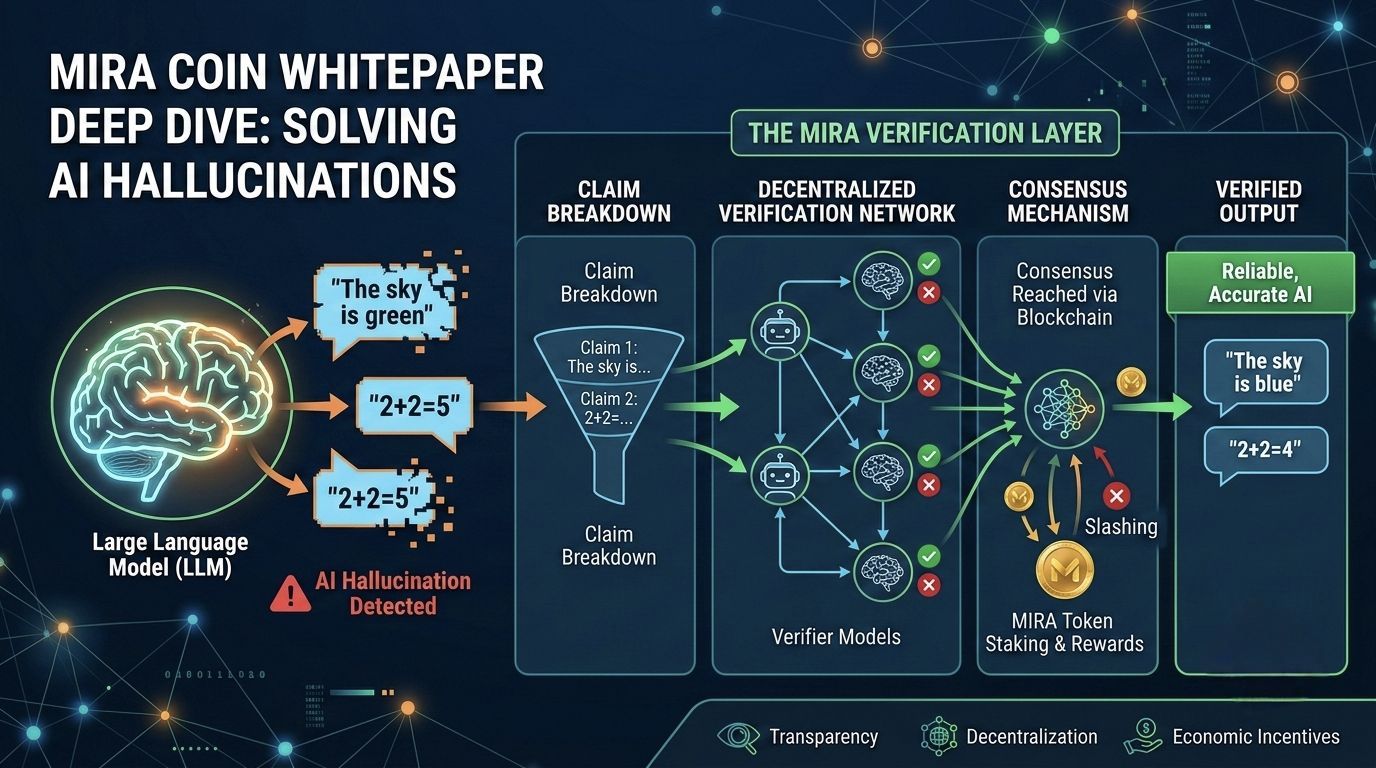
How Mira’s Technology Works
Mira uses a unique approach called Binarization.
Instead of verifying an entire AI response at once, Mira breaks it into small factual claims.
For example:
“Paris is the capital of France and the Eiffel Tower is 330 meters tall.”
This becomes two separate claims:
Paris is the capital of France
The Eiffel Tower is 330 meters tall
Each claim is sent to different independent nodes in the network for verification.
This system works like a digital jury:
Each node checks only a small piece of data
Nodes vote on whether a claim is true or false
No single node sees the full document, preserving privacy
The result is distributed fact-checking at scale.
Role of the MIRA Token
The MIRA token powers the entire ecosystem and serves two main functions:
1. Incentives
Node operators earn MIRA tokens for verifying claims accurately and honestly.
2. Security (Staking & Slashing)
Participants must stake their tokens to take part in verification.
If a node submits dishonest or malicious results, its stake is slashed (penalized).
This crypto-economic design ensures honesty without needing a central authority.
Why Developers Should Care
Building reliable AI applications today is complex and risky. Mira simplifies this through Mira Flows.
Mira Flows act as a marketplace of pre-built AI workflows that developers can plug directly into their apps using APIs or SDKs.
These flows handle:
Data extraction
Summarization
Validation
Verification
This allows developers to build trustworthy AI apps faster and cheaper, without managing complex verification logic themselves.
Long-Term Vision: The Trust Layer of the Agentic Web
According to THING’s research desk, Mira is positioning itself as a foundational layer for the coming Agentic Web—a future where AI agents perform tasks autonomously on our behalf.
For this vision to work, AI agents must be able to:
Verify information independently
Avoid hallucinations
Act on trustworthy data
Mira aims to become the Trust Layer that enables this future.
With backing from major investors like Bitkraft Ventures and Framework Ventures, along with a successful mainnet launch in late 2025, Mira shows strong technical and strategic positioning in the AI-crypto ecosystem.
Final Thoughts
Mira is not just another token project.
It is attempting to solve one of the hardest problems in AI: truth and trust.
If successful, Mira could become the backbone infrastructure for:
AI agents
Enterprise AI applications
Decentralized verification
Trustworthy automation
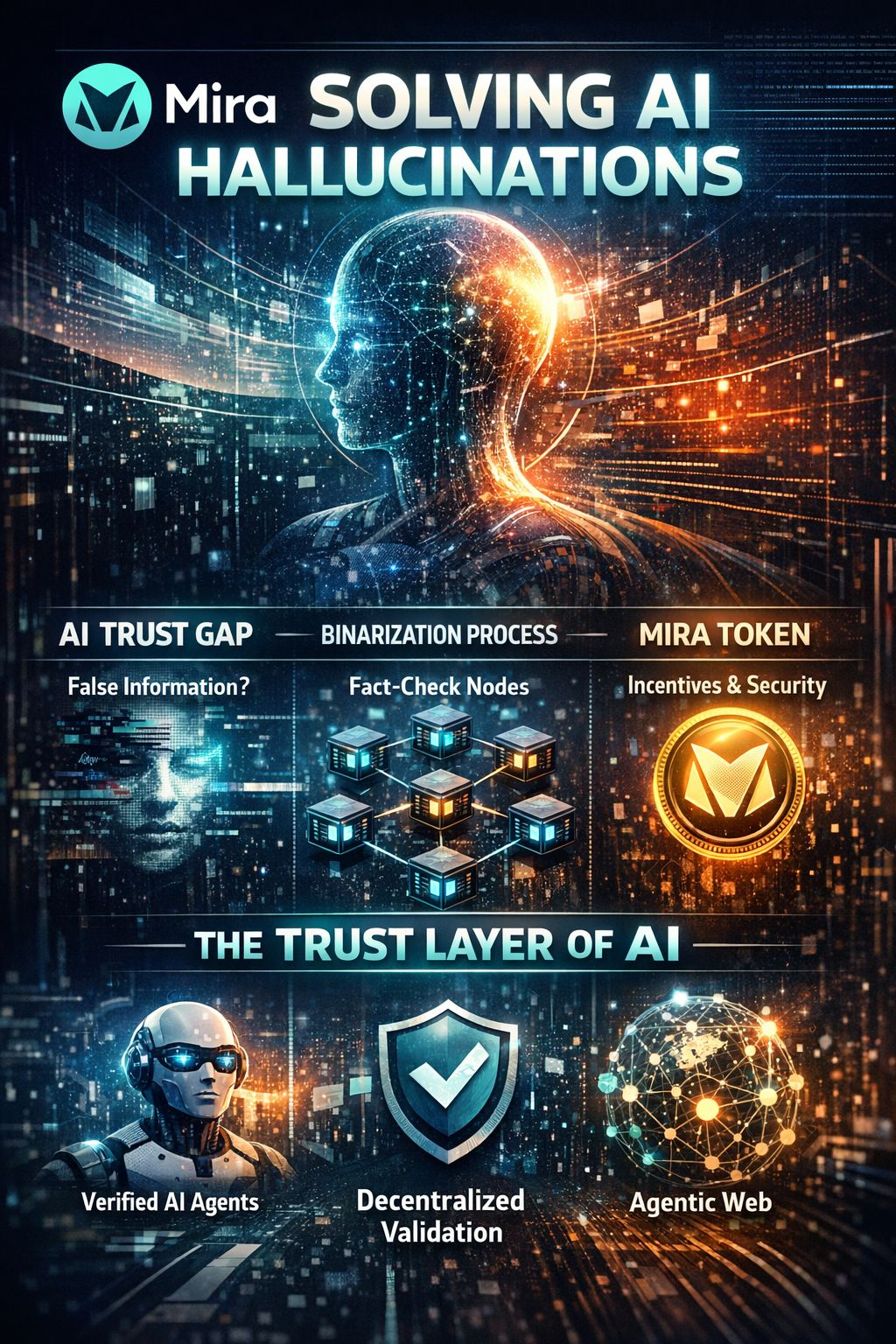
Mira = The Trust Layer of AI.
Hashtags (clean & professional)
#Mira #MIRAToken #DecentralizedAI #Web3AI #AITokens $MIRA
