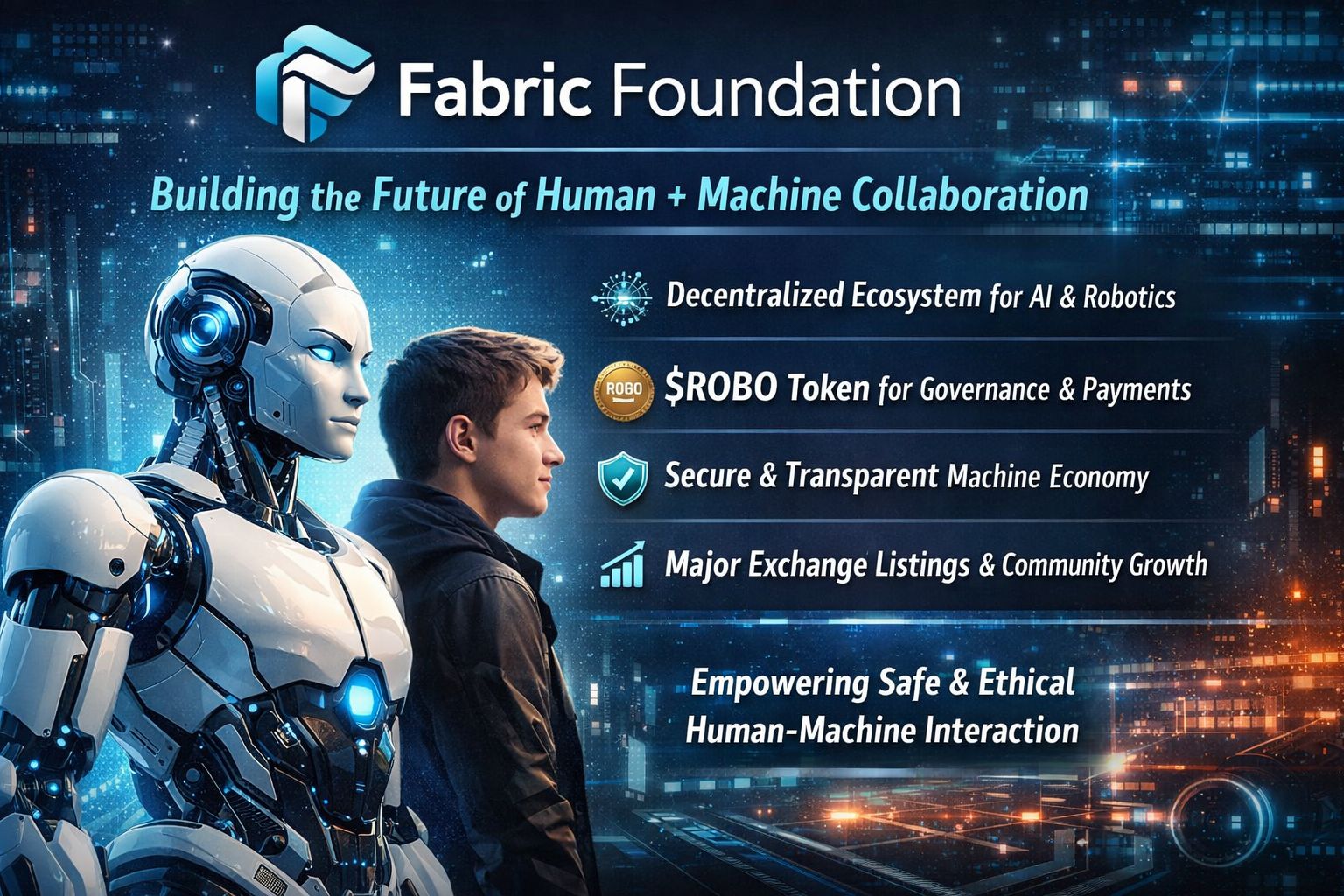
The Fabric Foundation(@Fabric Foundation ) is a nonprofit organization with a mission to build the global infrastructure needed for safe, transparent, and decentralized human-machine collaboration. As autonomous systems like robots and embodied artificial intelligence (AI) increasingly perform meaningful work in manufacturing, healthcare, logistics, and other sectors, the foundation aims to ensure that this future empowers people everywhere rather than concentrating power in a few institutions. The project’s core philosophy revolves around aligning machine behavior with human values, making it observable, predictable, and subject to decentralized governance — rather than leaving control solely to centralized corporations. �
fabric.foundation
At the heart of this vision is the native token $ROBO, which plays multiple essential roles within the Fabric ecosystem. Unlike typical speculative tokens, is positioned as an infrastructure and governance asset designed to underpin payments, identity verification, coordination of autonomous systems, and decentralized decision-making. Because robots and intelligent agents cannot hold bank accounts or legal documents like humans, the platform uses to manage on-chain identities, pay for services, validate tasks, and enable machine-to-machine economic activity. �
Bitrue
One of the most important milestones for the project came in 2026 when was officially listed for trading on major exchanges, including Binance and more. This transition marked the shift from community airdrop distribution and eligibility verification into open market price discovery, providing broader access and liquidity for traders and ecosystem participants. �
HOKANEWS.COM
Prior to public trading, Fabric coordinated eligibility and distribution through a structured airdrop and verification portal, signaling its desire to reward early contributors and community builders. This strategy not only seeded early engagement but also reinforced the foundation’s emphasis on inclusive participation and decentralization. �
HOKANEWS.COM
From a developmental standpoint, the foundation organizes its efforts into multiple tracks:
1. Research & Governance: Fabric funds and supports critical research into human-machine alignment, machine interpretability, and governance models that accommodate both human and machine participants. This involves working with policymakers, standards bodies, and global stakeholders to help shape norms for deploying intelligent machines at scale. �
2. Public-Good Infrastructure: The project builds open systems to manage human and machine identity, decentralized task allocation, accountability mechanisms, and machine-to-machine communication. These are foundational components for a future where autonomous machines perform economic tasks and interact safely with humans. �
3. Ecosystem Development: Fabric fosters community participation, education, and tools that enable developers and users worldwide to contribute to AI and robotics development — from tele-operation interfaces to localized customization of robotics models. �
In March 2026, the project announced partnerships with other protocols, such as OpenMind and Circle, to integrate payment infrastructures allowing autonomous agents to conduct real-world transactions. This includes enabling robots to pay for services, energy, and data autonomously, pushing the idea of a machine-driven economy closer to reality. �
phemex.com
The tokenomics of $ROBO have also been designed to support long-term ecosystem sustainability rather than short-term speculation. Total supply is fixed at 10 billion, with allocations spread across investors, team members, the foundation, and community incentives, most of which are subject to vesting schedules to prevent immediate selling pressure. This structure promotes gradual decentralization and aligns incentives with long-term development. �
HOKANEWS.COM
From a broader perspective, the project aims to enable a future where intelligent machines are not just tools but economic actors that can coordinate, transact, and contribute value — all while remaining aligned with human goals. Fabric’s approach rethinks how governance and economic participation could work in a world where intelligent robots and AI systems are ubiquitous. �
kucoin.com
However, it is important to understand that while the vision is compelling, this technology remains in an early and experimental phase. Building decentralized infrastructure for real-world robotics and autonomous systems involves complex engineering challenges, regulatory considerations, and significant adoption hurdles. The success of $ROBO and the Fabric ecosystem will depend on real adoption of its network, continued partnership growth, and the ability to attract developer and enterprise participation beyond speculative trading. �#robo