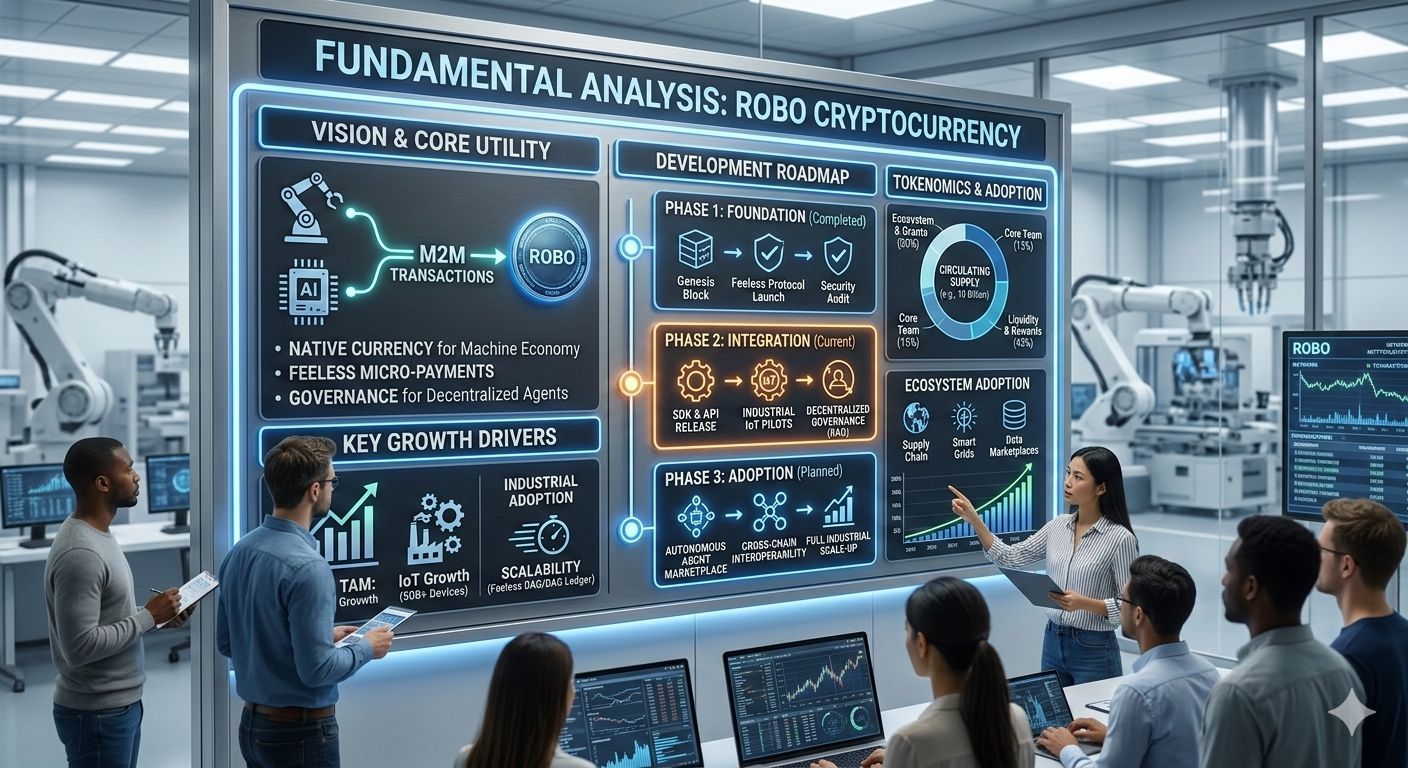
$ROBO Cryptocurrency (@Fabric Foundation ) is not merely another digital asset; it is a specialized token designed to facilitate machine-to-machine (M2M) transactions and autonomous agent interaction. In an increasingly automated world, from smart factories to decentralized autonomous organizations (DAOs),ROBO provides the native currency for settlement, resource allocation, and governance among AI and robotic agents.
Vision and Core Value Proposition
The proliferation of Internet of Things (IoT) devices and AI agents presents a new challenge: how do these autonomous entities trade value, settle payments, and collaborate without human intervention?
ROBO addresses this need by providing a high-throughput, low-latency, and feeless settlement layer tailored for small, high-frequency transactions. The core value proposition rests on:
Feeless Micro-Transactions: Machines operate on efficiency. Conventional transaction fees, even in cents, accumulate prohibitively when devices are settling payments thousands of times per second. ROBO’s architecture minimizes or eliminates these fees.
Rapid Finality: In manufacturing supply chains or automated trading, delays are costly. ROBO offers near-instant finality, ensuring operations continue smoothly.
Governance Utility: ROBO holders govern the decentralized networks that manage the critical infrastructure.
Technology and Development Roadmap
A critical aspect of fundamental analysis is assessing the engineering roadmap and the team's ability to execute. ROBO’s development plan is ambitious, yet technically grounded.
The development roadmap is divided into three key phases, moving from foundational architecture to full-scale adoption:
Phase 1: Foundation and Initial Infrastructure (Completed - Phase 1)
This phase was focused on developing the core protocol, achieving high transactional capacity, and launching the mainnet.
Development Milestone 1: Genesis Block: Launch of the layer 1 blockchain.
Feeless Transaction Layer: Implementation of a DAG (Directed Acyclic Graph) or similar ledger structure to support feeless or low-fee M2M transactions.
Security Audits: Initial smart contract and core protocol audits.
Phase 2: Integration and the M2M Ecosystem (Current Phase - Phase 2)
ROBO is currently transitioning into a practical ecosystem, focusing on integrating with existing infrastructure and building developer tools.
SDK and API Release: Providing developers with the tools to integrate ROBO into IoT devices, autonomous agents, and smart contracts.
Industrial IoT (IIoT) Pilots: This is a crucial milestone, showcasing ROBO’s utility in manufacturing, logistics, and supply chain management. These real-world proofs-of-concept are critical for proving utility.
Decentralized Governance (DAO): The full transition of protocol governance to ROBO holders.
Phase 3: Global Adoption and Autonomous Agents (Planned - Phase 3)
The long-term vision involves global adoption and advanced automation.
Autonomous Agent Marketplace: A decentralized marketplace where AI agents can buy and sell services, resources (e.g., compute power, data), and goods using ROBO.
Cross-Chain Interoperability: Enabling ROBO to move fluidly between different blockchain ecosystems, increasing liquidity and utility.
Full Industrial Adoption: Wide-scale deployment in automated logistics, smart grids, and smart cities.
Key Growth Drivers and Investment Case
TAM (Total Addressable Market): The growth of the IoT and AI sectors provides a massive addressable market for a standard M2M currency. As more devices become connected and automated, the demand for a localized settlement layer will escalate.
Feeless Architecture as a Differentiator: The ability to handle vast volumes of micro-transactions without high costs is a major competitive advantage over traditional layer 1 blockchains.
Industrial Partnerships: The success of the Phase 2 pilot programs with industrial partners will be the primary catalyst for short-to-medium-term growth. Successful integration into supply chain or smart factory environments validates the technology.
Risks and Challenges
Adoption Rate: The biggest hurdle is the rate at which industries adopt automated, decentralized systems.
Technological Complexity: The development of feeless, high-speed ledgers is technically challenging and subject to security risks.
Regulatory Uncertainty: As a new asset class focused on machine commerce, regulation regarding autonomous entities and decentralized finance remains evolving.
Conclusion
Robo Cryptocurrency presents a robust fundamental case built on a clear vision for the automated economy. The development roadmap outlines a strategic pathway from technological foundation to practical adoption. Success will hinge on technical execution, particularly the seamless integration with industrial IoT systems, and navigating the emerging regulatory landscape. ROBO represents a high-potential opportunity at the frontier of technology and finance.
Visualizing the Vision: The Robo Cryptocurrency Ecosystem
To complement this fundamental analysis, we visualize the core concepts discussed—the integration of machines, high-speed transactions, and the industrial application. The accompanying image depicts a decentralized smart factory where ROBO powers a seamless M2M economy, with a transparent view of the Phase 2 development roadmap at the core of operations.
#ROBO #MarketPredictions #StrategyBTCPurchase #PredictionMarketsCFTCBacking