When screens bleed red and the word CRASH takes over trading dashboards, attention immediately locks onto price. Traders rush into lower timeframes, watching support levels break, momentum indicators flip bearish, and volatility expand with force. But while the crowd focuses on chart structure, a deeper and more critical structure is being tested in parallel — the exchange infrastructure responsible for securing and moving capital.
During high-volatility phases, order books naturally thin. Liquidity becomes less evenly distributed. Liquidation cascades accelerate directional moves, amplifying fear and urgency. A breakdown below key support does more than trigger stop losses — it triggers behavioral acceleration. Volume surges. Spreads widen. Funding rates swing aggressively. Withdrawal requests increase. In these moments, operational resilience becomes just as important as market liquidity itself.
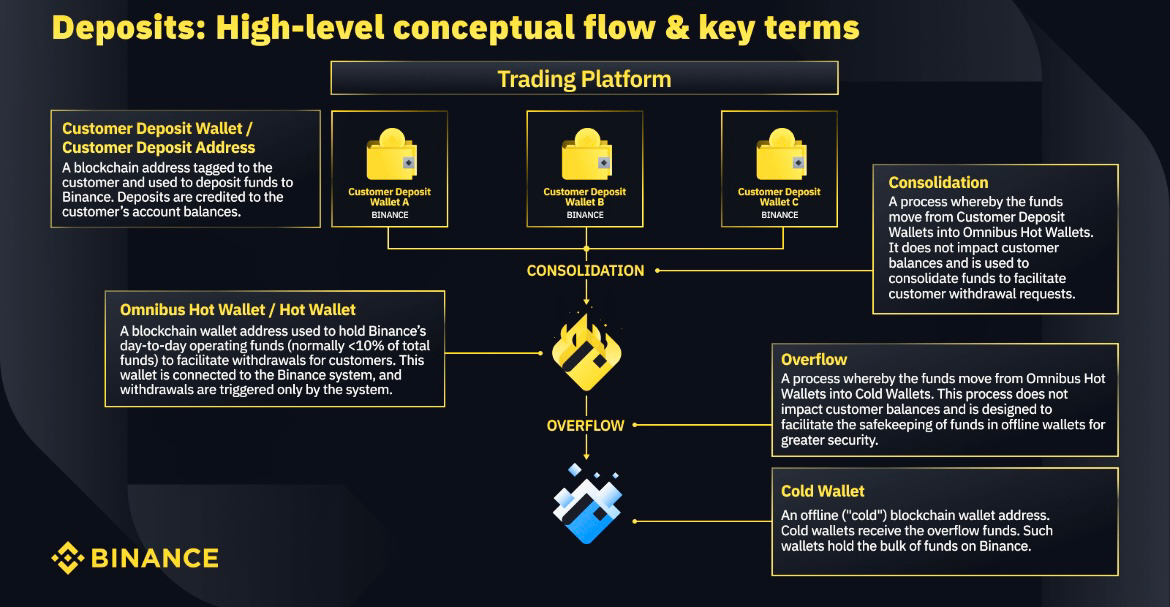
On Binance, every deposit begins with a uniquely assigned blockchain address linked directly to a user account. From the outside, the process appears simple: funds arrive, confirmations complete, balances update. But internally, a far more sophisticated system activates. Instead of leaving assets fragmented across thousands of isolated addresses, they are consolidated into structured liquidity pools.
This consolidation serves a critical purpose.
Fragmented liquidity weakens execution efficiency, especially during stress events. Consolidated liquidity strengthens coordination. It ensures that trading, settlement, and withdrawals continue operating smoothly, even under extreme demand. This is not a cosmetic feature. It is a capital management mechanism engineered specifically for volatility.
From there, funds are distributed into operational hot wallets. These wallets power real-time withdrawals and trading settlement. Because they remain connected to live systems, they allow the exchange to respond instantly to user activity. However, only a controlled percentage of total reserves remains in hot wallets, limiting online exposure while preserving immediate liquidity.
When balances exceed predefined thresholds, automated overflow systems activate. Excess capital is transferred into cold storage — offline environments isolated from internet-facing risk. This layered flow — from deposit address, to consolidation pool, to hot wallet, to cold storage — creates deliberate segmentation between accessibility and security.
Cold wallets ultimately secure the majority of reserves. They remain insulated from market panic, volatility spikes, and online threats. While traders watch charts, react emotionally, or reposition based on momentum, the backend architecture continues operating with mechanical consistency.
As the BNB ecosystem expands across spot markets, derivatives, staking, and on-chain activity, infrastructure resilience becomes increasingly important. Growth increases transaction throughput. Higher throughput increases stress potential. And higher stress potential demands stronger structural depth.
When traders analyze BNB during volatile periods, they focus on support levels, liquidity zones, and divergence signals on platforms like TradingView. But price structure is only one layer of the system.
Beneath it lies capital structure.
Long-term confidence in any ecosystem depends not only on price performance, but on whether the exchange infrastructure can sustain extreme transactional demand without interruption. Price reflects sentiment. Infrastructure reflects durability.
A crash tests technical conviction.
It also tests custodial engineering.
One is visible to everyone.
The other operates silently — inside wallet architecture, liquidity routing systems, and risk-segmented storage layers.
Volatility may shake price. Narratives may turn negative. Emotion may dominate headlines.
But disciplined infrastructure remains constant.
And in a market driven by leverage, speed, and psychology, resilient infrastructure becomes the invisible foundation behind every transaction.