

You don’t really care about infrastructure when everything is smooth. You only care when it lets you down. When you line up a trade, the setup looks perfect, volatility kicks in, you press confirm — and then nothing. The screen spins. The price runs. That small delay feels bigger than it is, but in trading, small delays cost real money. That’s the emotional gap Fogo is trying to close. Not speed for marketing. Not speed for screenshots. Speed so the chain still feels stable when the market turns loud.
Fogo is a high-performance Layer-1 built on the Solana Virtual Machine. The headline numbers are simple: sub-40 millisecond block times and around 1.3 second confirmations. It also introduces gas-free sessions, which aim to make interaction smoother for users instead of constantly reminding them about fees. But the real point is not the numbers. The real point is confidence. When markets move fast, traders don’t want hope. They want certainty that the network will respond.
This cycle feels different from the last one. The last wave was about onboarding and excitement. This one is about performance under pressure. On-chain perps, order books, routing, liquidations — these are not experiments anymore. They are normal. When markets are calm, most chains look fine. When volatility hits, weaknesses show. That’s where Fogo is positioning itself: in the uncomfortable moments where execution becomes the product.
Choosing the Solana Virtual Machine is not about hype. It’s about familiarity. Developers already understand how to build in that environment. They know how parallel execution works. They know where bottlenecks can appear. Instead of inventing something completely new and asking builders to relearn everything, Fogo is leaning into an execution model that has already been tested in public markets. That reduces unknowns. In crypto, fewer unknowns is often a quiet advantage.
But speed alone is not enough. “Fast” is not one single thing. Block times matter. Confirmations matter. How transactions are ordered matters. How the network behaves when bots and liquidations hit at the same time matters even more. A chain can look impressive in benchmarks and still feel unfair in real trading. Fogo talks about fair execution alongside speed, which shows they understand this tension. Traders do not just want fast systems. They want predictable ones.
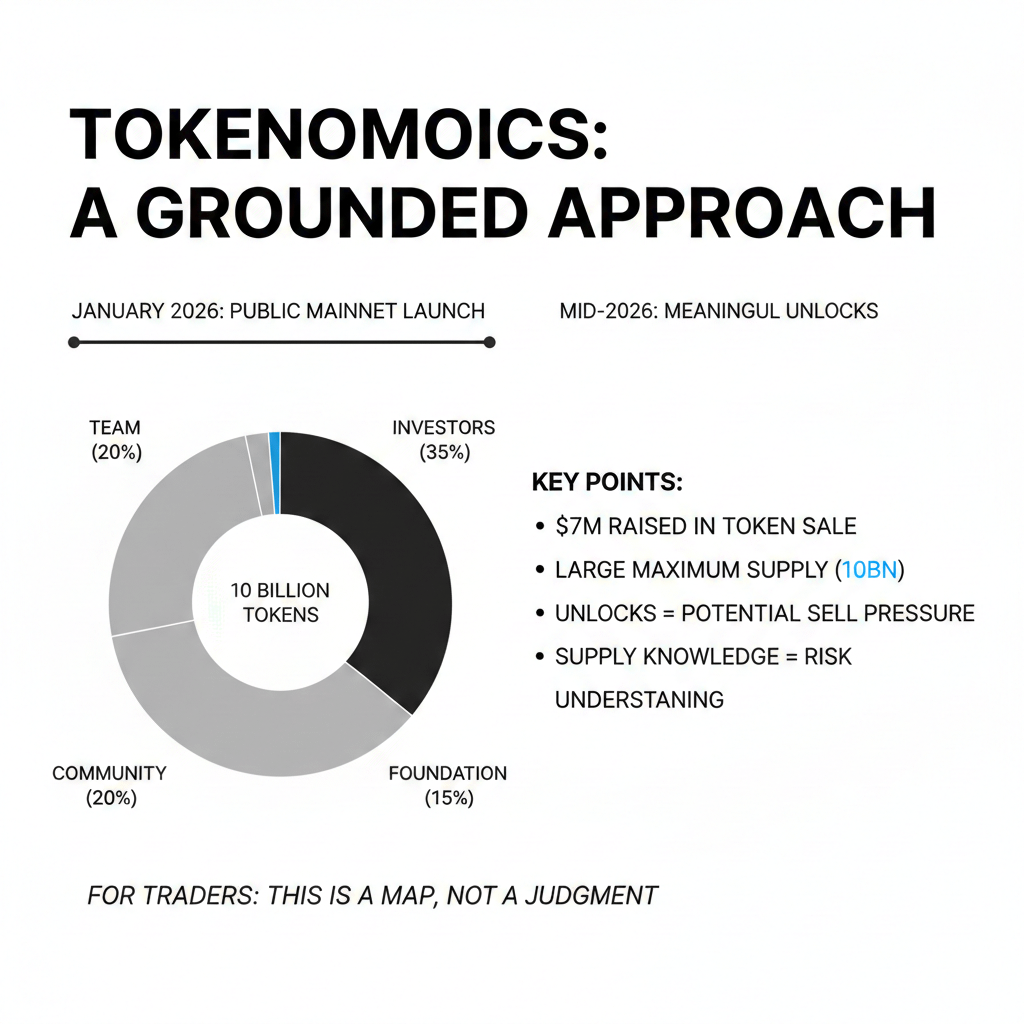
On the token side, the story is more grounded than flashy. The project launched its public mainnet in mid-January 2026 after raising around $7 million in its token sale. Distribution reports show a large maximum supply, commonly referenced at 10 billion tokens, split across team, investors, community allocations, liquidity, and foundation buckets. Some meaningful unlocks are scheduled later in 2026. For traders, this is not a judgment. It is a map. Unlocks mean potential sell pressure. Timelines matter. Understanding supply is part of understanding risk.
Ecosystem growth is where theory meets reality. Performance does not automatically create loyalty. Liquidity follows comfort. Comfort means working wallets, stable bridges, trusted exchanges, deep stablecoin pools, and tools that do not break during peak hours. Fogo’s SVM compatibility helps attract developers who already know the stack. That lowers friction. But incentives alone do not build habits. If users feel safe during high volatility days, habits form naturally. If not, liquidity disappears once rewards slow down.
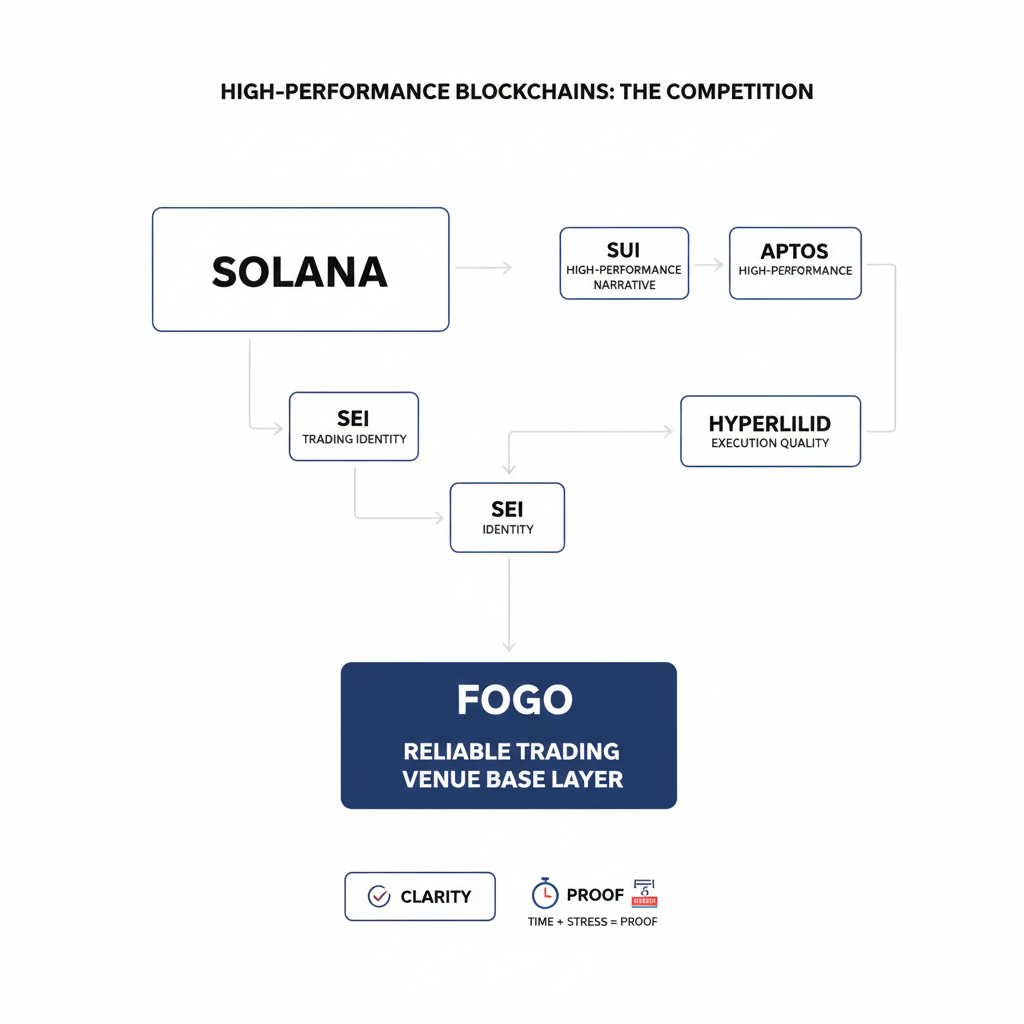
The competition is serious. Solana is the obvious benchmark. Sui and Aptos compete in the high-performance narrative. Sei leans into trading identity. Hyperliquid shows what happens when execution quality becomes central to product design. Fogo is stepping into this environment with a clear focus: make the base layer itself feel like a reliable trading venue. That clarity is good. But clarity is not the same as proof. Proof only comes with time and stress.
There is also a hidden risk with ultra-low latency. The faster a chain becomes, the more it can favor automated strategies unless fairness is carefully designed. High frequency behavior increases. If transaction ordering is not balanced, normal users can feel pushed aside. A network can be fast and still feel hostile. That is why the promise of fair execution is not optional. It is central. If regular traders feel disadvantaged, they will leave quietly.
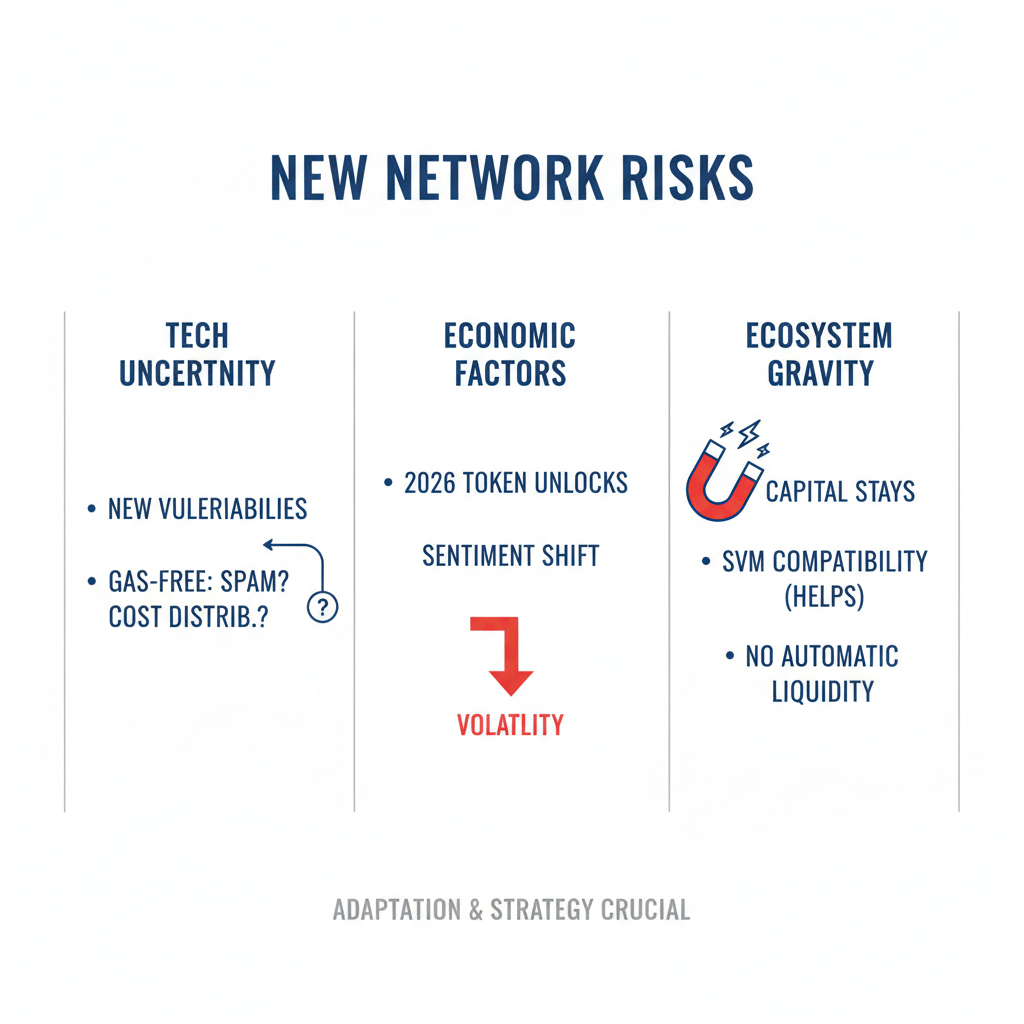
There are other risks. It is a new network. New networks find new ways to break. Gas-free sessions improve user experience, but they also create questions around spam control and cost distribution. Token unlocks later in 2026 can shift sentiment quickly. And ecosystem gravity is real. Capital often stays where it already feels safe. SVM compatibility helps, but it does not automatically pull liquidity away from established chains.
From a trader’s perspective, the right mindset is patience. The question is not “how high can this go.” The question is “does the market truly need another execution layer, and will serious applications choose it.” Spot exposure, if considered at all, should come after real liquidity proves itself. Tight spreads. Stable volume. Strong performance during a chaotic market day. If the network holds during stress, that is signal. If price moves only on thin books, that is noise.
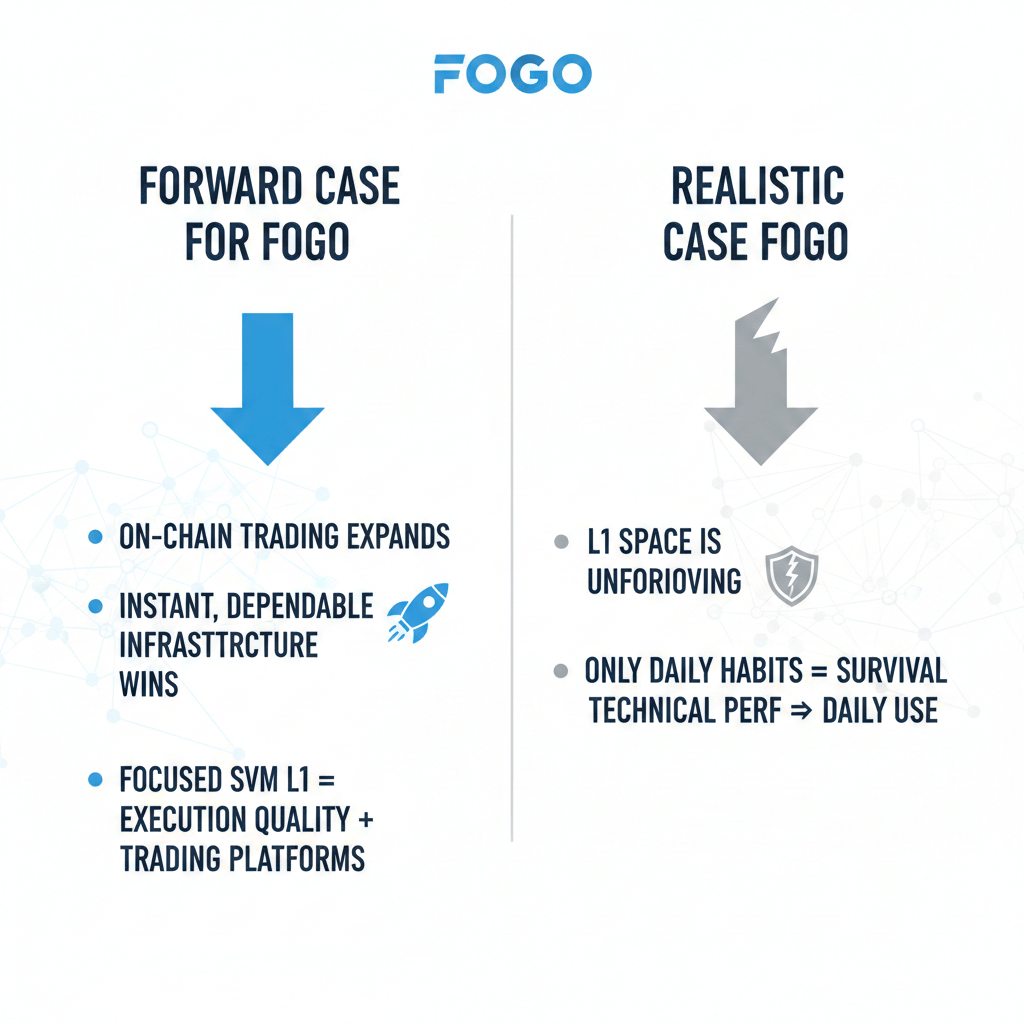
The forward case for Fogo is simple. If on-chain trading keeps expanding, infrastructure that feels instant and dependable will win attention. A focused SVM Layer-1 designed for execution quality could carve out a space, especially if real trading platforms anchor themselves there. The realistic case is also simple. The Layer-1 space is unforgiving. Only networks that turn technical performance into daily habits survive.
 Trader to trader, excitement fades quickly in this industry. What lasts is trust. Fogo is aiming at something real: the emotional gap between clicking confirm and seeing confirmation. That gap is small, but it carries a lot of weight. If Fogo can consistently close that gap — not just in quiet markets, but during the worst volatility days — then confidence can grow naturally.
Until then, the clean approach is observation. Watch how it behaves under stress. Watch how liquidity reacts after incentives cool down. Watch whether builders stay. In crypto, conviction should follow evidence. Fogo’s thesis is clear. Now it has to prove it where it matters most — in the moments when execution is everything.
#fogo @Fogo Official #fogo $FOGO
