Fogo quiet revolution unfolding in the world of blockchain — one that doesn’t revolve around NFTs, memecoins, or yet another layer-2 scaling promise. It’s about execution at the speed of thought, about removing the friction that has long haunted decentralized finance and making on-chain systems feel as responsive as the centralized platforms traders grew up with. At the heart of this shift is Fogo, a high-performance Layer 1 built on the Solana Virtual Machine (SVM) that is challenging assumptions about what a blockchain can do.
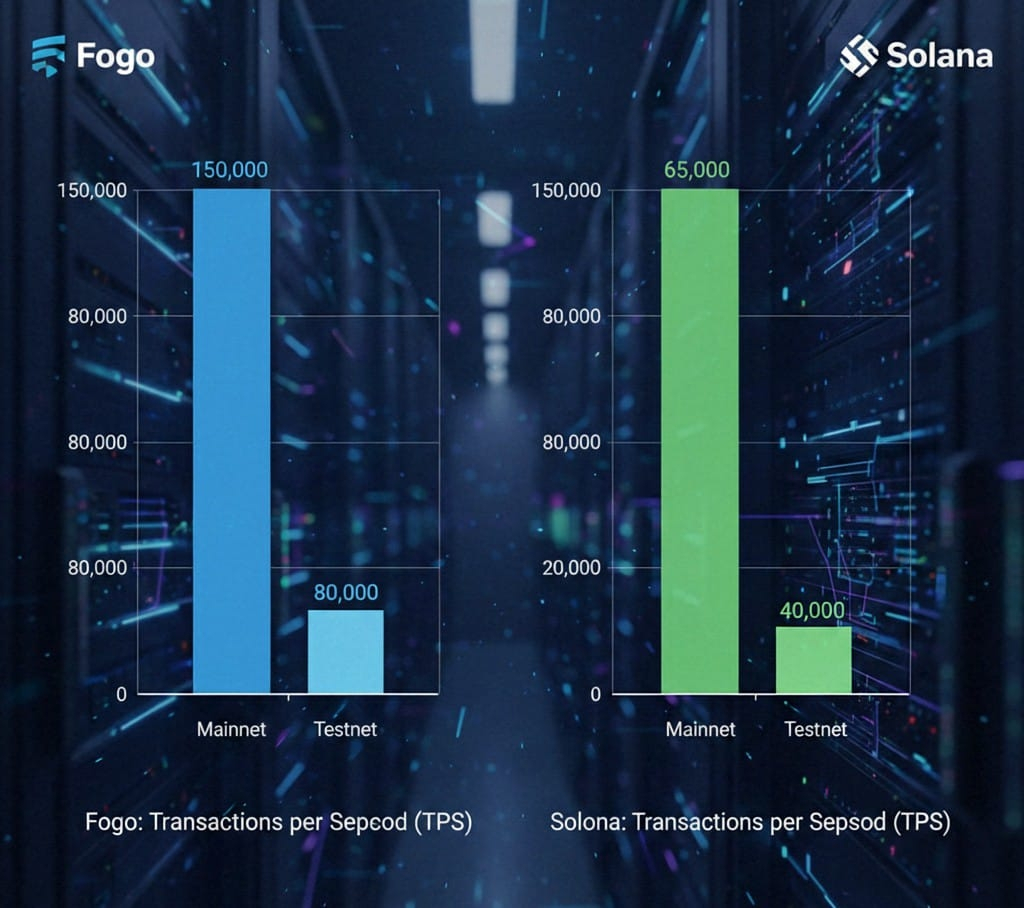
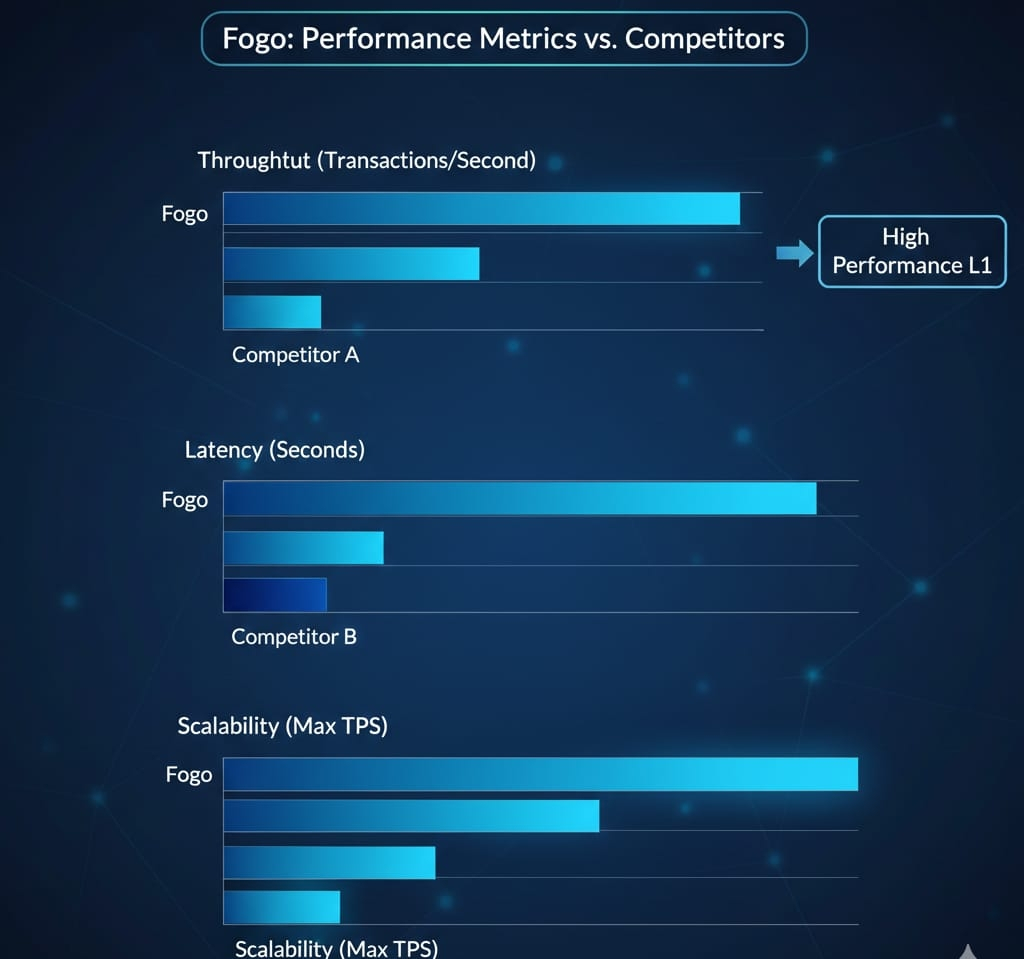
Imagine, for a moment, a world where submitting an order to buy an asset on a decentralized exchange doesn’t feel like sending a message into the void — where that order is acknowledged, processed, and final within the blink of an eye. Fogo is basically attempting to build that world. Technical benchmarks on its live mainnet — launched in January 2026 — claim block times as low as 40 milliseconds and throughput that stretches into the tens of thousands of transactions per second, metrics that eclipse many established chains and put the network in the same conversation as traditional systems like stock exchanges on raw speed.
The genius of Fogo lies not in a single breakthrough, but in how it rethinks every small piece of the stack. At its core, it leverages the Solana Virtual Machine, meaning developers who have poured months or years building on Solana don’t have to reinvent the wheel. They can bring their tools, programs, wallets, and contracts straight over with minimal friction, a practical boon that lowers the psychological and technical cost of adoption.
But compatibility alone isn’t innovation. What sets Fogo apart is the way it tackles latency — the seemingly innocuous delay between submitting a transaction and seeing it confirmed. In centralized trading systems, firms go to extreme lengths to shave microseconds off execution times, locating servers near exchanges and optimizing every micro-interaction. Fogo, in a blockchain first, embraces this ethos by organizing validators into “zones” that are physically colocated in data centers near major financial hubs. This reduces the physical distance data must travel and cuts down confirmation times drastically.
That approach — while controversial to purists — is pragmatic. It says: Yes, geography matters. The old blockchain ideal that validators should be everywhere runs headlong into physics. Signals don’t travel instantly; there’s literally speed-of-light delay. By acknowledging that, and by cleverly rotating which zone has consensus authority in each epoch, Fogo seeks a middle ground between decentralization and performance.
Another piece of Fogo’s performance magic is its reliance on a Firedancer-based validator client — a high-performance implementation originally incubated by Jump Crypto to optimize Solana infrastructure. Firedancer was designed from the ground up to minimize overhead, maximize throughput, and reduce variance in block production, and Fogo embraces it fully to deliver consistent, predictable performance rather than sporadic bursts.
But perhaps the most human-centric innovation isn’t about raw speed at all — it’s about how people interact with the chain. Fogo introduces a concept called Fogo Sessions, a way for users to interact with decentralized applications without signing every individual transaction, creating a smoother experience that feels more like Web2 than the clunky, click-once-per-action reality most crypto users tolerate today. It’s not superficial; every skipped signature and waived fee is a small reduction in the cognitive load of interacting with the network — a step toward making blockchain applications as effortless as logging into an app.
Yet, beneath the gleaming performance figures and slick UX promises, Fogo also raises questions that go beyond the usual blockchain market hype. At what point does performance optimization — especially measures like node colocation — begin to conflict with the ethos of decentralization that gave birth to blockchain in the first place? There’s a tension between achieving near-instant execution and maintaining a truly open, permissionless network. Some critics argue that any architecture that privileges certain validators or physical locations risks introducing new central points of failure or geopolitical vectors that are difficult to reconcile with a decentralized future. This is not a trivial concern; it strikes at the philosophical foundations of blockchain.
Then there’s the broader ecosystem question. Speed alone doesn’t guarantee utility. For every Fogo or Solana promising needle-fast confirmations, there’s a long road to cultivating liquidity, developer mind-share, and user activity. Real-world usage — not just testnet metrics or benchmarked claims — will determine whether Fogo becomes a hub of vibrant activity or just another high-performance outpost with little traffic. Some skeptics even suggest that Firedancer’s innovations might strengthen Solana itself more than spawn a suite of successful competitors, especially if liquidity and composability remain unevenly distributed across chains.
Still, Fogo’s emergence represents an important experiment in blockchain design. It confronts a basic truth: that decentralized systems have to compete with centralized ones not just on ideals, but on experience. Traders and applications want responsiveness. They want reliability. They want networks that don’t make them choose between decentralization and performance. Fogo doesn’t solve every problem, nor should it. But it points toward a future where blockchains aren’t defined solely by security models and theoretical throughput, but by how alive and responsive they feel in the hands of users. That combination of engineering precision, practical UX design, and willingness to question sacred cows could be the real legacy of projects like Fogo.