
Fogo and the Cost of Speed
There’s a quiet truth in blockchain that most people avoid discussing: speed is never free. If transactions feel instant, someone somewhere is absorbing the cost — not in token emissions, not in marketing budgets, but in silicon, bandwidth, and thermal limits.
Fogo forces that reality into the open.

When a network advertises 40ms finality, it’s not just a number. It’s a design decision. At that threshold, confirmation moves from “noticeable” to “invisible.” Below human perception, systems stop feeling like blockchains and start feeling like infrastructure. That psychological shift is powerful.
But here’s the story behind it.
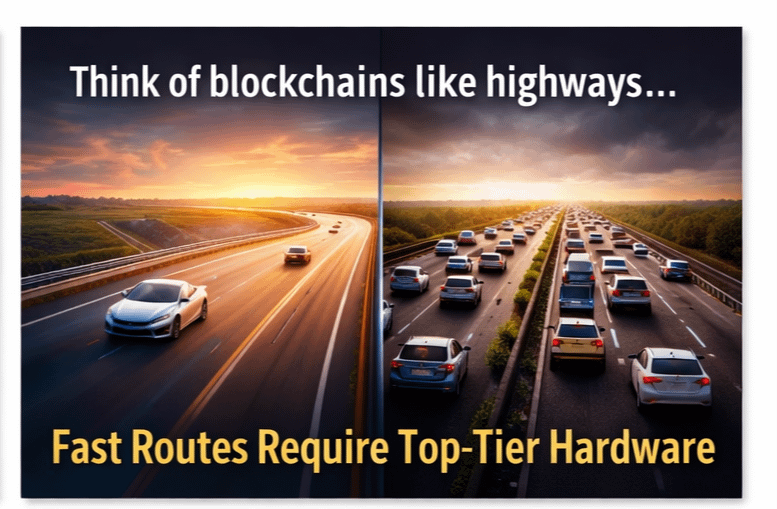
Imagine two highways. One is built wide, smooth, and perfectly engineered — but only high-performance cars can drive at full speed. The other allows almost any vehicle, but traffic flows more cautiously. Fogo chose the first model.
Its parallel execution engine is engineered to push hardware to its limits. With NVMe-grade storage and high IOPS capacity, the chain performs like a high-frequency trading system. Under pressure, it doesn’t gracefully slow down — it demands that validators keep up. If they can’t, they drift behind the chain tip. The performance is real. The requirements are equally real.
Compare this to networks like Solana, which historically balanced performance with broader validator accessibility. Or Monad, which attempts to retrofit performance improvements onto an inherited execution model. Even Sui approaches parallelism differently, restructuring data ownership to minimize conflicts at the protocol level.
Fogo doesn’t retrofit. It refines. It narrows the environment in which it wants to exist and optimizes aggressively inside that box.
One of its more subtle design decisions is isolating fee markets locally. Instead of allowing congestion in one area to contaminate the entire system, it segments economic pressure. This prevents the kind of cascade failures we’ve seen in high-throughput chains during peak demand. But there’s a tradeoff — liquidity becomes less universally fluid. Predictability increases, flexibility decreases.

So the real competition among high-performance chains is no longer just TPS numbers. It’s about failure behavior.
Does the chain degrade gradually, allowing operators to respond? Or does it maintain peak output until the moment it fractures?
Fogo feels like a system built for environments where performance is expected, not optional. But that also means its margins for hardware weakness are thin.
The deeper question isn’t whether Fogo can run fast. It can.
The question is whether its validator base can consistently meet the hardware reality required to sustain that speed — not for a benchmark, not for an airdrop phase, but for years.
Because in the end, blockchains don’t compete on whitepapers.
They compete on how they behave under stress.
