
Last Friday, I was playing chess with a few friends. One of them is extremely analytical — the type who calculates five variations before every move, thinks like an engine, and follows textbook principles with discipline.
And yet, he loses the most.
Why?
Because chess is not just a game of rules. It’s a game of psychology and timing.
He sees the board, but not the player.
He knows the value of each piece, but not the intention behind a move.
He plays the “correct” move — just not at the right moment.
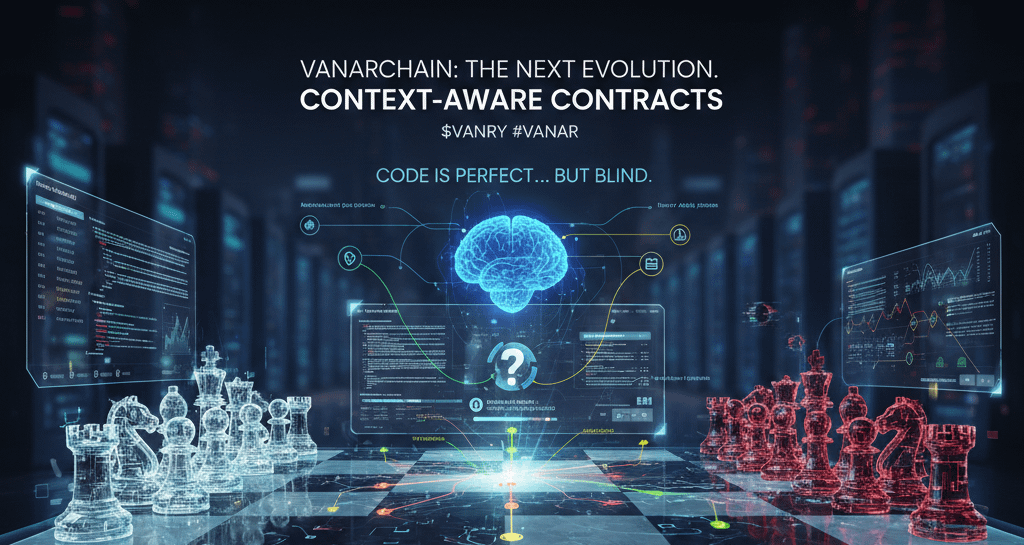
I told him:
“Rules can protect you from mistakes, but only awareness of the situation wins games.”
And suddenly it struck me —
Isn’t this exactly where blockchain stands today?
Code Is Perfect… But Blind
For years, we’ve proudly repeated: Code is Law.
A smart contract checks the signature, verifies the condition, and executes the transfer.
No hesitation. No judgment. No interpretation.
And that’s the problem.
It cannot recognize that a flash loan is draining liquidity.
It cannot detect that a massive token approval is going to a phishing contract.
It cannot sense abnormal gas spikes or understand when MEV bots are squeezing retail traders.
It has speed — but no awareness.
It has execution — but no judgment.
That’s why DeFi exploits never seem to stop.
The Next Evolution: Context-Aware Contracts
So what comes next?
Imagine a smart contract that doesn’t just execute if-then logic but first scans its environment:
Are gas fees behaving abnormally?
Does the caller’s historical behavior resemble known attack patterns?
Will this transaction dangerously impact liquidity?
Does this activity match a previously exploited structure?
If something feels wrong, it pauses.
It demands additional verification.
It refuses to execute blindly.
That’s not just automation.
That’s on-chain reasoning.
The 2026 Reality
As real-world assets (RWA) and institutional capital continue entering the space, do you think institutions will trust billions of dollars to rigid, context-blind contracts?
Unlikely.

They will demand infrastructure that understands risk, detects patterns, and adapts to dynamic conditions — more like an experienced chess player than a rule-bound beginner.
The Question for Investors
Short-term volatility often distracts from structural change.
But the real question is this:
Will you continue betting on rigid systems that only execute?
Or will you look toward the next phase — where code begins to interpret context and manage risk?
The board is set.
The game has just begun.
The next move is yours.
