
The first time I really slowed down and studied FOGO, I stopped looking at the token and started looking at the plumbing.
Because infrastructure tells you more than marketing ever will.
@Fogo Official runs on the Solana Virtual Machine, which immediately gives it parallel execution capabilities. On the surface, that means transactions that don’t conflict can process at the same time. But underneath, it means the network avoids the bottlenecks that choke purely sequential systems.
Parallel execution changes behavior. If two traders submit unrelated transactions, they don’t have to wait on each other. That reduces congestion pressure. It reduces unpredictable queue buildup.
Now layer in block production at roughly 40 milliseconds. That’s about 25 blocks per second. Fast inclusion alone isn’t rare anymore. But FOGO pairs that with around 1.3 seconds to finality. That finality number matters more than most people think.
Finality compresses uncertainty. If you’re trading during volatility, every second between submission and irreversible settlement carries price risk. Shrink that window and your effective slippage tolerance improves.
That momentum creates another effect. Liquidity providers feel safer deploying capital. Arbitrageurs tighten spreads. Execution quality improves.
Then you look at Dual Flow Batch Auctions.
On the surface, it sounds like a different order matching method. Instead of strict first-come ordering, trades are grouped and cleared together based on price priority. Underneath, it reduces the advantage of micro-latency extraction.
That’s important. In many ecosystems, speed advantages reward whoever has the fastest infrastructure, not necessarily the best price. FOGO is trying to reduce that imbalance.
Of course, batching introduces trade-offs. You slightly delay execution within the batch window. Critics will argue that pure speed is superior. But if the batching window is short enough, and fairness improves, the net market structure becomes healthier.
Meanwhile, $FOGO validator design reinforces the philosophy. Co-located validators reduce propagation latency. Firedancer optimizes packet processing and throughput efficiency. That means the performance claim isn’t theoretical.
But none of this matters without incentive alignment.
FOGO tokenomics allocates 16.68 percent to community ownership, 34 percent to core contributors, 21.76 percent to the foundation, and 12.06 percent to institutional investors. That structure tells you who the network is prioritizing long term.
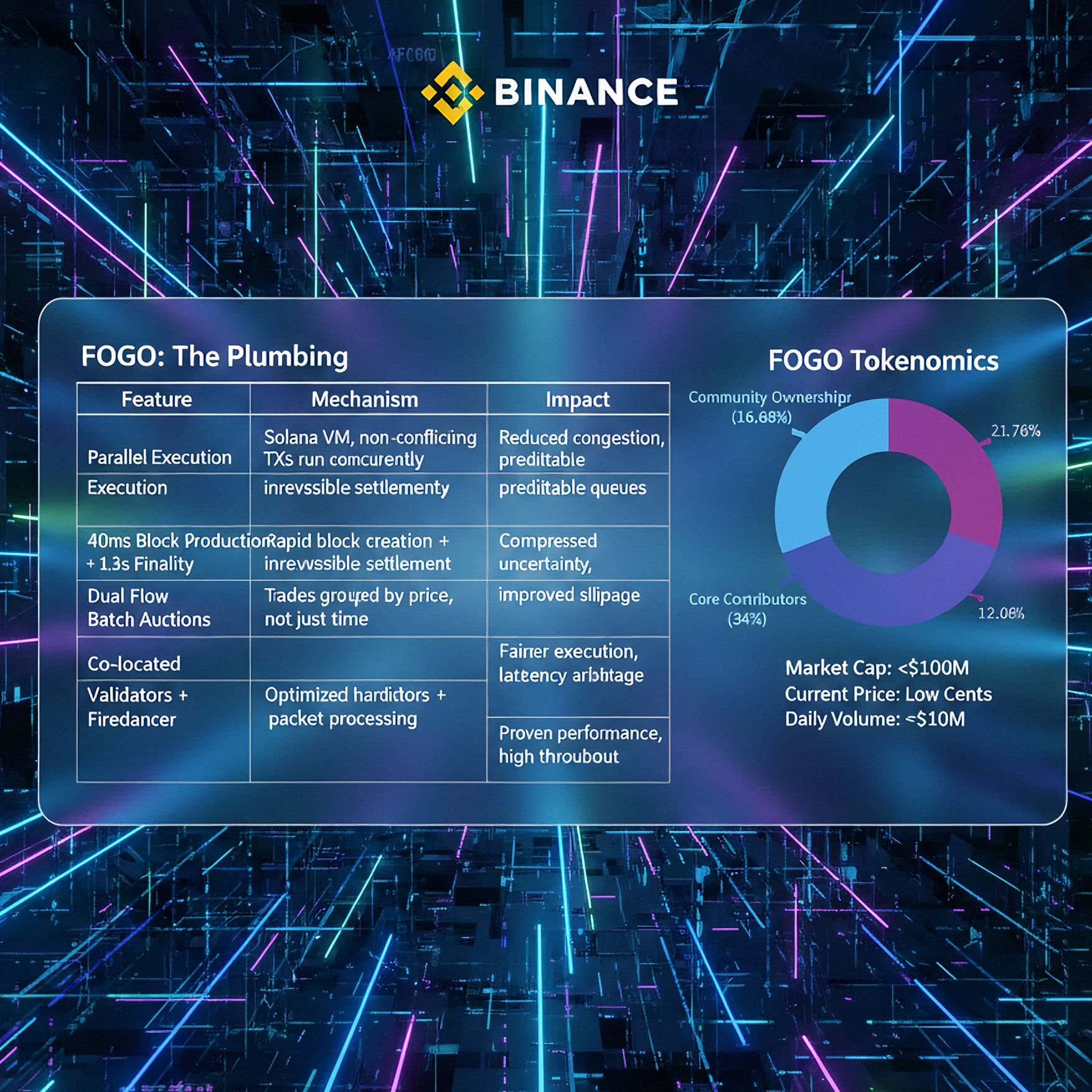
If community and foundation collectively hold a meaningful share, ecosystem funding and user incentives remain central. That influences how grants, staking, and participation rewards evolve.
There are risks. Unlock schedules create pressure cycles. Performance chains must continuously prove stability. Liquidity is competitive and migrates quickly.
Right now, FOGO trades in the low-cent range with a market cap under nine figures. That means expectations are still forming. Volume activity in the tens of millions suggests interest, but not mania.
That’s a delicate stage.
Zoom out and you see a broader shift in crypto. The conversation is moving from theoretical TPS to execution integrity. Traders are asking different questions now. Does the chain hold up under stress. Does ordering feel fair. Does settlement remain predictable.
FOGO appears to be positioning itself inside that evolution. It’s not trying to win headlines. It’s trying to control microstructure. And if crypto matures the way traditional markets did, microstructure wins. Because markets don’t reward noise.
They reward consistency.
