
When I first looked at Fogo, I’ll never forget my first trade during a volatility spike on Solana. The price was jumping fast, and my order did go through—but I could still feel that tiny pause between hitting “submit” and seeing it confirmed. Just a fraction of a second, almost imperceptible. Yet in trading, even these tiny moments carry weight. That subtle delay—that quiet space between intention and execution—is exactly where Fogo’s story starts.
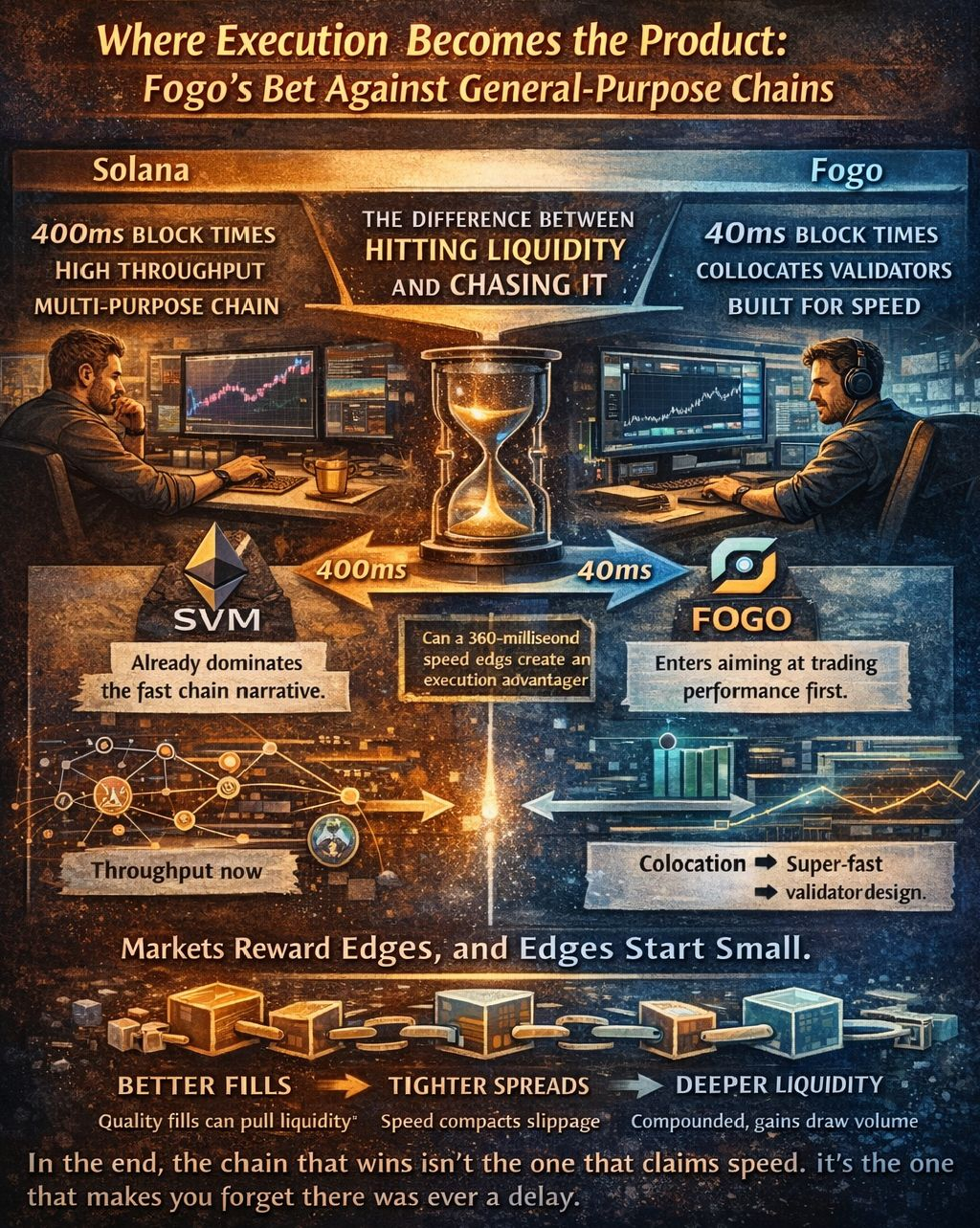
Fogo is entering the market with a narrow promise: build an SVM chain that treats trading performance as the primary product. Solana already dominates the fast-chain narrative, with high throughput, parallel execution, and years of real usage. Its 400 millisecond block times and sustained transaction volumes aren’t theoretical. Traders have tested them under stress, and the network held.
Fogo’s pitch is different. Early technical disclosures point to block times near 40 milliseconds. That gap seems small on paper, but in fast markets it changes the distance between intent and settlement. For automated strategies, that window is the difference between hitting liquidity and reacting to price movement. Over thousands of trades, those milliseconds compound into measurable execution differences.
That logic extends into Fogo’s validator design. Colocation and positioning aren’t cosmetic choices. Reducing physical distance between validators and trading infrastructure mirrors how traditional trading firms pay to sit next to exchange engines. Network topology becomes part of price priority. The chain’s structure starts to shape who gets filled first.
Solana has already shown resilience. Its parallel execution model keeps throughput steady during congestion cycles. That reliability created trust, and trust anchors liquidity. Fogo inherits SVM compatibility, which lowers the cost of porting contracts, but ecosystems don’t move easily. Liquidity follows momentum, and momentum compounds around deep markets.
Speed can still create gravity. Market makers notice consistent execution advantages. Slightly tighter spreads attract volume. Volume deepens liquidity. That loop can form quietly. But faster blocks increase validator pressure. Hardware and bandwidth demands rise. Colocation narrows geographic diversity. Performance gains come with decentralization tradeoffs.
The deeper distinction is intent. Solana balances NFTs, DeFi, gaming, and payments within shared block space. Fogo is optimized for execution above everything else. Specialization sharpens performance, but it narrows scope. Traders may accept that trade if fills improve, even marginally.
This isn’t about replacing incumbents. It’s about splitting roles. One chain as the general liquidity layer. Another as the ultra-low latency venue. Markets reward edges, and edges often begin small. In the end, the chain that wins isn’t the one that claims to be fastest. It’s the one where traders stop thinking about speed because the fills simply feel right.$FOGO @Fogo Official #fogo

