
When I look at the decentralized finance (DeFi) landscape, I'm always searching for projects that genuinely push the envelope, that don't just mimic traditional finance but fundamentally rethink how value can be exchanged on a blockchain. That's why I find "Fogo" (let's use that as our hypothetical example for now) so intriguing. I really believe Fogo possesses a distinct "structural edge" that could, and I mean could, redefine how we approach on-chain market design. It's not just another exchange; I see it as a thoughtful evolution.
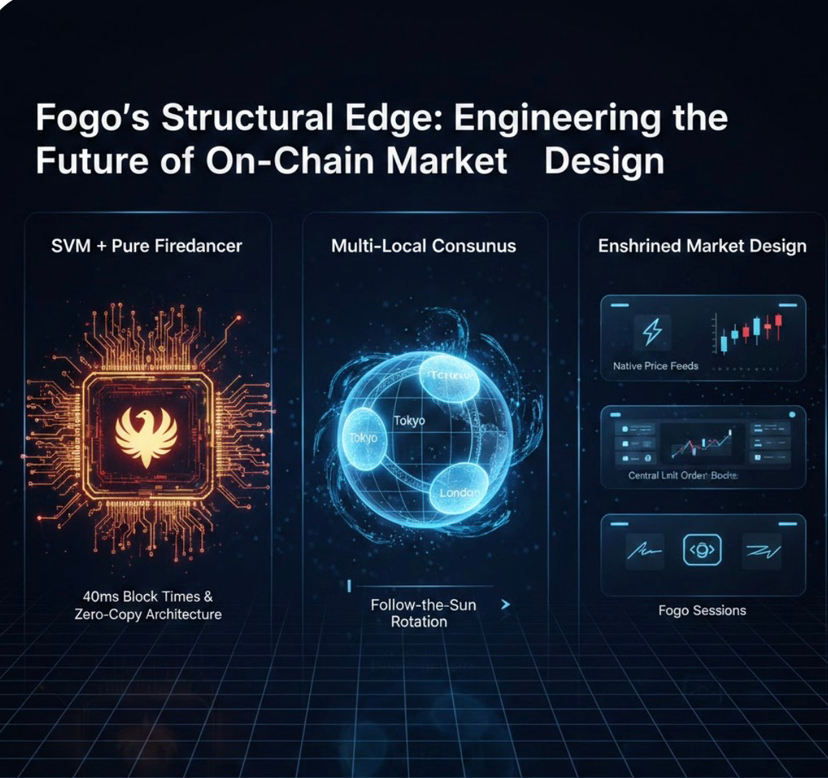
I think Fogo's core strength lies in its intelligent blend of different market paradigms. We've seen the rise of Automated Market Makers (AMMs) like Uniswap, and I think they've been revolutionary in democratizing liquidity. But honestly,I've always felt their limitations – impermanent loss is a real headache for liquidity providers, and in volatile markets, the pricing can feel a bit... rigid. Then you have traditional on-chain order books, which, while familiar, often battle with high gas fees, slow transaction times, and the ever-present threat of front-running. What I observe in Fogo is an attempt to take the best of both these worlds while ingeniously sidestepping their major pitfalls.
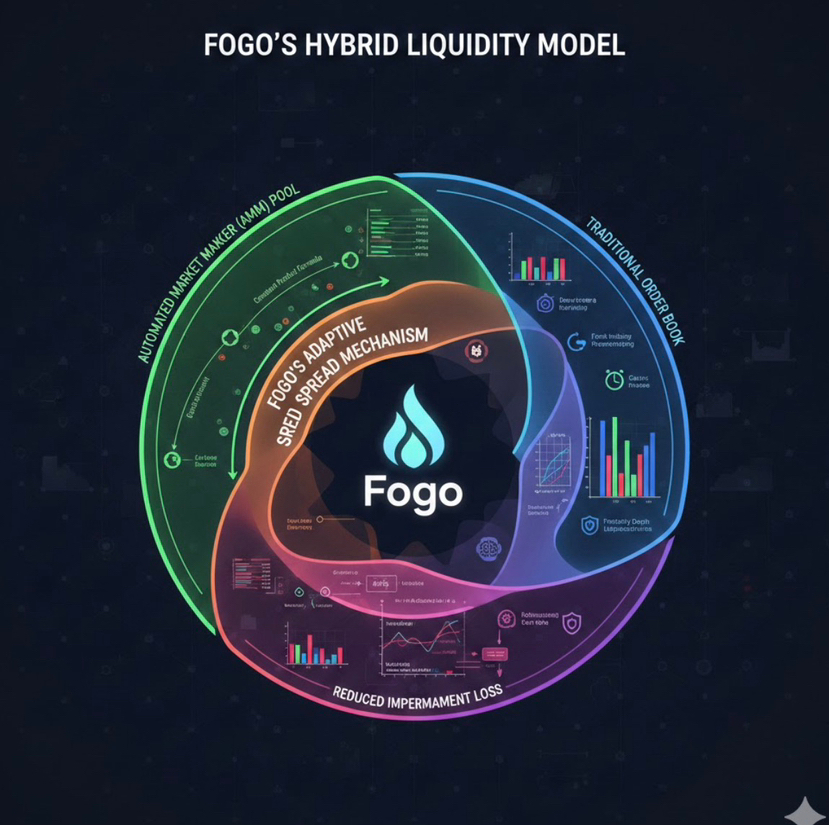
One of the things that truly catches my eye about Fogo is what I'm calling its hybrid liquidity model. I've seen a lot of AMMs, but Fogo's approach seems more dynamic. Instead of just relying on a fixed curve, it appears to incorporate an adaptive spread mechanism. This means the pricing isn't static; it intelligently adjusts based on what's actually happening in the market – volatility, how much liquidity is available, that sort of thing. I think this adaptability is absolutely crucial. It's like the market itself is breathing. During calm periods, spreads tighten, making trades more efficient. But when things get choppy, those spreads can widen, which I believe is essential for protecting liquidity providers. It makes me think that LPs will be more willing to commit their capital, knowing they're not just at the mercy of a rigid formula. It offers a more balanced risk-reward profile, and I think that's a huge step forward for sustainable liquidity.
I also find myself particularly drawn to Fogo's "intent-centric" order matching engine. This, to me, is where Fogo really starts to differentiate itself. Instead of just submitting a straightforward limit order, I can express my "intent." This means I'm not just saying "sell at X price"; I'm saying "I want to sell Asset A for Asset B, and I'm okay with a certain minimum amount and a maximum slippage." The engine then takes that intent and intelligently scours for the best way to fulfill it, pulling from its own hybrid pools and potentially even external liquidity. I think this is a much more sophisticated way to handle trades. It reduces the need for constant, expensive on-chain interactions, and it feels more aligned with how a human would actually want to trade, expressing their overall goal rather than just a precise point.
And let's not forget about front-running and MEV (Miner Extractable Value). I think these are some of the biggest headaches in current on-chain markets, eroding trust and creating an uneven playing field. Fogo's approach, using batch auction mechanisms and encrypted mempools, seems like a robust defense. Batching orders together can effectively neutralize the advantage front-runners get from seeing individual transactions. And encrypted mempools? That's just smart. If transactions are encrypted until they're actually included, it's much harder for malicious actors to exploit pending orders. I believe this commitment to fair execution is absolutely fundamental for DeFi to truly mature and attract broader participation, especially from institutions.
Beyond the trading mechanics, I've noticed that Fogo seems to integrate a thoughtful governance and incentive layer. I think this is critical for any decentralized protocol's long-term health. The idea that token holders can directly influence crucial parameters – like how spreads are adjusted, the fee structure, or which new assets are listed – creates a truly decentralized and adaptive system. It ensures that the platform evolves in a way that benefits its users and liquidity providers. And the way staking is tied into liquidity provision, offering extra rewards for longer commitments, just makes sense. I see this as a clever way to deepen liquidity and reduce market volatility. This symbiotic relationship between governance, incentives, and the market mechanics themselves is, to my mind, a powerful structural advantage; it builds a self-sustaining and constantly improving ecosystem.
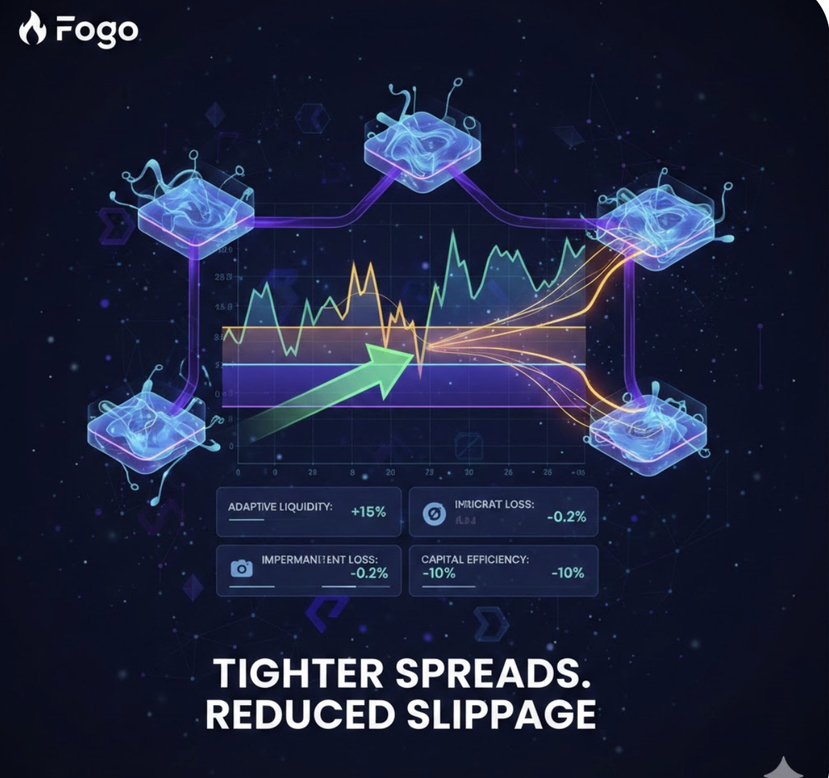
Ultimately, I feel that Fogo's structural edge isn't just about minor tweaks to existing models. I see it as a comprehensive,intelligent design that addresses many of the current pain points in decentralized exchanges. By creating a market that's more robust, fairer, and incredibly adaptable, I believe Fogo has the potential to unlock entirely new avenues for capital allocation and sophisticated risk management within DeFi. I can envision a future where complex financial instruments,beyond simple spot trading, could thrive on an infrastructure like Fogo's, pushing the boundaries of what we thought was possible on a blockchain.
So, in my view, Fogo's strength lies in this synergistic combination of its hybrid liquidity, intent-centric matching, MEV mitigation, and smart governance. It's a multi-faceted approach that truly excites me, and I think platforms like Fogo, with their focus on intelligent and adaptive market designs, are poised to play a really significant role in shaping the future of decentralized finance.
