Crypto has a habit of recycling the same pitch.
“Faster blocks.”
“More throughput.”
“Built for traders.”
“Next-gen infrastructure.”
And honestly, after a few cycles, you start hearing it like background noise. Because when real volume hits, most chains don’t fail in some dramatic Hollywood way. They fail in the boring way. Delays. Jitter. Random slowdowns. Weird little edge cases that don’t show up in demos.
That’s why, when Fogo talks about sub-40ms blocks and sub-second confirmation, a lot of people roll their eyes.
Fair. Healthy, even.
But if you zoom in, Fogo’s claim isn’t really “we turned the speed knob to 11.” It’s more like: “we rebuilt the engine that the whole machine depends on.” And that engine is the validator client.
That’s where Firedancer comes in.
Fogo runs on a custom Firedancer-based validator client. Firedancer started as Jump Crypto’s ultra-fast validator work for Solana, written in C and designed for performance from the ground up. Fogo takes that foundation, then tweaks it for stability, throughput, and low-latency communication inside its colocated setup.
Sounds like a detail. It’s not. It’s the main idea.
Let’s get the easy critique out of the way, the one people toss around because it fits in a single sentence.
“Fogo is just another Solana fork with a new ticker. Firedancer is just a buzzword.”
Neat. Clean. And kind of lazy.
Here’s what that take skips: a lot of SVM chain performance doesn’t break at execution first. It breaks in the plumbing around execution. The networking layer. Gossip. Block propagation. Message handling. Scheduling.
All the unsexy stuff that determines whether your “fast chain” is actually fast when it matters.
Firedancer matters because it’s not just “an optimization.”
It’s a full validator client rewrite, done in C, built to squeeze more performance out of modern hardware. Fogo’s own design pitch is basically, “don’t split the network across a bunch of slow clients, standardize around a high-performance one.” In their framing, slower implementations cap the network’s ceiling, and that ceiling shows up at the worst possible times.
So no, the interesting part isn’t that it’s SVM. The interesting part is that Fogo treats the validator client like the product.
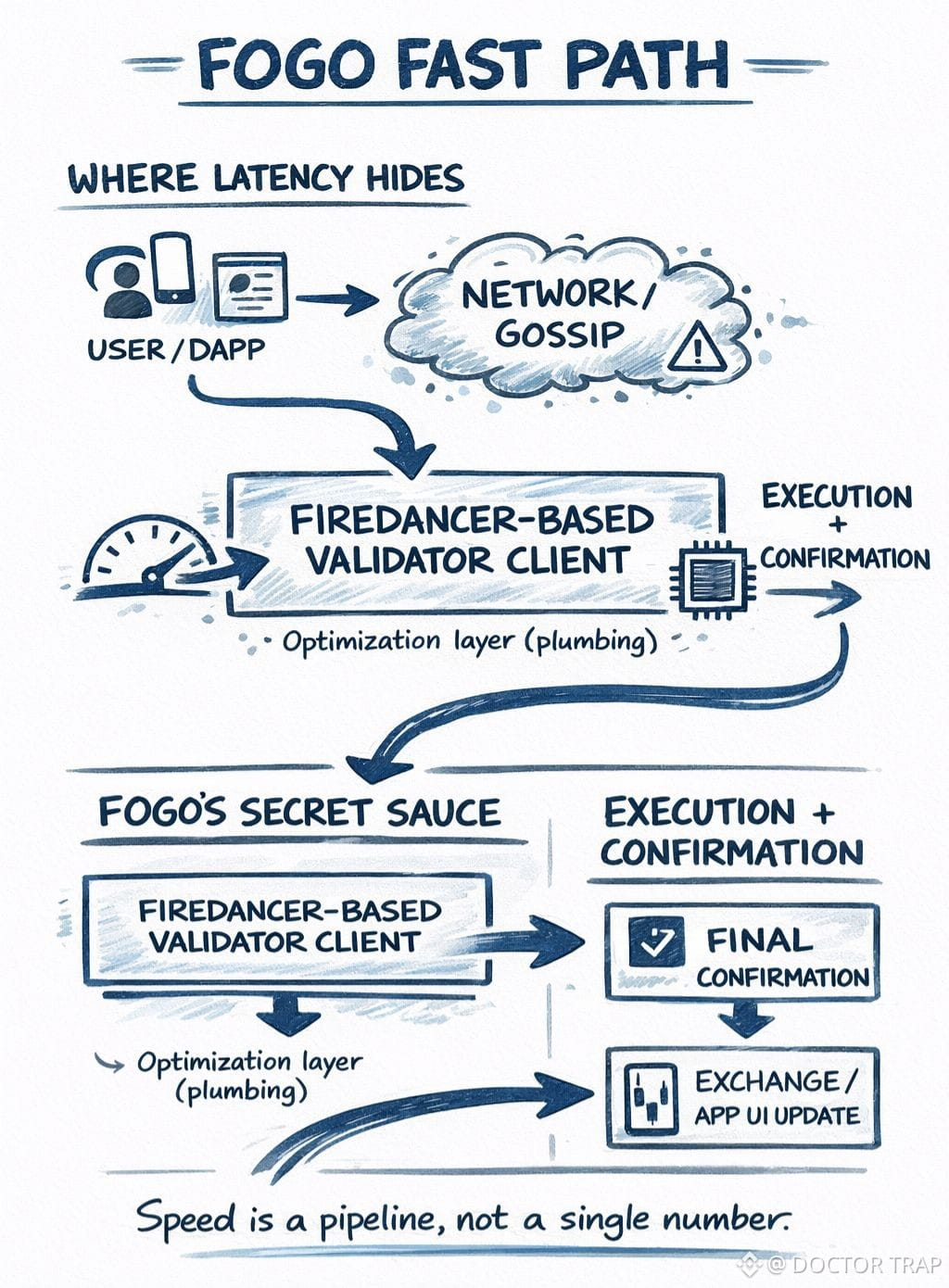
Think of a blockchain like an airport.
You can have a perfect plane, fancy cockpit, great engines. That’s your VM and execution.
But if the runway is short and the control tower is slow, your flights still get delayed. And the passengers don’t care why. They just know they’re stuck.
The validator client is that runway and that control tower. It’s the system that decides how quickly information moves and how cleanly the network stays coordinated.
One thing a custom client helps with is what I call the “compatibility tax.”
Many networks like having multiple validator clients, and sure, that can help reduce reliance on a single codebase. But there’s a cost. Teams spend time keeping everything compatible. Features move slower. And when the network is under stress, it often performs like the slowest safe implementation, not the fastest.
Fogo’s approach is pretty direct. Standardize around the fastest serious client. Reduce the overhead. Cut out the “it behaves differently on another client” mess. Less drama, more predictable performance.
Another thing a custom client gives you is the ability to tune the stack for the environment you actually want to run. Fogo doesn’t pretend validators are scattered on random consumer-grade setups. They lean into a colocated validator set in Asia near exchanges, with backup nodes ready. That choice changes what’s possible, because latency is suddenly a problem you can attack with real numbers, not wishful thinking.
And they act like it too.
Even in the nitty-gritty releases, there’s mention of moving gossip and repair traffic to XDP, which is deep networking-level tuning. That’s “we care about microseconds” energy. Not “we care about vibes.”
Then there’s the part that separates “fast in theory” from “fast in practice.” Traders don’t just want speed. They want speed that doesn’t wobble. Fogo markets 40ms block times and fair execution, and the point isn’t only that blocks are quick. It’s that the system pushes validators toward performance through incentives.
In Fogo’s framing, running slower clients means missing blocks and losing revenue in a high-performance setup.
That’s not hype. That’s economics doing enforcement.
People look at Jump Crypto’s name and treat it like branding. Like, “oh wow, a big firm, must be legit.”
That’s not the useful part.
The useful part is what Firedancer represents: a validator client built with hardcore performance engineering. Written in C, designed to push throughput and reduce latency.
Fogo basically ties itself to that direction, and positions itself so it can benefit from ongoing improvements without having to reinvent the whole structure every time.
So the collaboration isn’t “Jump mentions Fogo.” It’s “Fogo is using a client philosophy that was made for max performance, then shaping it for its own network design.”
You can argue with the approach, but you can’t really argue that it’s vague.
Now, let’s be adults about it.
There are risks, and pretending there aren’t is how you end up sounding like a reply-guy.
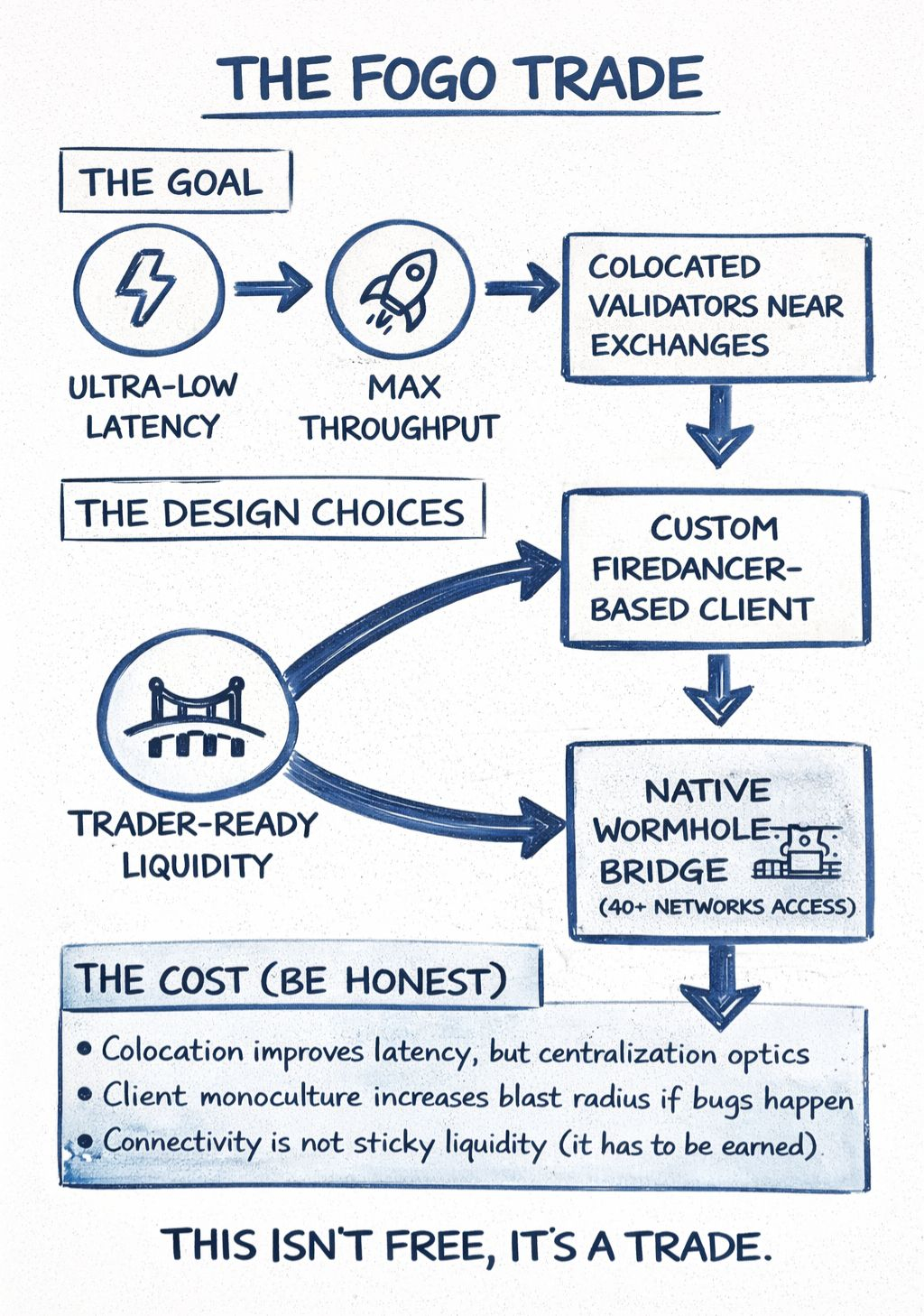
First, colocation consensus can look like centralization, even if the engineering logic is solid.
If validators are clustered in one region, you’re accepting a trade-off. Lower latency, yes. But you also invite questions about correlated outages, regional network issues, and governance optics. People will judge the network by how it feels, not just how it’s built.
Second, a single dominant client can be a sharp tool.
Fewer compatibility headaches, sure. But also a bigger blast radius if something goes wrong. If a critical bug lands in a monoculture environment, the whole network can feel it at once. No polite buffering.
Third, speed attracts the toughest users.
A chain that positions itself for serious trading doesn’t just attract traders. It attracts the people who try to game traders. MEV gets more aggressive. Attackers get more creative. The network is operating closer to the edge, so the penalty for mistakes is higher.
And then there’s timing and markets.
Fogo’s mainnet went live. It came after a $7 million strategic token sale on Binance, and it launched with Wormhole as a native bridge, which gives access to liquidity across 40+ networks. That’s a strong starting setup. But early-stage reality can still sting. Even good infrastructure can take time before people treat it as reliable. Markets are not patient, and narratives can flip fast.
So what are you really buying into here?
Here’s the clean thesis, without the marketing gloss.
Fogo is betting that the next real leap in SVM performance doesn’t come from tiny tweaks. It comes from the validator client itself, Firedancer-style engineering, plus a network environment built to minimize latency.
If they pull it off, Fogo becomes something closer to a specialized execution venue for high-speed finance. Less “general-purpose chain,” more “this is where low-latency trading actually works.” It starts to feel like infrastructure, not a social experiment.
If they don’t, the criticism writes itself. Too concentrated. Too dependent on one client. Too optimized for speed at the expense of resilience.
That’s the honest framing. Realistic optimism, not blind hype.
If you’re watching Fogo seriously, don’t just stare at TPS clips and victory-lap tweets.
Pay attention to whether the validator client matures cleanly, with upgrades that feel controlled, not chaotic.
Watch whether validator incentives really punish slow infrastructure like the design suggests, or whether the network quietly tolerates underperformance.
Watch whether actual trading-native apps show up, the kind that truly need sub-second finality, not just another copy-paste DEX.
And watch whether bridge access turns into sticky liquidity, because “40+ networks” is a door, not a guarantee anyone walks through it.
Because the secret sauce isn’t the phrase “Firedancer.”
It’s whether the custom Firedancer-based client, plus Fogo’s validator design, produces something crypto almost never delivers consistently.
Fast, yes.
But also steady. Repeatable. Calm.
When a chain gets boring in the right ways, that’s when serious money starts paying attention.