
@Vanarchain So there I was at 8:17 p.m., parked in the corner of my office, listening to the printer churn out this sad, crumpled receipt I’d already saved as a PDF—twice. The amounts were fine, but the “why” lived in ten different places: email chains, Slack messages, bank exports. And I just kept staring at it like… how is this the process in 2026?
What’s changed lately is that “paperwork” has started to collide with automation in a serious way. Tax agencies and large buyers are pushing toward structured e-invoicing, and the documents that used to be tolerated as flat PDFs are increasingly treated as second-class evidence. I see it in Peppol’s ongoing updates to invoice syntax and business rules, and in the broader global shift toward interoperable e-invoicing frameworks.
Software is definitely better at “reading” invoices than it used to be, but it still misses the stuff a person catches without thinking. It can pull totals and dates, sure, yet it hesitates on what a line item actually represents, whether a discount depends on early payment, or if the document is even the right kind of proof. If I’m asking an agent to reconcile spend, approve a reimbursement, or enforce a vendor limit, the file can’t just look readable. It has to act like structured data.
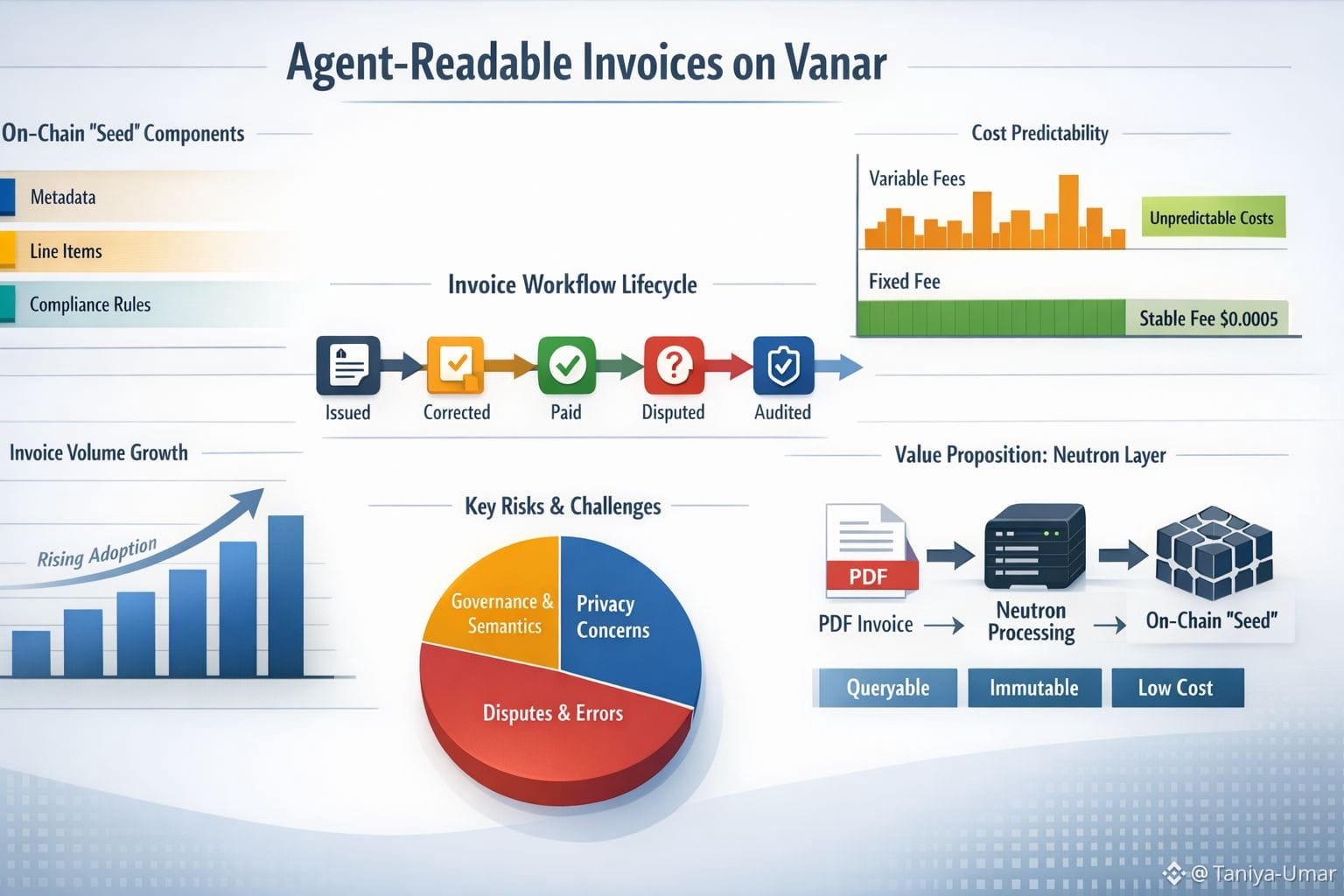
That’s where the idea of making receipts and invoices “agent-readable” on Vanar becomes interesting to me, especially through the VANRY fee lens. Vanar’s materials describe a layer called Neutron that turns raw files—like a PDF invoice—into compact, queryable “Seeds” stored on-chain, with the goal of making them readable by programs without rebuilding the meaning off-chain. I don’t take the slogans at face value, but I do take the underlying direction seriously: move from storing proof to storing usable context.
Fees are the part most people ignore until they try to scale. If each receipt upload or invoice update costs a variable amount that swings with network conditions, finance teams won’t treat it as infrastructure; they’ll treat it as a gamble. Vanar’s documentation lays out a fixed-fee approach that targets a predictable fiat value per transaction—$0.0005—by updating protocol-level fee settings from a price feed of the VANRY token. That design choice matters when I imagine real workflows: an invoice isn’t a single event. It gets issued, corrected, paid, disputed, and audited.
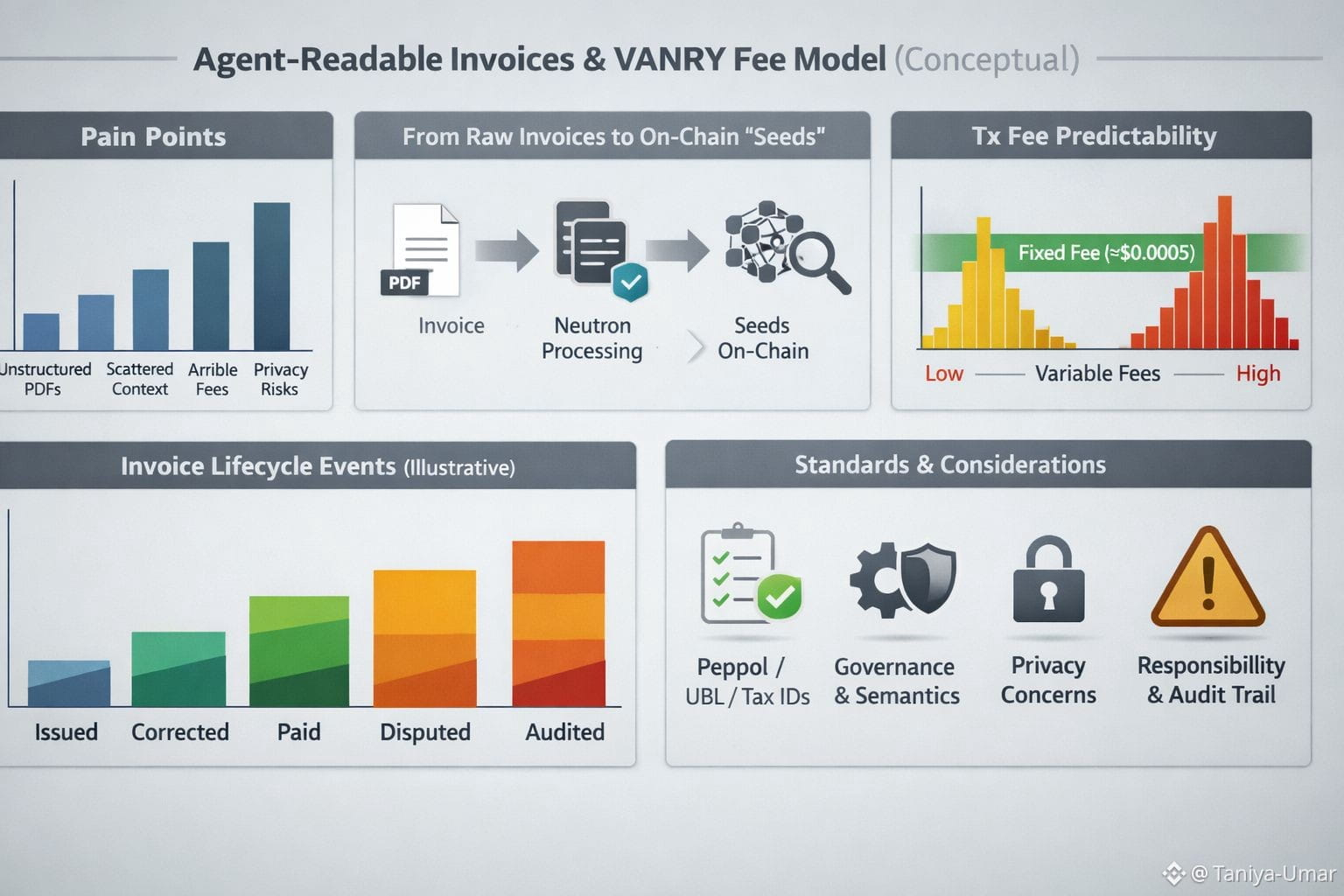
I also think about where “agent-readable” stops being a technical label and becomes a governance problem. If an automated system can query an invoice Seed and decide whether to release funds, then the schema, the interpretation rules, and the update history become the real product. Traditional e-invoicing has spent years standardizing those semantics—UBL profiles, Peppol business processes, tax identifiers—because ambiguity becomes expensive. On-chain storage doesn’t erase that; it just makes the ambiguity permanent.
The practical progress I see is that standards and tooling are moving closer together. Vendors are already using AI to classify invoice line items and automate posting, which shows there’s appetite for machine-friendly accounting beyond compliance checklists. If I can combine that with a ledger that stores an invoice’s meaning in a way I can query later, I get something I’ve wanted for years: fewer “Where did this number come from?” meetings.
Still, I’m cautious. Making documents agent-readable raises privacy questions, and even well-compressed data can leak patterns when it’s shared widely. It also raises responsibility questions: when an agent misreads a term and pays the wrong amount, the audit trail has to be clear enough for a human to unwind the mistake. Predictable fees help, but they don’t solve disputes.
Right now I care because the volume is rising. More invoices are arriving as structured data, more teams want automated checks, and more payment rails are blending with records. If Vanar can make receipts and invoices genuinely queryable while keeping fees boringly predictable in VANRY terms, it could reduce the friction that keeps finance work stuck in PDFs. I just don’t know yet whether the semantics will stay clean when the real world gets messy.
