
Let us talk about $FOGO in an real way.
#fogo is a blockchain.
A lot of blockchains say they are fast.
Some blockchains increase block size.
Some blockchains tweak fees.
Some blockchains market transactions per second numbers.
@Fogo Official does not just chase numbers.
Fogo focuses on something practical: latency.
Because in trading milliseconds matter more than marketing.
Why Fogo Exists
If you have ever used an on-chain orderbook or traded during volatility you have probably felt it:
Transactions waiting.
Blocks filling up.
Confirmations lagging.
Price moving before settlement.
That is not a scalability issue.
That is a latency problem.
Fogo is built specifically to reduce that friction.
Fogo is designed for on-chain trading order books, arbitrage systems, market-making logic and high-frequency DeFi.
Fogo is not designed for general-purpose experiments.
Fogo is designed for execution.
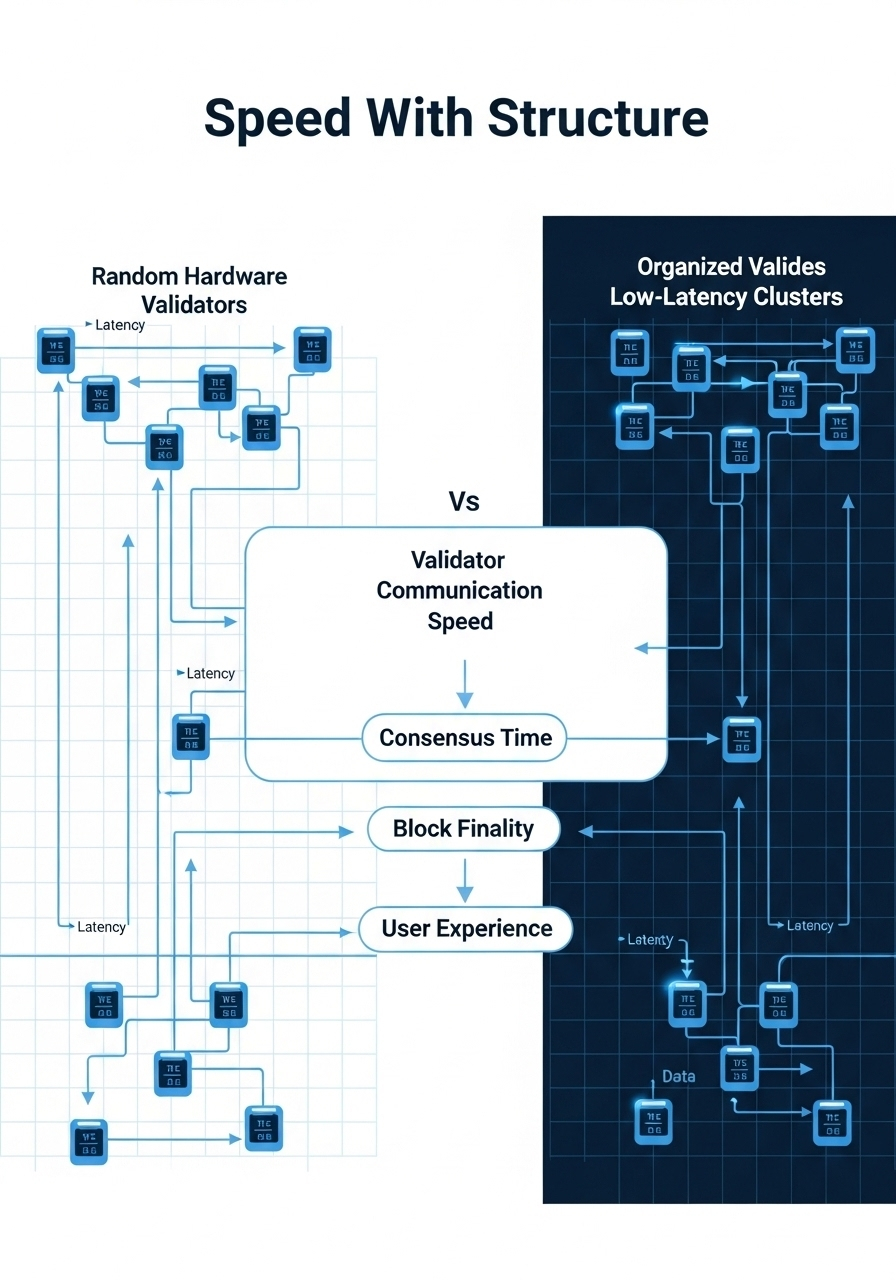
The Fogo Validator Philosophy. Speed With Structure
Here is where Fogo takes an approach.
Most networks allow any hardware to run validators.
That is great for openness. It also introduces inconsistency.
Some nodes are fast.
Some nodes are slow.
Some nodes create propagation delays.
Fogo leans toward performance discipline.
Fogo organizes validators into zones clusters optimized for low communication latency.
That means block producers and consensus participants are not randomly scattered in ways that increase network delay.
Why does that matter?
Because consensus time is part of block time.
Block time defines user experience.
If validators talk to each other faster blocks finalize faster.
That is simple.
It is not static.
Leadership rotates across epochs to maintain fairness and prevent centralization from becoming permanent.
So performance is prioritized,. Not at the cost of security mechanics.
The Fogo Execution Engine. Where the Real Magic Happens
Now let us talk about the part most people overlook: execution.
Fogo runs on the Solana Virtual Machine model, which is built around processing.
Of executing transactions one by one like a single-lane highway the runtime behaves more like a multi-lane expressway.
Here is how:
Every transaction declares which accounts it will read and write before execution.
If two transactions do not touch the state they run at the same time.
That means multiple CPU cores are fully utilized.
Trading activity does not bottleneck unnecessarily.
Throughput scales with hardware efficiency.
Under heavy trading conditions this matters a lot.
Parallelism is not a bonus feature here.
Parallelism is the foundation.
What Happens When You Send a Fogo Transaction
Let us walk through it like an user.
You click trade.
• Your transaction hits an RPC endpoint.
• It gets validated, signature, structure, account checks.
• The scheduler evaluates whether it conflicts with pending transactions.
• A block leader assembles the block.
• The runtime distributes transactions across cores.
• State updates are applied.
• The block is confirmed.
All of that happens within a time window.
Because validators are organized efficiently communication overhead is reduced during block production.
The goal is simple: reduce time between action and confirmation.
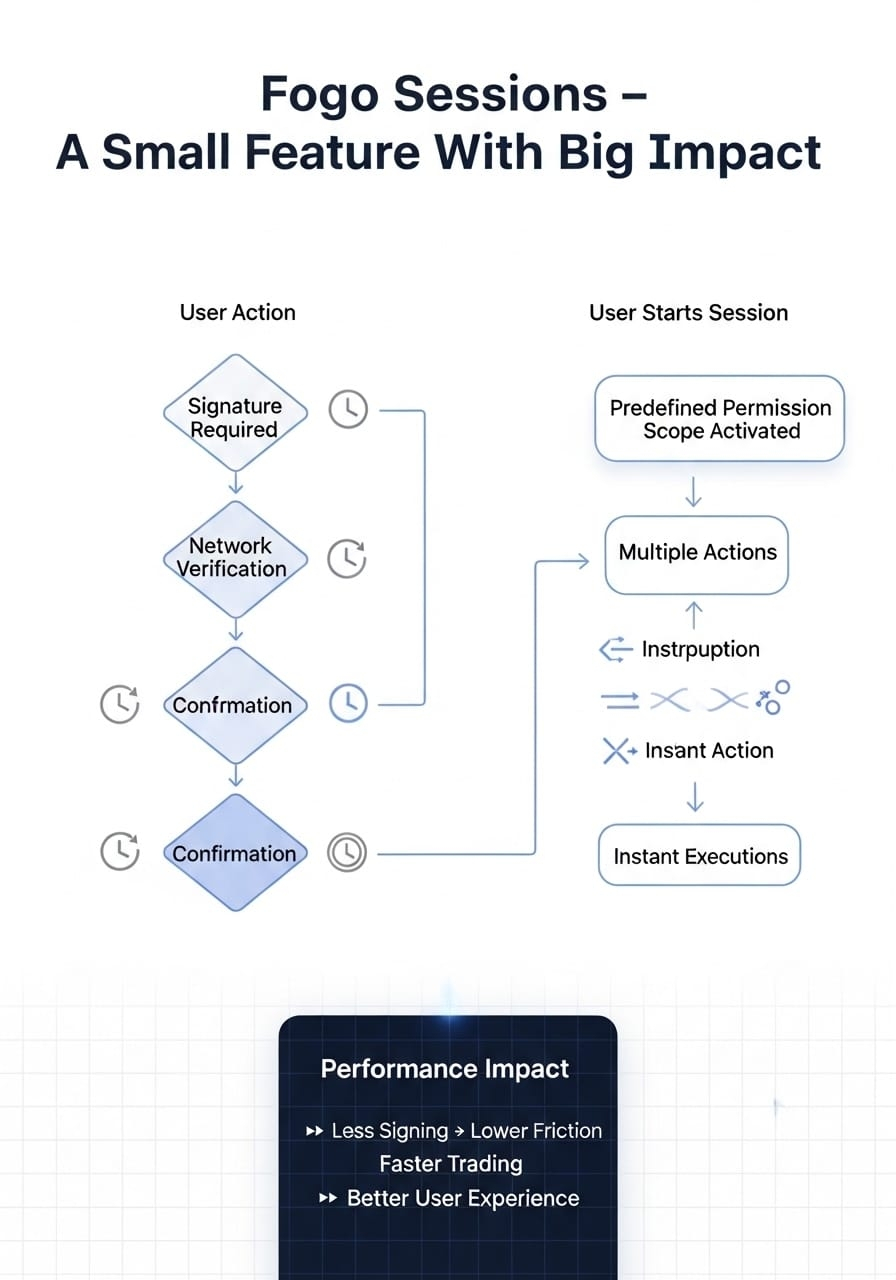
Fogo Sessions. A Small Feature With Big Impact
One improvement is Fogo Sessions.
Normally every interaction requires a signature.
That adds delays and friction.
Fogo Sessions allow applications to operate within a predefined permission scope.
For traders that means interruptions.
Less clicking.
Less waiting.
Less signing.
When you are trading actively those seconds add up.
The Fogo Trade-Off Conversation
Let us be honest.
Performance optimization always involves trade-offs.
By emphasizing hardware standards and validator zoning Fogo favors predictability over openness.
Mechanisms like epoch rotation and staking participation maintain accountability and security.
It is not decentralization.
It is structured decentralization optimized for speed.
That distinction matters.
Where Fogo Architecture Actually Wins
This kind of Fogo infrastructure shines in environments like on-chain orderbooks real-time auctions, arbitrage engines, high-volume AMMs and institutional DeFi.
If your application depends on execution timing Fogo structure makes sense.
If you are building low-frequency dApps you may not notice much difference.
In trading environments you absolutely will.
What Makes Fogo Different
Fogo is not trying to be everything.
Fogo is not optimizing for meme apps or low-priority traffic.
Fogo is focused on one goal: deliver exchange- speed without sacrificing on-chain transparency.
The differentiation comes from layering optimizations:
Fogo validator zoning,
high-performance client engineering,
parallel execution runtime,
latency-aware consensus,
trading-friendly primitives.
No single breakthrough.
Just multiple performance layers working together.
Final Thought
Fogo feels like a blockchain experiment and more like infrastructure built by people who understand trading systems.
Fogo does not just ask, "How transactions per second can we push?"
Fogo asks, "How quickly can users act and see results?"
That is a mindset.
In high-performance finance mindset matters.
Fogo is about Fogo.
Fogo is about latency.
Fogo is about trading.
Fogo is, about speed.
That is what Fogo is.
