
Vanar Chain is trying to feel like an app network, not a “wait around” network. The docs say its block time is capped at 3 seconds.
Consensus is Proof of Authority, guided by Proof of Reputation, and the docs also say the Vanar Foundation initially runs all validator nodes, then onboards others through PoR.
And if you’re tracking where value lands, you can’t just stare at the token chart. It spreads across gas, staking, validators, infra, and the apps that actually bring users in.
Lots of chains say “mass adoption” and stop there.
Vanar at least tells you what that means in practice: speed that regular users can tolerate.
Because let’s be real, if a transaction takes half a minute, most people won’t wait. They just close the app. They don’t write a thinkpiece about decentralization. They leave.
Vanar’s docs make this pretty direct.
They talk about UX and they set the target with a block time capped at a maximum of 3 seconds.
And the main docs describe Vanar as a new L1 designed for mass market adoption.
Personal insight (this is my opinion, not a “fact”): speed is not rare anymore. What’s rare is speed that stays stable when things get busy. That comes from boring stuff, validator ops, networking, and how disciplined the system is under load. That’s the stuff I watch.
Vanar’s architecture :
I’m going to keep this simple, the way people actually think about systems.
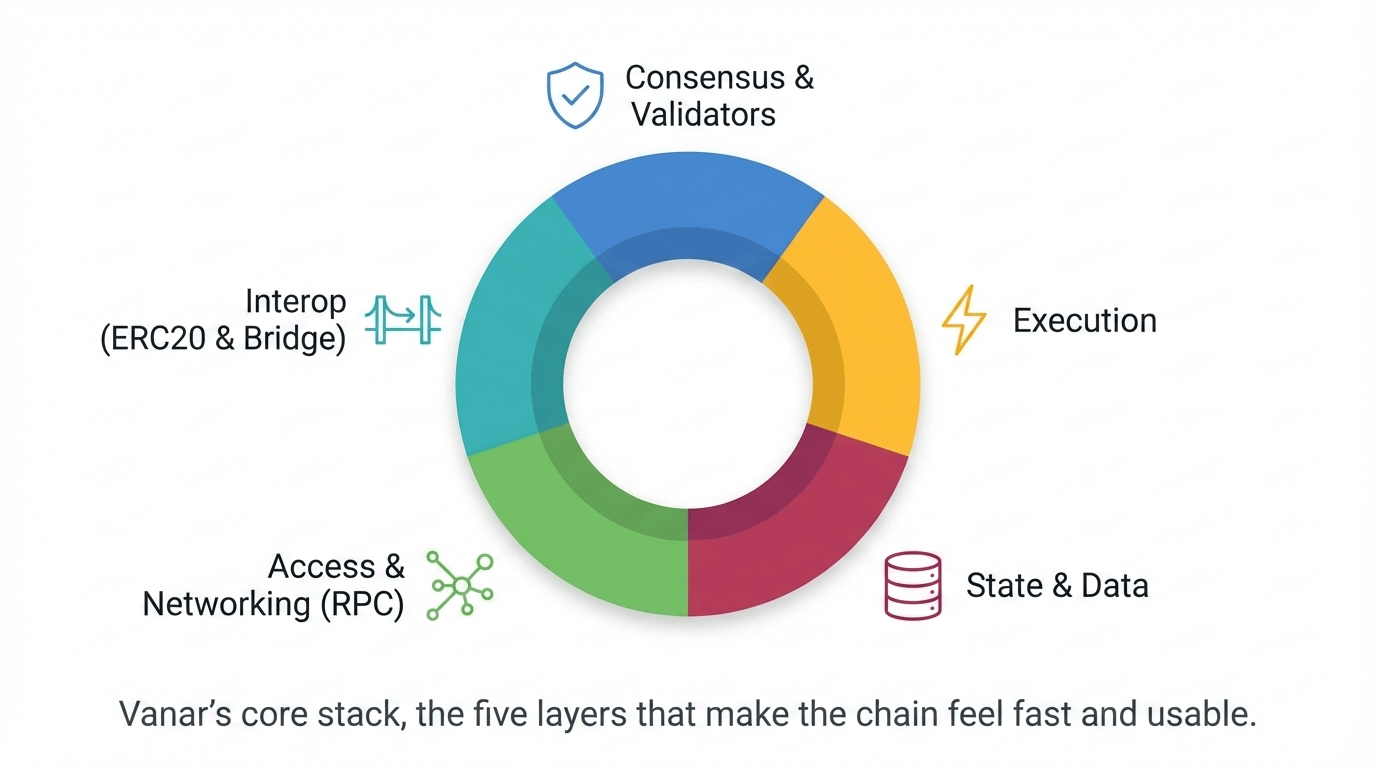
Layer 1: Consensus + validators (who orders blocks, who secures) :
Vanar says it uses a hybrid consensus model, mainly Proof of Authority (PoA), complemented by Proof of Reputation (PoR).
Same page, same paragraph, it also says the Vanar Foundation will initially run all validator nodes, then onboard external validators through PoR.
That’s a choice.
It trades early coordination for a “widen later” story. If you want smooth performance early, this is one way to do it.
From my view, people argue about decentralization in abstract terms. Users argue about whether the app worked.
If Vanar’s early validator setup reduces chaos and downtime, it helps the real goal, which is getting users to stick around. The long-term job is proving that onboarding path is real, visible, and not just vibes.
Layer 2: Execution (where transactions actually run) :
This is where smart contracts do their thing.
Every swap, mint, transfer, game action, whatever. The point for value is basic: execution produces fees, fees are a clean kind of demand pressure because they come from usage.
Layer 3: State + data (what the chain remembers) :
Consumer-style apps create a ton of tiny state updates. If those updates get expensive, users feel it fast. This layer decides whether “cheap and fast” stays cheap and fast as the chain grows.
Layer 4: Access + networking (RPC, nodes, propagation) :
Most users never touch a validator. They touch a wallet, an explorer, an RPC endpoint. This layer is where reliability becomes a business. When it breaks, everyone suddenly learns what an RPC is.
Infra is underrated. It’s invisible until it’s on fire.
Layer 5: Interop (getting vanry where users already are) :
Vanar’s docs say an ERC20 version of Vanry is deployed on ethereum and polygon as a wrapped version for interoperability.
They also say the Vanar bridge allows users to bridge between the native token and supported chains.
Interop is not glamorous, but it matters. Liquidity and users usually start somewhere else.
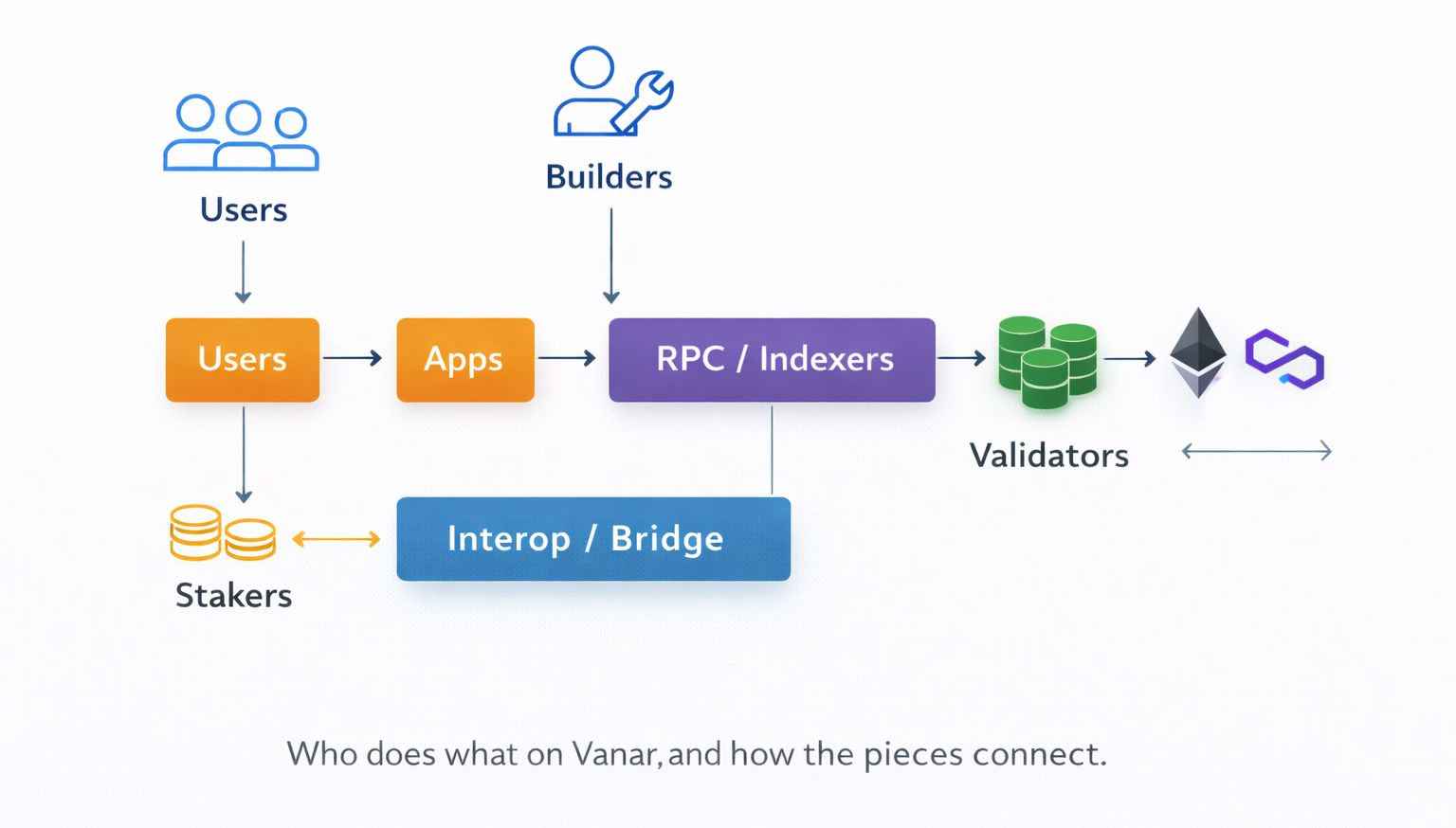
If you want “where value accrues”, you need the cast.
Validators :
They produce blocks and keep the chain running. Vanar’s docs frame the early validator phase as Foundation-run, with external onboarding via PoR.
Stakers (delegators) :
Vanar describes staking as DPoS, and it adds a Vanar-specific rule: the Vanar Foundation selects validators, while the community stakes vanry to those nodes to strengthen the network and earn rewards.
That detail matters.
Stakers aren’t picking validators from scratch, but they are still allocating weight and supporting security.
Builders (teams and devs) :
They bring apps. Apps bring users. Without apps, token utility stays theoretical.
Infrastructure providers :
RPC, indexing, explorers, analytics.
When usage gets real, this layer captures value in a quiet way, sometimes through paid access, sometimes through enterprise deals, sometimes through ecosystem partnerships.
I’ve seen chains with decent tech still lose because infra wasn’t smooth.
Users blame the app, not the chain, but the damage is the same.
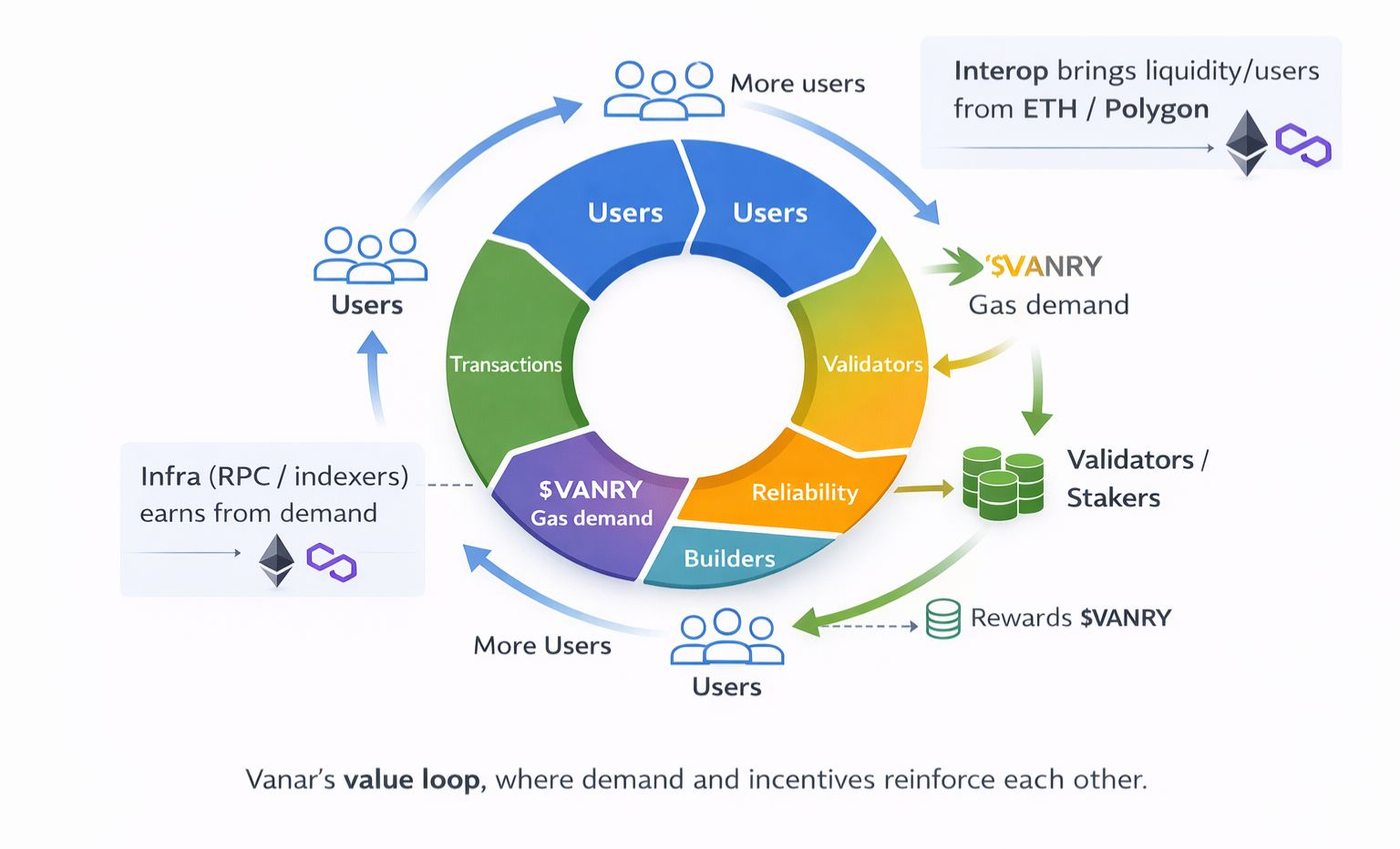
Alright, this is the main event.
Value on a chain usually flows through a few channels. Vanar is not special in that sense, but its design choices nudge the channels in a specific direction.
i. Vanry utility demand (gas + staking) :
Vanar’s docs position vanry as the ecosystem token and also talk about its wrapped ERC20 form for interoperability.
On staking, the docs are explicit that the community stakes vanry in their DPoS setup.
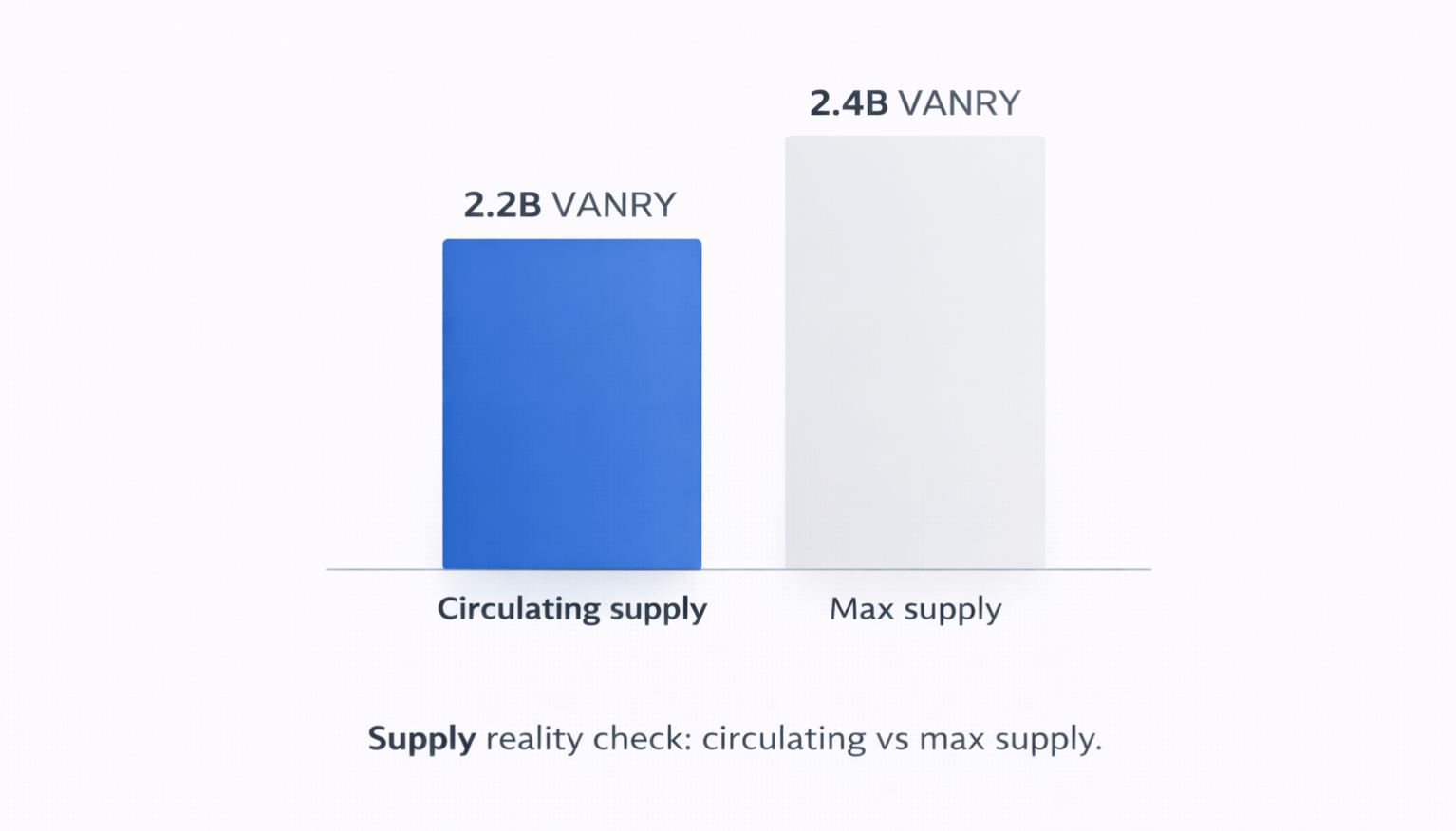
On the market data side, CoinGecko currently reports a circulating supply of about 2.2 billion VANRY (it also shows live price and volume, but supply is the key part for this discussion).
Coinbase lists max supply at 2.4 billion VANRY.
If Vanar wins on consumer-style usage, the strongest demand signal won’t be hype spikes. It’ll be boring gas demand that keeps showing up day after day. That’s the healthiest kind.
ii. Validators and stakers (fees + rewards, plus “operational moat”) :
Vanar’s block reward docs say the remaining vanry issuance is minted incrementally with each block over a span of 20 years.
That long runway can support incentives while usage ramps.
From my point of view, long issuance is not automatically good or bad. The good version is stability while the ecosystem matures. The bad version is when rewards are the only reason anyone participates.
Vanar’s goal should be to shift the weight from rewards to real fee demand over time.
iii. Infrastructure value (RPC, indexing, bridging) :
If Vanar keeps a 3-second block cadence in real conditions, infra providers will be busy.
And the ERC20 footprint plus bridging gives liquidity routes.
That’s not just convenience, it’s a distribution channel.
iv. App value (where users get captured) :
Fast blocks and low friction tend to favor apps with frequent actions, gaming loops, collectibles, creator features, micro-interactions.
If those apps become sticky, they capture revenue and users. The chain captures flow through gas and staking participation.
That’s the loop.
Now, the parts people usually argue about, but let’s keep it practical.
Every chain has tradeoffs. The question is whether the trade fits the mission.
Early validator structure :
Foundation-led validators can reduce early chaos and keep performance predictable.
The constructive pressure is transparency, showing how validator participation expands, and making that expansion measurable.
Bridging :
Bridges add complexity, no way around it. But Vanar’s ERC20 deployment on Ethereum and Polygon plus its bridge approach lowers onboarding friction for users who already live on those networks.
The “positive risk” framing here is simple: if Vanar makes bridging feel idiot-proof (not insulting, just safe), it can convert outside liquidity into real on-chain usage.
Long issuance schedule :
A 20-year minting schedule signals predictability, not sudden shocks.
That gives the ecosystem time to grow into real demand instead of forcing a fee-only economy too early.
Conclusion: Vanar’s design choices point to one core aim: keep the chain feeling responsive, with block time capped at 3 seconds.
When users show up, transactions show up.
When transactions show up, gas demand shows up. That supports validators and stakers.
Reliability attracts builders, builders bring more users, and the loop tightens.
That’s why I like architecture breakdowns.
Not because they sound smart, but because they show where value naturally pools once the network stops being an idea and starts being used.


